















Vítkov Returns to Its Original Purpose: Honoring Those Who Have Served Our Country
The National Memorial at Vítkov is undergoing a transformation designed to bring it closer to its original purpose from the time of the First Republic. The Military History Institute in Prague is gradually renovating not only the building itself and the area around the Tomb of the Unknown Soldier, but is also preparing a new exhibition titled “Symbols of Statehood.” This exhibition aims to connect Czechoslovak and Czech history, the tradition of the legions, the Second Resistance, and the modern foreign operations of the Czech Armed Forces. The changes taking place at Vítkov were discussed in a special CZ DEFENCE podcast by Brigadier General Aleš Knížek, director of the Military History Institute in Prague, and Colonel Michal Burian, director of the Institute’s Museum Department. The second major topic of the interview was the Military History Institute’s cooperation with Ethiopia, where Czech experts are helping to establish a military museum, preserve historical collections, and continue the search for a Czechoslovak tank that was delivered to this African country before World War II.
Video: Vítkov is returning to its original purpose. It is meant to honor those who have served our country. / CZ DEFENCE
The transformation of the National Memorial is evident as soon as one approaches the Tomb of the Unknown Soldier. According to the leadership of the Military History Institute (VHÚ), the new installation at the entrance and the restored First Republic state emblems emphasize the significance of the site, which was originally conceived as a symbol of Czechoslovak statehood. “That memorial was never built to serve as the final resting place of Klement Gottwald, the first working-class president, but rather as a celebration of the founding of the Czechoslovak Republic and, in fact, as a thank-you to everyone for the establishment of our Czechoslovak Republic in October 1918,” recalls Brigadier General Aleš Knížek. Because Vítkov is a national cultural monument, any changes are subject to strict heritage protection regulations. The new installation therefore also had to be approved by the National Heritage Institute. According to Colonel Michal Burian, they succeeded in creating a design that not only highlights the entrance to the Tomb of the Unknown Soldier but also commemorates the original concept behind the entire structure. “It’s actually a kind of temple of the republic,” says Colonel Burian. According to him, Vítkov represented a certain counterpoint to Prague Castle and St. Vitus Cathedral as symbols of the former monarchy. The memorial was intended to represent the newly formed Czechoslovak Republic and, at the same time, serve as the final resting place for the most prominent figures associated with the founding of the state in 1918, including members of the legions.
The Tomb of the Unknown Soldier holds a special place. Yet its history began elsewhere than at Vítkov. The remains of the Unknown Soldier from Zborov were interred at the Old Town Hall in 1922. During the German occupation, they were removed and destroyed in 1942. Consequently, the remains of the Unknown Soldier from Dukla were interred at Vítkov in 1949. It was not until the new millennium that new remains of the Unknown Soldier from the Zborov battlefield were recovered, thus symbolically uniting the first and second Czechoslovak resistance movements in one place. Colonel Burian described the Tomb of the Unknown Soldier as “the most significant place for our army” – meaning not only today’s Army of the Czech Republic but also its Czechoslovak predecessors.
The names of the fallen as a link between generations
The immediate surroundings of the grave are also undergoing a transformation. In addition to the flags of the Czechoslovak Army and the Army of the Czech Republic, visitors will see the texts of military oaths. A significant new feature will be electronic lists of the fallen, which are being compiled in cooperation with the Central Military Archives. “Those screens will display lists of names – lists of fallen Czech and Czechoslovak soldiers from World War I, the interwar period, and World War II, as well as our soldiers who gave their lives in overseas operations of the Army of the Czech Republic,” explained General Knížek. The lists will be continuously updated, and visitors will also find specific stories associated with individual names. The column containing soil from the battlefields of Czech and Czechoslovak soldiers also holds symbolic significance. It, too, will be further modified and expanded to include locations associated with the Czech Armed Forces’ current overseas operations. According to Colonel Burian, the goal is to create a symbolic link between the First Resistance, the Second Military Resistance, the domestic resistance, and current overseas operations. “This entrance area to the National Memorial should become a symbolic place of remembrance for those who gave their lives for our independent state – whether in 1918, 1945, or even in recent years,” said the director of the Department of Museums at the Military History Institute.
This motif continues on the red staircase. According to General Knížek, the names of the fallen “flow like water” here, creating a symbolic connection between life and death. It is from here that visitors proceed to the upper levels of the memorial.
Symbols of statehood will feature both original artifacts and modern technology
One of the most important projects is the new exhibition, “Symbols of Statehood.” Its location on Vítkov Hill is no coincidence. The complex of buildings that now houses the Military History Institute at the foot of the hill and the National Memorial were conceived as a single entity as early as the First Republic. “In 1925, when the Liberation Memorial, together with the committee for the construction of the statue of Jan Žižka of Trocnov, announced a competition for the construction of the building complex, it was a single competition,” recalls Colonel Burian. An archive, a museum, and offices were to be built at the foot of Vítkov Hill, while a representative pantheon – the “temple of the republic” – was to stand at the summit. According to Burian, the Military History Institute is now effectively returning to the original purpose of the entire complex. The ceremonial hall itself was to be opened on October 28, 1938, marking the 20th anniversary of the republic. The Munich Crisis thwarted this plan. However, the valuable First Republic-era decorations survived both the occupation and the Communist era, thanks in part to the employees of the then-Memorial of Liberation, who covered up the mosaics and other elements. Meanwhile, the German army used the building primarily as a warehouse during the war.
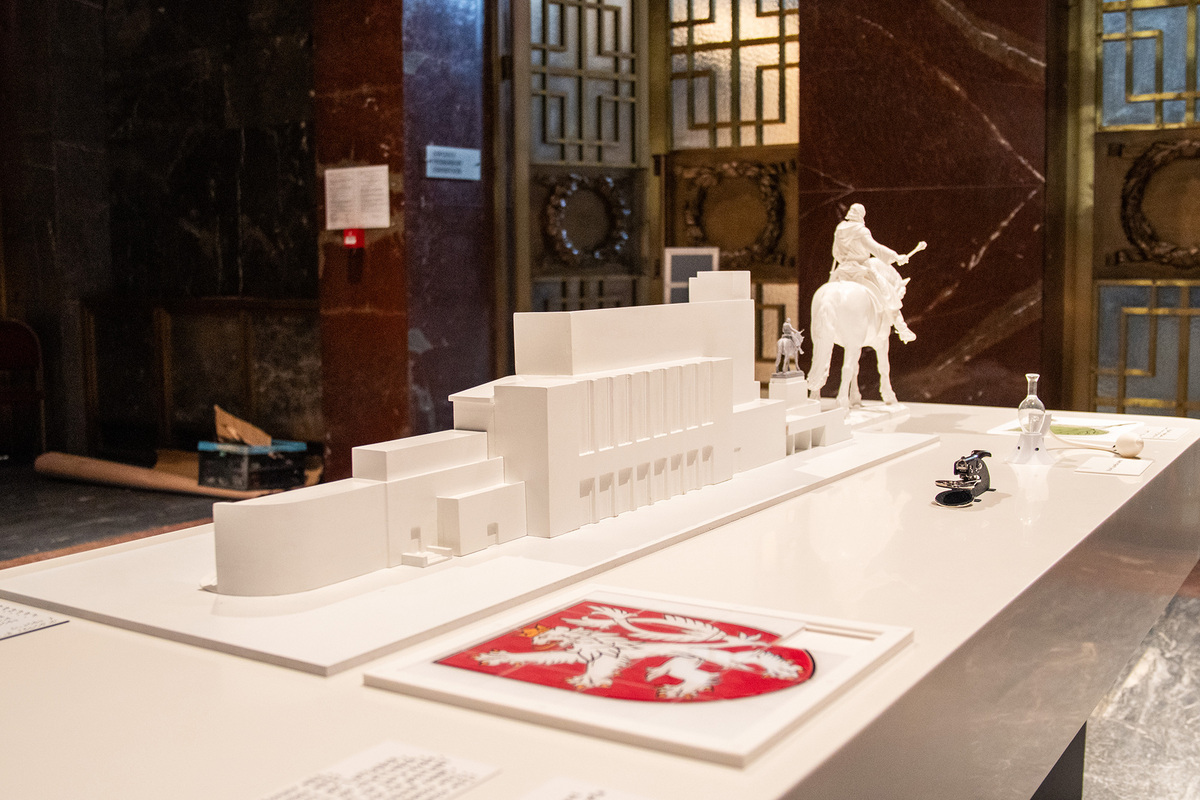
The new exhibition is to be based on a combination of the original architecture, authentic historical artifacts, and modern museum technologies. Among the most significant exhibits will be the original ceremonial version of the 1920 Constitution of the Czechoslovak Republic, on loan from the archives of the Chamber of Deputies. Visitors will also see unique designs for state symbols, including flag designs and works by leading Czech artists. Among the exhibits will be a design by Milan Rastislav Štefánik from May 1918, which was created in Rome in connection with the Czechoslovak Legions in Italy. “Visitors will be able to learn about the complete history of Czech national symbols – or, originally, Czechoslovak national symbols,” said Colonel Burian. He noted that the only state symbol used in the same form since 1920 is the Czech national flag. A separate section of the exhibition will feature an audio booth dedicated to music associated with Czech statehood. In addition to the national anthem, visitors will hear, for example, the St. Wenceslas Chorale and “Ktož jsú boží bojovníci.” The exhibition will also highlight compositions that acquired extraordinary symbolic significance during critical moments in modern history – such as “Oath to the Republic,” associated with the 1938 Sokol Rally, or “Prayer for Marta” from 1968. However, the Military History Institute does not intend to limit its historical narrative to World War II or the year 1989. An important part of the story is the Czech Armed Forces’ (AČR) recent overseas operations.
One of the authentic exhibits will be the so-called “totem” from the Czech soldiers’ base in Kabul, featuring the names of Czech cities and towns and information about their distance from home. At the same time, a large-screen display will feature testimonies from soldiers who served in overseas operations ranging from the Persian Gulf to Mali. “These are the people upon whom the Czech Armed Forces also build their modern history,” emphasized General Knížek. According to Colonel Burian, the VHÚ’s philosophy is to combine traditional museum practices with modern exhibition methods. However, technology is not meant to replace authentic exhibits. It is precisely these original objects – which were direct witnesses to Czech and Czechoslovak history – that, in his view, offer visitors something they won’t see anywhere else. The exhibition is scheduled to open officially on September 28 and will be open to the public starting the following day.
From Vítkov to Addis Ababa
The second part of the special CZ DEFENCE podcast focuses on the Military History Institute’s cooperation with Ethiopia. According to General Knížek, significant progress has also been made in this area over the past year. Under the methodological guidance of Czech experts, the Ethiopian side opened the first section of a military weapons exhibition as well as a military archive. Just a few years ago, according to Knížek, the military museum was practically nonexistent, and the archive was stored in unsuitable facilities. The new exhibition in Addis Ababa, which is open to the public, now features, among other things, Czechoslovak light machine guns from the First Republic era. However, Czech experts are not only assisting with the museum’s concept. During visits to Ethiopian military bases and warehouses, they search for items of historical value that could be lost forever without professional care.
The search for the Czechoslovak tank continues
For the Military History Institute (VHÚ), this collaboration has another exceptionally interesting aspect – the search for Czechoslovak military equipment that made its way to Ethiopia in the past. The institute has managed to identify a number of Czechoslovak weapons in its collections and warehouses that were exported to the country in the 1930s and after World War II. According to Burian, Ethiopia received, for example, approximately 15,000 German Mauser rifles manufactured during the occupation at the Zbrojovka Brno arms factory. The VHÚ therefore hopes to acquire some Bohemian-made items that are currently missing from its collections. However, the search for a Czechoslovak tank continues to attract the most attention. According to General Knížek, twenty of these vehicles were delivered to Ethiopia, and the VHÚ is trying to find at least the remains of one of them. Representatives of the Ethiopian Ministry of Defense, people associated with the newly established military museum, and the Czech diplomatic mission have joined the search. The VHÚ now also plans to collaborate with the Association of Ethiopian Patriots and, through its contacts, distribute photographs and a description of the sought-after vehicle to various parts of the country. “It’s like looking for a needle in a haystack in Ethiopia,” admits General Knížek. The search has not yet been successful, but hope remains, according to both VHÚ representatives. During one of their visits to a base near the Somali border, Czech experts saw a scrapyard containing tens to hundreds of historic weapons and vehicles dating from World War I to roughly the Vietnam War. According to Burian, it was a collection that virtually any military museum in the world would love to add to its holdings.
A tradition that began nearly a century ago
Furthermore, the VHÚ’s collaboration is expanding to include the Ethiopian memorial to the Battle of Adwa in Addis Ababa. According to General Knížek, in terms of significance, it is, to a certain extent, the Ethiopian equivalent of the Czech National Memorial at Vítkov. It commemorates Ethiopia’s victory over the invading Italian army at the end of the 19th century and represents one of the most important events in Ethiopian history. Czechoslovak-Ethiopian relations have a long tradition. “That tradition has actually been strong since the 1930s, when our light machine guns defended Ethiopia against the Italian invasion in 1936,” recalls Colonel Michal Burian. Furthermore, after February 1948, some former Czechoslovak RAF pilots fleeing the communist regime made their way to Ethiopia. They became advisors to Emperor Haile Selassie and helped build the Ethiopian Air Force.
According to both representatives of the Military History Institute (VHÚ), this history continues into the present. Czechoslovak L-39 Albatros aircraft are still in operation in Ethiopia, and Czech specialists are involved in their maintenance. The Czech legacy in the country is thus not merely a museum exhibit, but a living part of the relationship between the two nations.
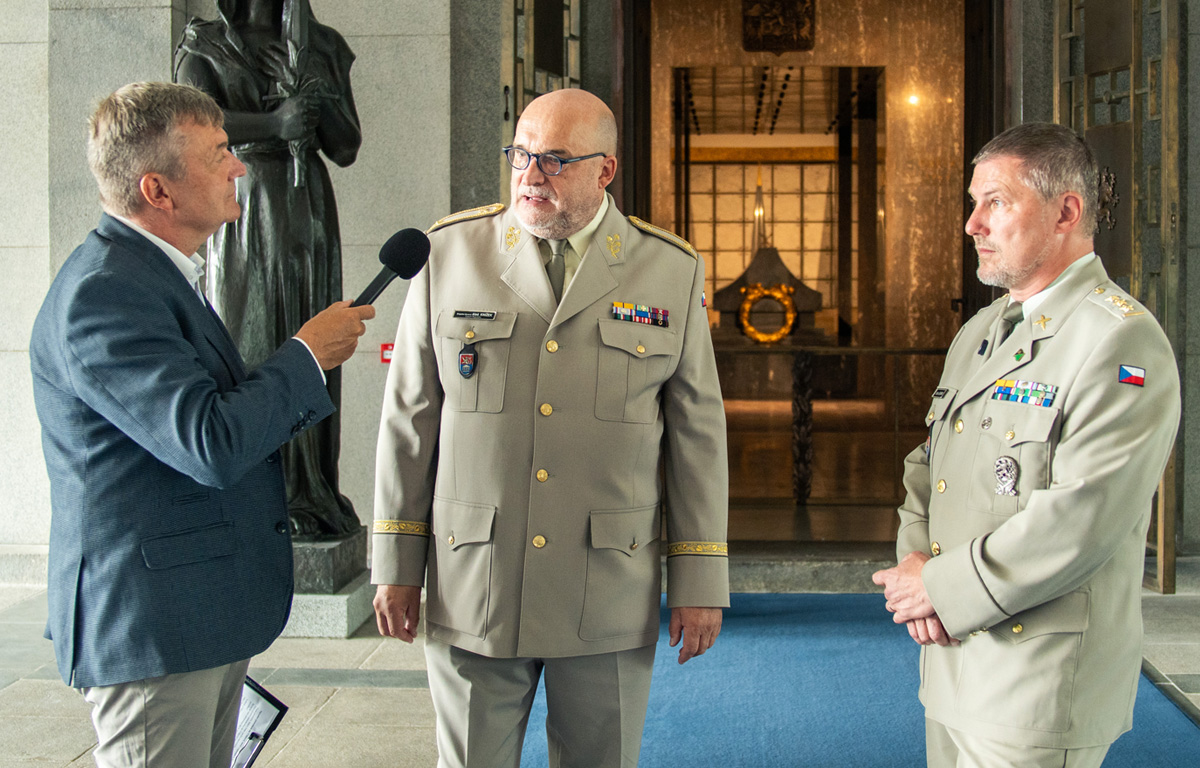
At Vítkov, the Military History Institute is working to restore one of the most significant Czech memorials to its original significance and to preserve the history of Czech and Czechoslovak statehood. In Ethiopia, Czech military historians are helping in a similar way to preserve the historical memory of a country with which Czechoslovakia had close ties nearly a century ago.
You can learn more about the memorial at Vítkov or the work of our military historians in Ethiopia in the video interview at the beginning of this article.