






Applications of Additive Manufacturing in the Repair of Ground Military Equipment
The unavailability of a replacement part can prolong the downtime of a military vehicle, even in cases where the part in question is relatively simple. Additive manufacturing makes it possible to produce missing parts based on digital data or, in some cases, to restore damaged components by adding material. Its capabilities range from polymer covers and fixtures produced in mobile workshops to metal replacements and refurbishments requiring more extensive technical facilities. The specific application depends on the operational requirements of the component and the equipment available at the repair facility.

Additive manufacturing, known to the general public primarily as 3D printing, encompasses a set of technologies whose common principle is the creation of three-dimensional parts by gradually adding material based on a digital model, typically layer by layer. These technologies enable the production of both polymer and metal parts.
In addition to industrial manufacturers, the armed forces are also taking advantage of additive manufacturing, gradually integrating it into their logistics and maintenance support systems. Applications range from mobile workshop stations that can be deployed where units are operating to stationary facilities with more extensive technical infrastructure for more demanding manufacturing and refurbishment processes during higher-level repairs.
Additive manufacturing can thus help ensure the availability of selected replacement parts in field conditions as well as during more complex repairs at repair facilities. At the same time, some additive processes allow for the refurbishment of components by adding material directly at the site of wear or damage. These technologies can find significant application particularly with older equipment for which spare parts are no longer readily available, or in cases where their production using conventional methods would be time-consuming or costly.
Production of Polymer Parts
Polymer printing, particularly material extrusion technology – also known as FFF (fused filament fabrication) or FDM (fused deposition modeling) – is the simplest and most accessible additive manufacturing technology, making it ideal for use in field conditions. Its main advantages include the ability to produce parts from a wide range of materials – from elastic materials used in ground military equipment for the production of protective boots, rubber-metal mounts, and seals, to rigid materials with varying chemical compatibility suitable for the production of tanks, hose couplings, and conduits.
When this technology is used in field conditions as part of mobile repair stations, a clear advantage from the perspective of logistics and production itself is the ease of handling the raw material, which is supplied in the form of a string wound on spools. A significant portion of the materials used can withstand temperature changes and relatively long-term storage well. Completing a part may require only a few simple operations. Among the disadvantages of this technology is lower mechanical strength compared to products made from the same material using conventional technologies (injection molding, compression molding), particularly depending on the orientation of the print relative to the direction of stress on the part. The layered structure of the product also significantly affects its pressure resistance and is often the cause of gradual leakage in containers exposed to multiple stress factors simultaneously (e.g., pressure, higher temperatures, and chemical exposure to operating fluids). These limitations must be taken into account when selecting and subsequently designing a component.
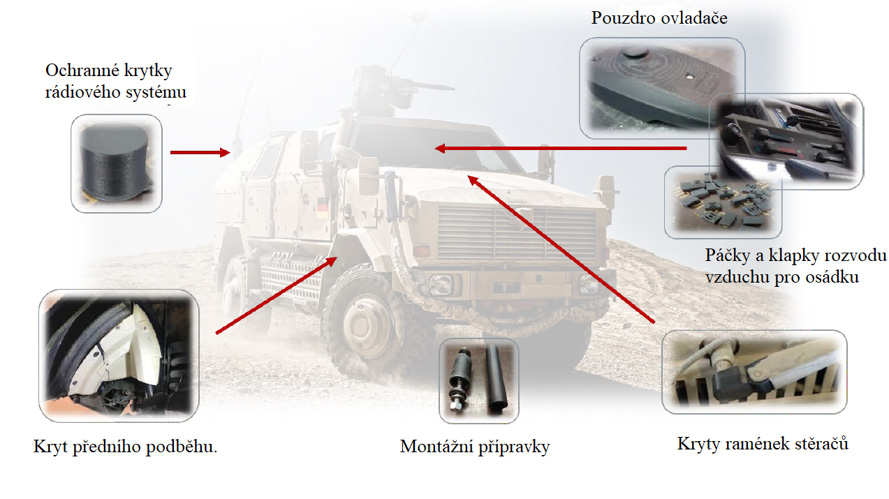
Material extrusion is best suited for the production of less critical components for ground-based military equipment, or for the production of short-term replacements as part of temporary repairs. Examples of replacement parts for the Dingo 2 vehicle manufactured using material extrusion technology by the German Army can be seen in Figure 1. These are non-critical parts whose failure does not significantly affect the vehicle’s operational capability, and the malfunction can be repaired after the mission is completed.
High-performance polymers, such as PEEK, PEKK, and PEI, can be used to manufacture parts with higher mechanical or thermal resistance requirements; to a certain extent, these polymers can even replace components made of metal. Processing these polymers requires higher printing temperatures, which are not achievable with most standard commercially available 3D printers. The material also has more stringent requirements in terms of preparation, storage, and feeding during the printing process.

Powder-based polymer printing (PBF) offers additional possibilities. These technologies are less suitable for mobile workstations in terms of part handling and subsequent cleaning. However, they offer a significant advantage in mitigating uneven mechanical strength under loads in different directions due to the part’s orientation during production. Furthermore, the technology does not require the creation of support structures, as the part is supported during production by unsintered powder; thus, it is possible to create highly complex geometries with internal cavities. The technology is therefore suitable for prototyping or small-batch production in permanent repair facilities, particularly for the production of hard-to-find parts for older equipment or parts with long lead times.
In the field of polymer-based manufacturing, there are thus suitable systems both for producing simple, non-critical parts or temporary replacements directly at the point of deployment and for producing industrial-quality parts in stationary repair facilities, where the entire production chain – including more complex preparation, storage, and material handling, the manufacturing itself, and subsequent post-processing – can be managed.
Manufacturing of Metal Parts
Additive manufacturing also includes technologies for producing metal parts. Similar to polymer materials, the process involves extruding material that is wound onto spools. The manufacturing material consists of metal powder and a polymer binder, so the manufacturing technology is very similar to that used for polymer materials. After printing, the binder is removed and the part is sintered in a controlled-atmosphere furnace. During sintering, the metal particles bond together and the part shrinks; this shrinkage must be accounted for during the design phase. This technology is suitable for producing small components with simple geometries, whose design allows for shrinkage during sintering to be factored in.
Similar to polymers, metal parts can also be manufactured from powdered materials. Integrating these technologies into mobile workstations is challenging primarily due to powder handling, maintaining the production atmosphere, and finishing operations. However, the technology is highly precise, and the mechanical properties achieved – taking print orientation into account—are nearly comparable. Depending on the print settings and the quality of the raw material, however, printed parts may suffer from porosity and higher surface roughness; therefore, one cannot expect the same fatigue strength and ductility as with parts manufactured using conventional technologies.
These manufacturing technologies are suitable for producing geometrically complex parts with internal structures or cavities. The technology also allows designers to partially break free from the original geometry of the part – which is dictated by the need for conventional machining – when designing a replacement part. This approach is known as “design for additive manufacturing” (DfAM).
The technologies mentioned so far were intended exclusively for the production of replacement parts. Other technologies that fall under the category of direct energy deposition (DED) – in which both the material and the energy required to melt it are supplied in a single process step – also allow for the repair of damaged or worn components, unlike the technologies mentioned above. After precisely measuring or scanning the damaged part, it is possible to add material only to the damaged area, thereby restoring the component’s original geometry. In the field of ground military equipment, potential applications are evident particularly in the renovation of transmission gears, drive wheel ring gears, and track links of tracked vehicles. In the case of the gear mentioned above, material was deposited only in the area of the damaged teeth, which were subsequently machined during post-processing.
Beyond repairs, these technologies also enable the production of new components by gradually depositing material onto the workpiece surface, using an energy source such as a laser beam, an electron beam, or an electric arc. In the case of technology using an electric arc (WAAM), a rougher product surface must be expected; however, it is the most productive method for manufacturing large parts (e.g., vehicle structural components), where the welding torch can be mounted on a robotic arm or gantry system. Finishing machining and, if necessary, heat treatment are essential with these technologies.
As previously mentioned, a significant number of armed forces are implementing these technologies in the field of ground military equipment repairs – and, by extension, logistical support – as a comprehensive system that combines technologies suitable for both mobile and stationary use.
The same is true of the Czech Armed Forces, which have begun implementing these technologies. The University of Defense in Brno is also involved in their implementation, specifically in the areas of selecting suitable technologies for specific applications, choosing and testing appropriate materials, preparing and conducting personnel training, and designing processes. In January 2026, the Czech Armed Forces also announced the trial operation of a 3D printing facility at the Lázně Bohdaneč Repair Support Center.
In addition to selecting appropriate technologies for individual levels of logistical support, it is also essential to train personnel capable of creating 3D models of components in a CAD environment, preparing and managing production, operating equipment, and inspecting the resulting parts. However, it is not entirely appropriate for part designs to be created at every level of logistics support. This approach would complicate their subsequent approval for use. A logical step, therefore, is to create a shared repository of manufacturing data that would contain not only the part’s geometry but also the specified material, manufacturing process, and requirements for inspection and use. Furthermore, it is essential to establish certification and quality control processes so that the use of these technologies in the repair of military equipment is as effective and, above all, safe as possible.
Conclusion
Additive manufacturing is a promising technology that can significantly expand the repair and maintenance capabilities of ground-based military equipment. Its main benefit lies primarily in the ability to produce specific replacement parts directly where they are needed, shorten repair times, and reduce dependence on traditional supply chains. This approach becomes particularly important when military units are deployed in field conditions, where the availability of spare parts can be significantly limited.
For the Czech Army, 3D printing represents an opportunity to increase the flexibility of repair and logistical support. The use of mobile workstations enables, in particular, simpler repairs and the production of temporary spare parts, while more technologically demanding production and refurbishment of components can be carried out at stationary repair facilities. An important prerequisite for the wider adoption of these technologies is the creation of a system for verifying the quality of manufactured parts, sharing production data, and providing professional training for personnel.
Additive manufacturing cannot completely replace conventional manufacturing and repair processes, but it can effectively complement them. Its systematic implementation within the Czech Army may, in the future, help reduce equipment downtime, increase operational availability, and strengthen the ability of military units to carry out their missions even with limited logistical support.
Related