







KVAČR 2040: General Hlaváč Says the Czech Republic Will Gradually Close Gaps in Meeting NATO Capability Requirements
A press conference on the 2040 Concept for the Development of the Czech Armed Forces (KVAČR 2040), which had been approved by the government shortly before, took place yesterday at the General Staff of the Czech Armed Forces. The Chief of the General Staff of the Czech Armed Forces, Army Gen. Miroslav Hlaváč, addressed the media, speaking primarily about the goals of the new concept and how it will be implemented. Key topics at the press conference included the Czech Republic’s shortcomings in meeting NATO requirements for capability development and the future development of the army in light of the government’s proposed defense budget for the coming years.
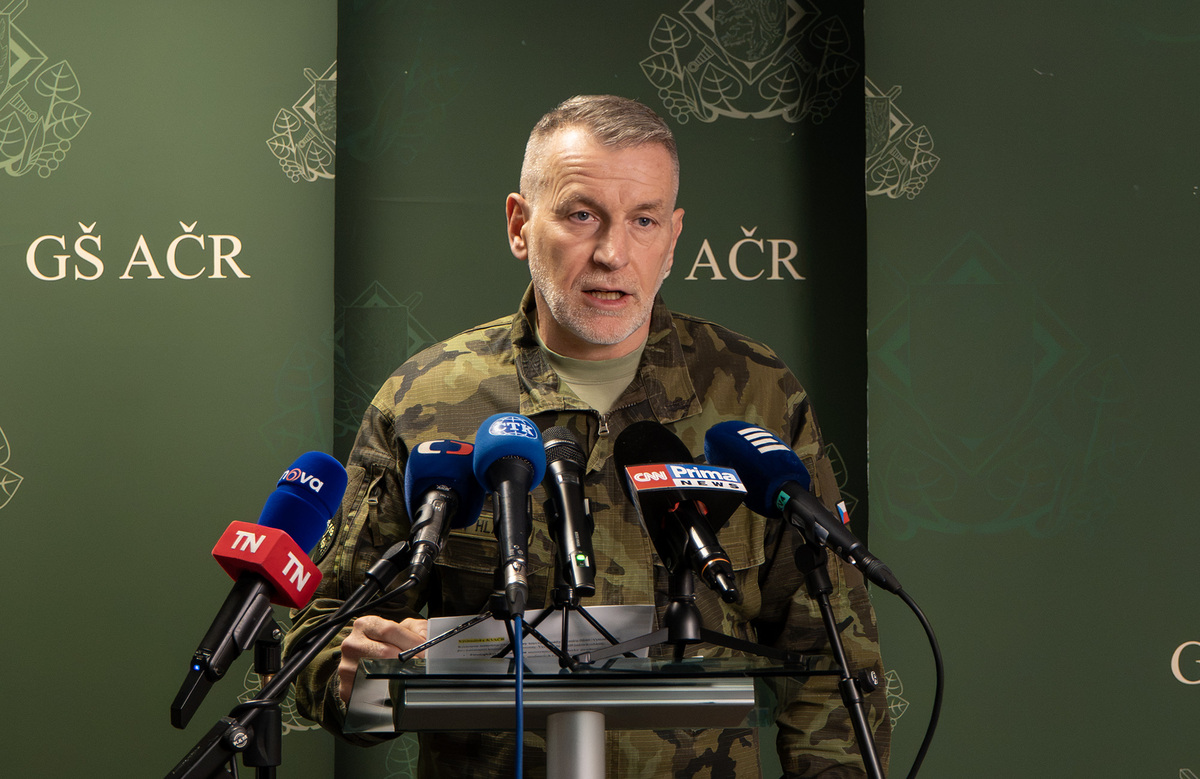
The Chief of the General Staff of the Czech Armed Forces opened the press conference with a brief introductory presentation of the new concept. “This isn’t a shopping list,” Hlaváč pointed out right at the start of his remarks. The document, in fact, outlines the main directions and priorities for the development of the Czech Armed Forces and defines the required capabilities, the newly appointed army general clarified.
Hlaváč further emphasized that the AČR Concept 2040 serves as a framework for lower-level concepts. This means that this document will be elaborated upon in the future through additional, functionally defined concepts. In this regard, Hlaváč specifically mentioned concepts for the development of land, air, and territorial forces, as well as concepts related to the development of logistics and capabilities in the cyber domain.
KVAČR 2040 Objectives
“The concept’s ultimate goal is [this – editor’s note] to build a modern, technologically advanced, next-generation armed force that contributes to deterrence and collective defense, responds to threats with minimal warning time, and is prepared for a long-term conflict,” the Chief of the General Staff of the Czech Armed Forces noted, highlighting one of the key tenets of the recently approved concept.
It is worth noting that the concept itself defines eight strategic objectives for the development of the armed forces:
- Staff the armed forces with prepared and motivated personnel.
- Modernize and strengthen the personnel training system.
- Expand air and anti-drone defense capabilities.
- Adapt the army’s structure to the total forces model.
- Meet NATO capability-building objectives.
- Strengthen capabilities for the defense of the nation’s territory.
- Accelerate technological adaptation and strengthen cooperation with industry.
- Carry out a digital transformation.
Among the objectives mentioned, Hlaváč identified the following as top priorities: staffing the military, strengthening air defense capabilities, meeting NATO capability-building goals, and accelerating the technological adaptation of the Czech Armed Forces.
With regard to personnel recruitment, KVAČR 2040 sets a goal of reaching at least 32,000 professional soldiers by 2030, while accounting for 10,000 members of the active reserves, whose numbers are expected to rise to 15,000 following an increase.
In light of the planned increase in active reserve personnel, the Chief of the General Staff of the Czech Armed Forces told the media that the army is preparing a focused media campaign. Hlaváč also explained that the AČR aims to attract students from civilian universities and high schools interested in new technologies to join the active reserves: “Thanks to the way we are introducing new technologies, we see an opportunity to recruit students into the active reserves.”
In this context, Hlaváč also mentioned the planned innovation and experimentation system. The top official of the AČR had previously stated that, as part of the innovation system, a so-called experimental component would be established within the army’s structure, through which the AČR plans to attract students from civilian universities.
According to the new concept, the AČR aims to build a multi-layered air defense system by 2040, including medium- and long-range capabilities and defense against ballistic missiles. In this regard, Hlaváč outlined specific aspects of air defense development in the coming years: in addition to the acquisition and integration of the SPYDER All-in-One system, the army should “begin to consider” defense against ballistic threats as early as 2030, although the concept does not call for the development of such capabilities until the third decade.
“What we definitely want to complete – and this is also my priority during my term in office – is the implementation of anti-drone defenses. Both within the territory of the Czech Republic [and – editor’s note] with regard to facilities critical to national defense, as well as [in the context – editor’s note] of anti-drone defense for our operational units,” Hlaváč told the media.
One of the document’s most serious assertions is a statement pointing to significant gaps in the Czech Republic’s fulfillment of NATO requirements: “The Czech Republic is not meeting 70% of NATO’s capability-building targets, and in the most resource-intensive areas, it lags behind by 5 to 10 years. This deficit limits the Czech Armed Forces’ ability to carry out collective defense missions,” the concept states.
“Of that 70% [of NATO capability-building targets – editor’s note], about half are those we are partially meeting, and the other half we are not meeting at all,” said the Chief of the General Staff of the Czech Armed Forces, assessing the country’s status. As Hlaváč told media representatives, there are two main reasons for the shortfall presented. First, there is the long-term underfunding of the AČR. “You can’t fix that overnight. Nor […] from one year to the next,” said Hlaváč, who estimated that eliminating even the most serious “shortfalls” would take at least 3 to 5 years.
The second reason is the enormous increase in required capabilities under Capability Targets 2025. According to Hlaváč, this “enormous” increase in requirements (up to 300%) occurred primarily in air defense systems.
“We have a plan for how we will gradually achieve these capabilities. […] For example, by successfully introducing certain capabilities, such as the F-35, CV90, tanks, and artillery, and by digitizing the command and control system… This will allow us to gradually eliminate the very shortcomings we currently face in meeting [the force development goals – editor’s note],” Hlaváč indicated. “[…] I can imagine that as early as 2030, we’ll be in a significantly different place.”
In connection with the acceleration of technological adaptation within the Czech Armed Forces, the Chief of the General Staff confirmed that the military urgently needs to adopt new technologies (e.g., quantum technologies, AI). Hlaváč emphasized that the army is already taking steps in this area that will propel it forward significantly in the future—even though it may seem that nothing significant is being done in this regard at the moment. He cited the aforementioned experimental system of the Czech Armed Forces as an example.
Three Phases of Concept Implementation
As stated in the concept, capability development will take place in three phases. During the first phase (through 2030), resources will be focused on addressing urgent shortcomings, particularly in the areas of heavy brigades and air defense. Comprehensive capability development is planned for the second stage (through 2035) and the third stage (through 2040), contingent upon an increase in defense spending beginning in 2030.
The limited scope of the first phase thus reflects the government’s proposed budget for the Ministry of Defense for next year, as well as the medium-term outlook, under which the ministry’s budget will amount to 2% of GDP by 2029.
Hlaváč noted that the second and third phases may be adjusted in subsequent updates (i.e., future concepts), depending on developments in the security environment and how resources are reallocated in the future.
Given the goal of allocating 2% of GDP to defense by the end of the decade, there will inevitably be a slowdown in the development of the Czech Armed Forces’ capabilities, as the Chief of the General Staff noted at the last meeting of the Chamber of Deputies’ Defense Committee. At the press conference, Hlaváč specifically mentioned the risk of a delay in forming the medium brigade.
At the same time, however, the head of the Czech Armed Forces pointed out that the modernization of the medium brigade has already begun, referring to projects being procured for both the medium and heavy brigades (specifically: artillery support, command and control systems, and the digitization of command and control systems). Regarding the transition to wheeled infantry fighting vehicles – a key project linked to the development of the medium brigade – Hlaváč stated: “We expect the specifications for this acquisition to be finalized next year.”
As mentioned above, the presented plan for the development of the Czech Armed Forces (AČR) calls for an increase in defense spending starting in 2030. However, in his response to the media, the Chief of the General Staff of the AČR pointed out certain risks associated with this trajectory. The planned increase in spending will have to align with the availability of the required weapon systems on the market and the defense industry’s ability to deliver contracted defense products on time, while placing increased pressure on the acquisition process itself.
“It will probably also be necessary to amend the legislation in some way, because we’re still essentially conducting acquisitions the same way. Just as we procure the F-35, we use the same process to procure items like backpacks, for example, which doesn’t really suit us,” concluded Hlaváč.