












Brig. Gen. Petr Tománek: We Are Overhauling Our Entire Air Defense System
The Czech Republic’s Air Force is undergoing the largest modernization in its history. However, according to its new commander, Brigadier General Petr Tománek, in addition to the introduction of F-35 aircraft, new air defense systems, and extensive investments in infrastructure, what must change above all is the way of thinking, command, and working with people. In an interview with CZ DEFENCE, he also discusses his experiences from the war in Ukraine, multi-domain operations, unmanned systems, artificial intelligence, the training of future F-35 pilots, cooperation with the Czech defense industry, and what the Czech Air Force should look like by the end of his command.
Video: Brig. Gen. Petr Tománek: We are overhauling our entire air defense system / CZ DEFENCE
General, you’ve taken office at a very dynamic time, as the Air Force is undergoing the largest modernization in its history. What is the biggest challenge today? Is it the people, the equipment, the infrastructure, or logistics?
It’s all of these things combined. It’s a complex problem, and it’s like a series of puzzles that fit together. And those puzzles have to be precise for everything to fit. I try not to view modernization through the lens of purchasing individual systems, but rather through the lens of capabilities – the implementation of new capabilities. So for me, the be-all and end-all of being able to implement these capabilities is people. People who are motivated, who are experts in their fields, and who understand the complexity and dynamics of the current modernization effort. And that’s the foundation. On the other hand, the relatively simplest part – though I emphasize “relatively” – is the actual procurement of aviation equipment. Even though that, too, is a very complex and demanding process.
In almost every interview, we eventually come around to the idea that people are what matter most. Is that true in this case as well?
Exactly. You can't do it without people. That shift in mindset and understanding of what needs to be done is extremely important. The platforms themselves – and simply buying the hardware – won't enable you to do what you want to do.
You are continuing the work of General Petr Čepelka. Is there anything you want to change, or will you continue along the path he set?
I’ve known General Čepelka for years. We first met at the aviation university in Košice 37 years ago. That’s a long time. We’ve had similar careers. Two years ago, I took up the position of his deputy in the Air Force. We share a similar view of leadership and a similar style. I am absolutely convinced that General Čepelka has set the Air Force on an excellent path toward modernization, and I want to follow in his footsteps. Of course, the times bring new challenges, and that’s where I’ll be making my own contributions.
One of these new challenges may be command and control. New technologies – whether they involve new aircraft, the F-35, or air defense – ill require a new approach. Is that correct?
That's right. We are truly committed to this, and one of our priorities is setting up what we call C2 – Command and Control. It is very important to structure decision-making processes so that they are fast, so that we can get information to the right place at the right time and make the right decisions. And in multi-domain operations, this is crucial.
Is it possible to practice and train for any of this today using current technology? On the one hand, you need to prepare people who will be working in the new system; on the other hand, you still have to operate the current air force. Don’t these two needs sometimes conflict with each other?
Sometimes, yes. But that’s one of the challenges – how to introduce new capabilities and new ways of thinking into an existing, functioning system in a way that preserves our capabilities and continuity while also accelerating change.
I ask every commander about their experiences on the Ukrainian battlefield. What do you think are the key lessons for the air force? Is there anything about the current nature of the conflict that has surprised you?
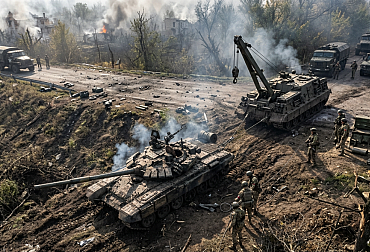
To begin with, I’d say it’s always important to draw the right lessons. The conflict in Ukraine has its own specific characteristics and cannot be fully extrapolated to what we might expect in future theaters of war and future conflicts. We are part of a coalition; NATO has something that Ukraine does not, and that is very strong air power. The ability to penetrate an adversary’s air defenses, strike targets with precision weapons, and achieve information superiority – these are the capabilities our allies possess. We analyze the lessons learned from Ukraine more or less every day. In my view, what is crucial is how quickly the dynamics are changing, how new weapon systems are emerging, and the need for adaptation and innovation. And also the fact that, in essence, quantity is quality. Relatively inexpensive platforms can destroy expensive ones. These are the things we’re focusing on. On the other hand, we need to view everything through the lens that we have different capabilities and see future conflicts somewhat differently.
For example, there is talk of deploying F-16s in Ukraine. In your opinion, could the air force be a game-changer in this conflict? Is this something that could decide the outcome of the war?
From Ukraine’s perspective – and I really don’t want to speak for Ukraine here – the F-16 is an important component of its air defense. Its main purpose is to intercept cruise missiles, protect the population, and push Russian forces further away from the border so they have to protect their own people. From our perspective, it’s a little different. I don’t quite see it that way.
Let’s turn to air defense. For a long time, it wasn’t discussed much, but today it is, on the contrary, one of the most talked-about topics. Where do we stand, and what do we need to urgently add to the capabilities of the Czech Army?
We’ve made incredible progress recently. Air defense hasn’t been a priority over the past twenty to thirty years. It’s a very expensive capability. Now the priorities have changed, and it’s one of the top priorities for the government, the Secretary of Defense, and the new Chief of the General Staff – and therefore my priority as well. We’re overhauling our entire air defense system. It is a comprehensive effort. It is not just about purchasing new SPYDER systems. It involves new sensors, new radars, new passive systems, command and control capabilities, decision-making processes, and the introduction of the F-35 aircraft. So it really is a comprehensive effort. We are strengthening – and will continue to strengthen – the Czech Republic’s air defense, both within the national system and within NATO systems.
In the past, the military distinguished between the protection of military and strategic targets and that of civilian targets. Has this approach changed, or has the basic doctrine remained the same?
I would say that the fundamental principle remains the same. It is the protection of those critical targets. The idea that air defense will be able to provide 100 percent protection for everything is simply not true. We must focus on ensuring that our systems truly protect the most critical elements.
Let’s turn to the F-35. This aircraft is increasingly being discussed as a strategic component of the Czech Army’s capabilities. How will it change the air defense system, and what role will it play in it?
First and foremost, we need to change people’s mindset so that they don’t view the F-35 as a platform, but rather as a system – a tool capable of gathering an incredible amount of data through its sensors and transmitting it. That connectivity is amazing. We must ensure that the air defense system makes the most of these capabilities so that we have connectivity, established decision-making processes, and the ability to effectively use all the resources at our disposal in real time.
From a fighter pilot's perspective, how significantly has this segment changed over the course of your career?
It’s unbelievable. I started flying on a MiG-21, then switched to the L-159, and I’ve logged a few flights on the F-16 and the Gripen. The transition from analog to digital – actually, to fourth-generation systems – was challenging. The Gripen was challenging. But now, the transition from a digital environment to multi-domain operations is even more challenging. It’s an amazing time with amazing opportunities.
What does the Air Force commander need to know about the F-35 in order to lead effectively?
I don’t think a high level of detail is necessary. One of the things I’ve learned is to work as a team and trust people. We have plenty of experts who are capable of handling a high level of detail when necessary. For me, it’s important to understand the strategic approach, the integration with other systems, and the connections and collaboration with other domains – that is, the terrestrial domain, the space domain, and the cyber domain. It’s about configuring the system so that it’s precisely fine-tuned at the strategic level. I believe that’s my job. My job isn’t to know every little detail.
Infrastructure is also crucial for the development of the air force. The airport in Čáslav is undergoing extensive renovations. Is the project proceeding according to plan?
Yes, things are going well. I recently flew on an L-159, and we took a look at Čáslav from the air. There’s no runway there anymore, no concrete. It’s just a brown patch with a lot of equipment. We’re working on it; we’re on schedule, and the reconstruction is going very well so far.
The original runway in Čáslav was built in the 1950s. Is the construction of the new runway significantly different from a technical standpoint?
I would say that track construction is similar to what took place in the 1950s. Of course, construction technologies have changed, but the basic elements remain the same: to build a track that will last for decades to come and meet the requirements placed on it in terms of load-bearing capacity, roughness, and operational reliability.
What is your view on the military gradually taking over more airports in the Czech Republic?
This is a matter that falls under the government’s mandate. We understand that. In recent years, we’ve phased out a lot of airports. Now, with the new system – as we see it – especially with the decentralization of air operations – since one of the lessons from Ukraine is that we can’t keep all our resources at a single airport and must spread them out if necessary – this is something we need, and we’re working on it.
We probably need to look at this not only from the perspective of the Czech Republic, but also from that of the Alliance. The ability to operate from airfields in neighboring countries will be important.
Yes, exactly. We have various agreements and partnerships within NATO and at the bilateral level regarding the deployment of aircraft and the ability to operate from other airfields. NATO places great emphasis on ensuring that we are capable of doing this – that we have technicians who can, for example, maintain F-16s or Rafales. And conversely, when we land in Slovakia, for example, the Slovak Air Force needs to be able to support us. We’re working on these capabilities, and I think we’ll see even greater integration with the F-35 system in the future.
A somewhat speculative question: Do you still see potential in other Czech airports that could serve the Czech Army? And I’m certainly not trying to steer you toward Hradčany, for example.
I wouldn't even consider it. Of course, I see the potential, but it comes down to analyzing what we need, our financial resources, and the realities of operating those airports. So I'll just say: no comment.
You yourself mentioned that you are a fighter pilot. Which two, three, or four skills of a fighter pilot help you the most in your role as commander of the Air Force?
It might come as a surprise, but I’d say it’s all about teamwork. Being a pilot means being part of a team. You have to trust the people you’re flying with one hundred percent. When you’re flying in a formation through a cloud, you have to trust that they’re flying with precision. When you’re on a mission, you have to know that the people around you are ready. And that trust is one hundred percent. So it’s about trusting your teammates.
How many people are actually on the team around you when you're in the air?
That's a lot of people. I'd say hundreds. If you consider logistics, maintenance, air traffic control – the people who sit at the radar, direct air traffic, manage the sensors, and operate them – all the way to when you go to the cafeteria after a flight and get lunch. There are hundreds of people.
Will the transition to the F-35 change these staffing requirements?
With the transition to the F-35, we will face far greater demands in the areas of information technology, cybersecurity, and system security itself. There will be far greater pressure on these areas of expertise.
So, will the people on the ground perhaps be under even more pressure than the pilot at the controls?
Exactly. The pilot is sort of the imaginary tip of the pyramid – the part you see, the part that appears in magazine photos. But at the same time, there’s a lot of painstaking work done by hundreds of experts, without whom none of this would be possible.
Recruitment is a major issue throughout the Czech Armed Forces. In the case of the F-35, there is probably no doubt about the appeal of training and transitioning to this platform. What about air defense, for example?
We’ve been relatively successful in recruiting for the Air Force. I think people see us as the Air Force – as a branch with a distinct organizational culture, interesting work, and access to new technologies. However, we’re still struggling to recruit enough specialists, such as air traffic controllers and cybersecurity specialists.
In my view, we need to focus not only on recruitment itself, but also on engaging with the public and young people, so that we can present the Air Force– and, by extension, the Czech Armed Forces – as an employer that is transparent, has a distinct organizational culture, and offers opportunities for professional growth and interesting work.
When I put on the blue Air Force uniform, I don’t have to be just a pilot. What other professions can I find here?
It’s a whole portfolio. As I said, it ranges from Force Protection – that is, being a combatant who guards our forces and assets – all the way to being a pilot. It includes logistics, maintenance, sensor operation, and air defense. We have the new SPYDER systems, which are really very demanding, for example, in terms of information technology. It’s a completely different job than working with the old Russian equipment. Today, it’s far more a matter of operating various servers and computers than just soldering vacuum tubes.
How close is your relationship with the University of Defense? Is that the only place where you recruit future pilots, technicians, and other specialists?
Over the past two years, we have significantly stepped up our collaboration with the University of Defense. We have very good relationships there. Last year, we launched a so-called sponsorship program for the “blue” division of the University of Defense, where we are striving to maintain much closer ties. We visit the students, and the students visit us. For example, on September 15, we’ll be holding Aviation Day. We’ve invited students from the University of Defense to celebrate it here with us in Prague at the Winged Lion and to experience the spirit of aviation.
Ultimately, the greatest challenge for any fighter pilot may be to become an astronaut.
You could say that. We have Aleš Svoboda, and I’m really rooting for him to succeed. Aleš Svoboda is an amazing expert and an exceptional person, and I am 100 percent convinced that he will represent us very well as members of the Air Force.
Let's turn now to the training of future F-35 pilots. Is it proceeding as planned? Those people must already be undergoing training today.
That’s exactly right. We’ve been working on this for several years now. We have implementation plans; we have plans for how we’ll conduct training. It’s quite challenging because you not only have to set up the system so that future pilots can log enough flight hours and study the system, but you also have to prepare it for a fifth-generation aircraft. You can’t train for a fifth-generation aircraft using a fourth-generation system. And that’s one of the biggest challenges. I have to say that we’re very fortunate to have LOM PRAHA as our partner and the Pardubice Aviation Training Center. We’ve introduced new training aircraft there – the L-39NG, Zlín Z-242, and Z-143. But it’s not just about these aircraft. It’s the entire training system, simulation technology, and configuring the system so that people train from the very beginning in the same way they will train on the F-35s.
Do you have any experience with how other NATO countries handle training? Or is our plan based on the approach recommended by Lockheed Martin?
Of course, we’re in communication with our NATO partners – the countries that have the F-35 – and with the United States, and we’re trying to gather as much information as possible about the requirements for this training and how we should approach it. LOM PRAHA has a contract with Lockheed Martin, which conducts certain reviews of the training to ensure it meets the requirements for F-35 training. So we’re working on that. We’re not copying anyone; we’re creating our own national system, but we’re drawing on the information and experience of our NATO allies.
In one of our interviews with Jiří Protiva, the director of LOM PRAHA, we discussed the fact that, once the needs of the Czech Armed Forces have been met, the company will be able to offer a certain portion of its capacity to neighboring NATO member states. Do you think this is the right approach?
Yes, I completely agree. I think this is the right approach. First, from an economic standpoint, it will allow us to make the most efficient use of the capabilities we have – that is, our aircraft and the entire system. And also from the perspective of interoperability. The ability to train foreign students ensures that our domestic training will also meet the required standards.
We’ve already touched on experiences from battlefields abroad. In your opinion, how significantly have unmanned and autonomous systems changed the battlefield, and what does this mean for air defense and air forces?
The experience from Ukraine is clear. Over the four years of this conflict, what used to be a distinct front line has turned into a zone dozens of kilometers wide that is effectively controlled by UAVs, and anything that moves there can be destroyed. That change is drastic. On the other hand, as I’ve already said, we can’t automatically apply all the lessons from Ukraine to our own situation. Drones, unmanned aerial vehicles, unmanned systems – that is the future. We have to come to terms with that. As a pilot, I could never have imagined that an aircraft would be pilotless. But nowadays, I can imagine that a sixth- or seventh-generation aircraft will be one that doesn’t have a pilot on board, but rather an operator sitting somewhere else.
Or the pilot will fly, with other aircraft alongside him that he will control.
Exactly. That’s the Loyal Wingman concept. That’s the direction we’re heading in. When it comes to sensors and the capability to deliver long-range, precision strikes, drones have made incredible strides. It’s now simply a cycle of innovation, adaptation, measures, and countermeasures. The importance of electronic warfare is growing significantly. It’s truly much more complex, and it’s rapidly changing our perspective on the matter.
Air policing is an important part of the Air Force’s operations because it involves actual deployment, not training or exercises. How important is this capability?
It is very important. This demonstrates that we are a reliable partner who, when necessary, will provide the forces and resources to protect the airspace of our partner countries. It’s not just about the Gripen, which flew in the Baltics and protected the Baltic states or Iceland. It’s also about the helicopters that are currently in Poland, for example. Last year, we were able to deploy helicopters within a matter of days to protect Polish airspace, and this is greatly appreciated.
According to both NATO and Czech concepts, future conflicts will be multidomain. They will involve the convergence of the land, air, cyber, and space domains. To what extent does this change the demands placed on the command and control of air forces?
I’d say that the strict boundaries between domains are truly blurring. It’s no longer the case that we have air domain here, land domain there, and cyber or space domains elsewhere. Those boundaries are blurring, and capabilities are converging. I can explain this using the F-35 as an example. The F-35 can use its sensors to detect an enemy target, identify it, determine its exact coordinates, and send this information in real time to the command post. There, a decision may be made that long-range artillery is the best means of engaging this target. The artillery receives the target’s coordinates and characteristics in real time, and within tens of seconds, the information from the F-35 is relayed to this effector, which destroys the target. And that, in a nutshell, is a multi-domain operation.
When it comes to modernizing the military, there is a lot of talk about the involvement of Czech companies and the Czech defense industry. How important is that to you?
We recognize this, and it is very important. The Czech Republic’s defense capability is based on the fact that we must have some kind of industrial base. Without this base, the Czech Republic’s long-term defense capability is unthinkable. Historically, we have had – and continue to have – a defense industry of a very high standard. When I was a defense attaché in Asia, I must say that the name “Czech Republic” – or rather, “Czechoslovakia” – still carries weight when it comes to the defense industry. We have a lot to offer. As for the Air Force, I’ve already mentioned our incredible aircraft manufacturing capabilities. We are one of the few countries capable of doing this. Aero Vodochody, the L-39NG, the L-410NG, and the Zlín Z-242 and Z-143. It is an incredible capability for a small country, one that other, far larger nations envy us for.
Another advantage is the service and the ability to have these resources available almost immediately.
Exactly. We have the ability to communicate directly with manufacturers. The manufacturer knows exactly what we need. That’s the advantage of working with a domestic manufacturer – you can truly communicate on a daily basis, define your requirements, and the manufacturer knows you. And it’s not just aircraft. It includes radars, passive sensors, and software solutions. Ukraine is demonstrating the importance of drones and anti-drone measures today. We have incredible capabilities in this area. We have companies that manufacture firearms. So we have nothing to be ashamed of. I am convinced that one of the key aspects of my role is precisely communication with the defense industry, as well as supporting and coordinating with it.
At the same time, the Air Force needs a place to train. After all, the Czech Republic doesn't offer much space for testing certain capabilities.
At the same time, the Air Force needs a place to train. After all, the Czech Republic doesn’t offer enough space to test certain capabilities. And that’s true. But as part of our international cooperation, we have established processes and plans in place whereby, when necessary, we reach out to countries that do have these capabilities so that we can conduct the training in question.
In this new era, you will have access to a vast amount of data directly from sensors. Will a commander’s decisions continue to rely on the command staff to prepare them, or might that process be too slow?
It’s both. You have to set up the system so that – and this is where I see the future of AI – it can correctly analyze an incredible amount of data so that you can draw the right conclusions and apply them to the decision-making process. But it will still be the commander at the end of the day who makes the decisions, interprets the data, and issues orders. I don’t think we’ll see anything like Skynet from the movie *The Terminator* in the near future. But AI’s ability to process an incredible amount of data is already here. Software solutions to support a commander’s decision-making already exist.
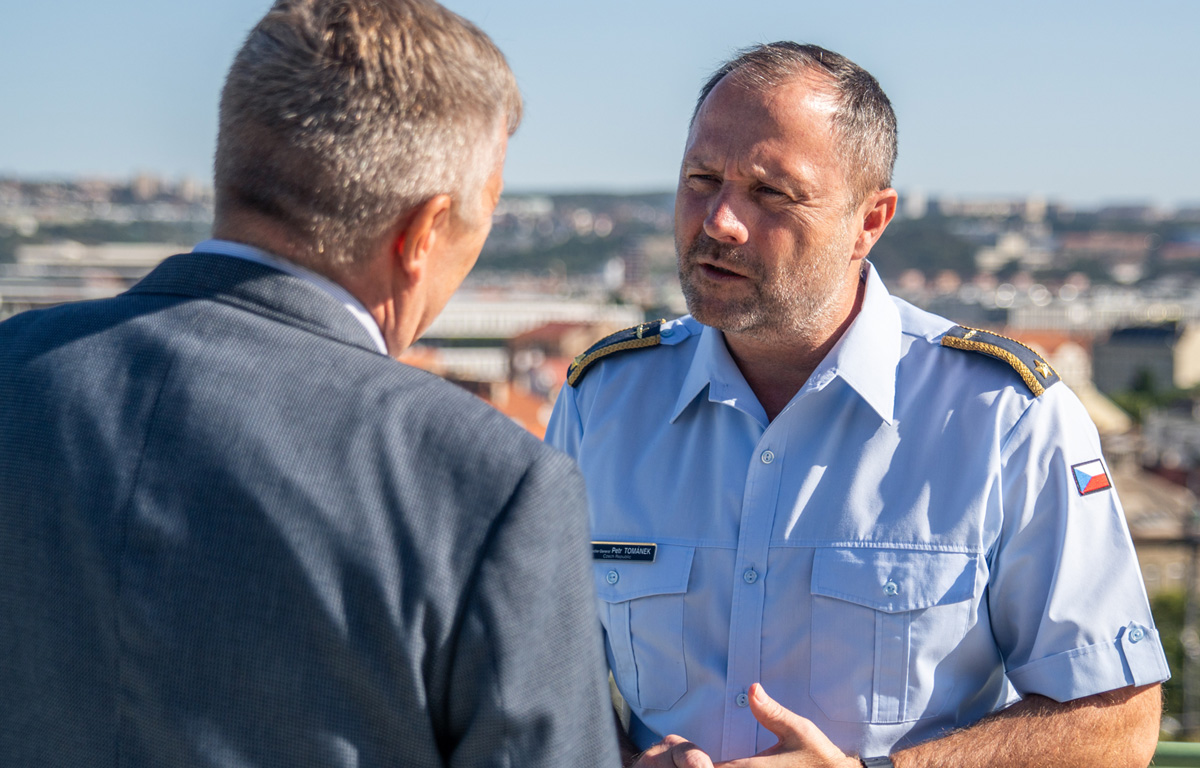
When you watch older science fiction movies, for example, it's actually surprising how many of the fantastical ideas from back then have become reality today.
That's right. It's unbelievable. Technology is advancing so quickly that it can sometimes be frightening. But let's hope it will ultimately be for the best.
Your command assignment has just begun. You have four years ahead of you. Will the F-35s be ready by 2030?
We'll be conducting training in the United States; we'll already have the F-35s, but they'll still be in the U.S. The first aircraft are expected to arrive sometime toward the end of 2031.
Okay, let me ask it another way. When I come to check out NATO Days – or rather, the Czech Army Air Force Days – in 2030, what will the Czech Army Air Force be demonstrating there?
I would like the Air Force to be more modern, more confident, and more adaptable. I want it to be better equipped to respond to current threats. And then I’d like to be able to step down and say: Yes, this transformation – just as I envisioned it – has taken place, is proceeding well, and we are ready to receive the F-35s. We have an air defense system capable of responding to current threats so that we can protect our people.