












Jiří Protiva: A State-Owned Enterprise Should Be Profitable, Grow, and Serve the Public Interest
LOM PRAHA, a state-owned enterprise of the Czech Ministry of Defense, has been significantly expanding its capabilities in recent years. In addition to its traditional services in military aviation maintenance and pilot training, it is entering other areas critical to the Czech Republic’s defense capabilities. It is modernizing the Aviation Training Center, preparing for training related to the Czech Air Force’s transition to the F-35, operating airports in Přerov and Líně, and is set to take over operations at the Karlovy Vary airport starting next year. At the same time, it is developing its own design and construction capabilities and can now serve as a contract integrator in intergovernmental transactions involving the Czech defense industry. Jiří Protiva, director of the state-owned enterprise LOM PRAHA, spoke about the present and future of the company in the CZ DEFENCE podcast.
Video: Jiří Protiva: A state-owned enterprise should be profitable, grow, and serve the public interest / CZ DEFENCE
One of the most visible changes currently taking place at the state-owned enterprise LOM PRAHA is the modernization of the Aviation Training Center (CLV) in Pardubice. According to Director Jiří Protiva, an extensive renewal of aviation equipment is underway there, affecting virtually all major categories of training. “Our training center is currently experiencing a major boom as we gradually renew our aircraft fleet,” said Protiva.
Of particular significance is the introduction of new L-39 Skyfox jet trainer aircraft. LOM PRAHA expects to receive two more aircraft at the turn of this year and next, which should bring the total to eight. The company also aims to reach the same number with the L-410 aircraft. According to Protiva, the modernization is not an end in itself. It is linked to a change in the entire training system and, above all, to the future transition of the Czech Air Force from the JAS-39 Gripen to the F-35.
At the same time, the new technology creates training capacities that need not be limited to Czech military pilots. LOM PRAHA anticipates that some of these capacities can be offered to foreign air forces. A key platform for such cooperation is the NATO Flight Training Europe (NFTE) initiative, which enables Alliance countries to share training capacities. “We plan to offer these capabilities to NFTE in the future,” said Protiva, adding that LOM PRAHA is interested in virtually all forms of training – from helicopters to tactical transport aircraft to jet aircraft. However, the company’s greatest ambitions are tied to the introduction of the F-35. Hundreds of these aircraft will gradually enter service in European countries, creating significant demand for training capabilities. LOM PRAHA is therefore also collaborating directly with the F-35 manufacturer, Lockheed Martin. “We have signed an industrial agreement with Lockheed Martin, and we have now progressed to a stage where we have specific recommendations on how to modernize not only the training process itself but also the facilities we have at the CLV,” Protiva explained. According to him, representatives of the Czech Army and the pilots themselves are also involved in the discussion about the future of training. The topic of training was also prominently featured at this year’s Farnborough Airshow. Protiva noted that the entire aviation industry is increasingly focusing not only on the development of new platforms but also on the stability of supply chains and the ability to secure the necessary personnel. “You need to train people, because no airplane or helicopter would ever take to the air without a pilot at the controls – and that pilot must be well-trained,” emphasized the director of LOM PRAHA.
The expansion of the state-owned enterprise’s activities is also clearly evident in its airport operations. LOM PRAHA has been managing the airport in Přerov since 2013. Its capacity has now proven crucial at a time when the airspace around Pardubice is heavily congested not only by civilian and military traffic but also by the temporary deployment of Gripen fighters in connection with the renovation of the Čáslav base. As a result, part of the helicopter training could be moved to Přerov. “The airport is ideally suited for helicopter operations because it was a military base in the past, so operations are returning there,” said Protiva. According to him, Přerov offers less congested airspace and, at the same time, provides an interesting environment where several different types of air traffic converge. The state-owned enterprise is gaining experience here in coordinating and deconflicting them. According to Protiva, airport operations are becoming one of LOM PRAHA’s new long-term focuses. “This is a clear direction in which we want to continue developing. I’m pleased about this because we’re building out our portfolio,” he said. Following Přerov, the company took over operations at the Líně Airport in 2024, and another significant step is coming in Karlovy Vary.
According to a government decision, LOM PRAHA is to begin operating the Karlovy Vary Airport as of January 1, 2027. International civilian operations are to be maintained, but the airport’s use for the needs of the Czech Army will be significantly expanded. According to Protiva, specific preparatory steps are already underway, including in cooperation with the Civil Aviation Authority. “The airport will be used in a similar way as it has been until now. It will continue to serve as an international civil airport, but it will also be used by the Czech Army,” said Protiva. According to him, the Air Force could use it, for example, during exercises, for logistical tasks, and other activities. LOM PRAHA is also interested in the possibility of using Karlovy Vary and the surrounding airspace for the needs of the Aviation Training Center. Another area of opportunity is also opening up for the future. “I see some growth potential, because there are also discussions about training drone operators and operating unmanned aerial vehicles. And these are all areas that can be used specifically for this activity,” said Protiva. According to him, cross-border cooperation with Germany is also on the table, though its specific form has yet to be defined.
Líně, near Plzeň, also has a promising future. LOM PRAHA has been operating the airport since 2024, and according to Protiva, it is important that civilian aviation operations have been preserved here alongside its future military use. Sports clubs, flying clubs, and paratroopers are active here. At the same time, plans call for the development of military infrastructure for logistics, territorial forces, and the active reserve. However, Protiva also sees the significance of Líně in a broader security context. “The airport can be used for NATO forces, but also in crisis situations. I would like to point out that all the airports we are discussing are critical infrastructure.” As an example, he mentioned Přerov, which demonstrated during the floods just how important a role an airport can play in rescuing people, transporting supplies, and providing emergency assistance. It is precisely in Líně that LOM PRAHA can combine two relatively new areas of expertise – airport operations and construction. In recent years, the company has built up its own design and construction capabilities.
The construction division is not merely a supplementary activity. LOM PRAHA has already carried out specific projects for the military and is involved in further construction. “We’ve already completed the taxiway along which the first Embraer to arrive in the Czech Republic taxied. So that’s our work,” said Protiva. According to him, the company also designed certain elements for the unmanned aerial vehicle battalion in Přerov and is involved in the reconstruction and revitalization of the Čáslav base.

LOM PRAHA also intends to use its design and construction capabilities for its own needs. In Pardubice, it is considering building a new campus for students and is also planning further investments at its Malešice site. The construction division has gradually grown to such an extent that the company is considering giving it a more prominent position within its organizational structure. “A state-owned enterprise shouldn’t just be a ‘pass-through’ entity; it should always provide some added value,” Protiva emphasized. According to him, LOM PRAHA therefore does not want to simply outsource work to other companies. It handles part of the design, construction, and excavation work, electrical installations, and certain physical security elements in-house. For larger projects, it naturally still needs external partners; however, according to the director, it is important for the company to retain its own know-how and added value.
The expansion of LOM PRAHA’s portfolio was also evident during this year’s participation at Farnborough. Protiva particularly appreciated the opportunity to negotiate with major global partners with the support of top representatives of the Czech government. At the event, LOM PRAHA held talks with companies such as Embraer, Lockheed Martin, Airbus, and Draken, among other partners. The goal was not only to develop existing cooperation but also to explore further opportunities for the Czech state-owned enterprise to become involved in the international aerospace industry.
At the same time, LOM PRAHA’s new role involves supporting Czech companies in intergovernmental trade. According to Protiva, the first significant example is the contractually completed delivery of products from Česká zbrojovka and Sellier & Bellot to Montenegro. In such cases, a foreign partner may require that the other party to the transaction be a government or a government entity. “We’ve found a way forward, and I’m glad that the state-owned enterprise LOM PRAHA is part of that process, serving as a contract integrator and helping to facilitate trade between the Czech Republic and, in the case I mentioned, Montenegro,” Protiva explained.
According to him, a similar mechanism can also be used in other cases. LOM PRAHA already has experience with intergovernmental cooperation, for example in North Macedonia, where it provided helicopter maintenance services. Now, however, a path has emerged whereby the company need not be merely the supplier of a product or service, but can function as a contract integrator. “We’ve already found this path. So, of course, we can replicate it in other cases as well,” said the company’s director. It is precisely through this example that Protiva explains his vision for the role of a state-owned enterprise. According to him, LOM PRAHA must operate efficiently, generate profits, and grow, while at the same time serving the public interest and acting as a tool that the state can utilize where needed.
The scope of LOM PRAHA’s current activities is thus significantly broader than it was just a few years ago. In addition to traditional aircraft maintenance, it includes pilot training, maintenance of Western helicopter platforms, airport operations, project and construction activities, and support for intergovernmental trade. “We’ve made significant progress over the past five years. We’re responding primarily to the demand from the Czech Army. At the same time, we’re addressing the fact that a state-owned enterprise needs to be self-sustaining. My vision extends not only to tomorrow, but to what should be in ten or twenty years, so that the state-owned enterprise can be a strategic partner in the long term – not just for a few years,” said Protiva.
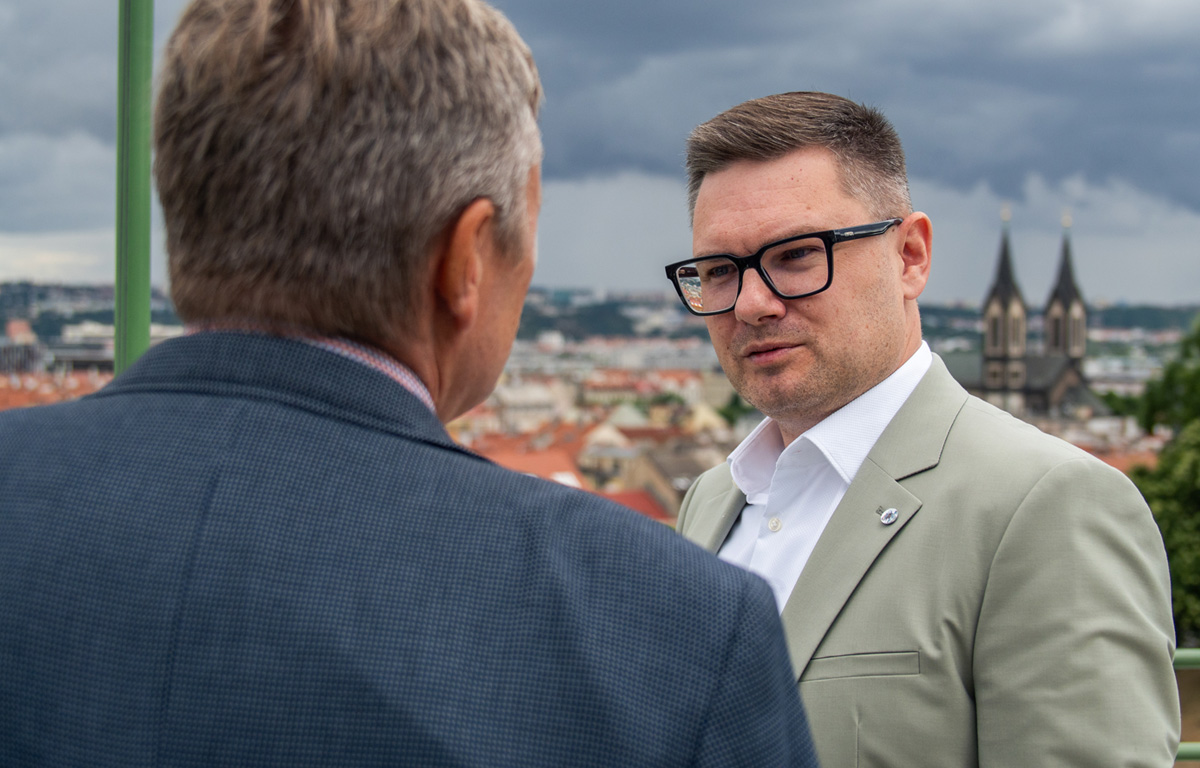
He considers personnel to be one of the biggest constraints on further growth. In his view, acquiring a certain skill is often easier than maintaining it over the long term. “I think the ability to retain is important, because we need to retain quality people, expertise, and know-how. But it’s not just about retaining it – it’s also about developing it. You can’t afford to stagnate.” According to Protiva, it is precisely people who will also determine the limits of the company’s further development. “Those limits lie with the people. As long as I have skilled people around me who want to move forward with me, as long as we have ideas, and – most importantly – as long as we can handle it, then of course we’ll go for it.” The company is therefore striving to attract the younger generation and collaborates with high schools, whose students come for internships or part-time jobs. According to Protiva, interest continues to exist primarily in technical trades, which remain the foundation of LOM PRAHA’s operations. “Maintaining military equipment—specifically aviation equipment—to keep the army in the air is our primary mission,” Protiva emphasized.
Looking ahead to 2030, Protiva therefore does not speak of another fundamental change in LOM PRAHA’s identity, but rather of consolidating the capabilities the company has acquired in recent years. “I would like to see a state-owned enterprise still here in four, five, or even ten years – one that serves as a strategic partner primarily for the Ministry of Defense, the Czech Republic, and the military – but one that offers more comprehensive services, because we see multiple synergies that can be realized there.”
Přerov is a case in point. Here, LOM PRAHA can operate an airport and provide helicopter pilot training, while simultaneously assisting the military with infrastructure development and servicing the equipment used for training at its own facilities. According to Protiva, it is precisely this concentration of capabilities that reduces dependence on external – especially foreign – suppliers. “These are truly synergies that help us handle these things in-house. We don’t have to rely on external entities – and here I’m talking mainly about foreign ones – and we can do these things safely, with high quality, and quickly.”
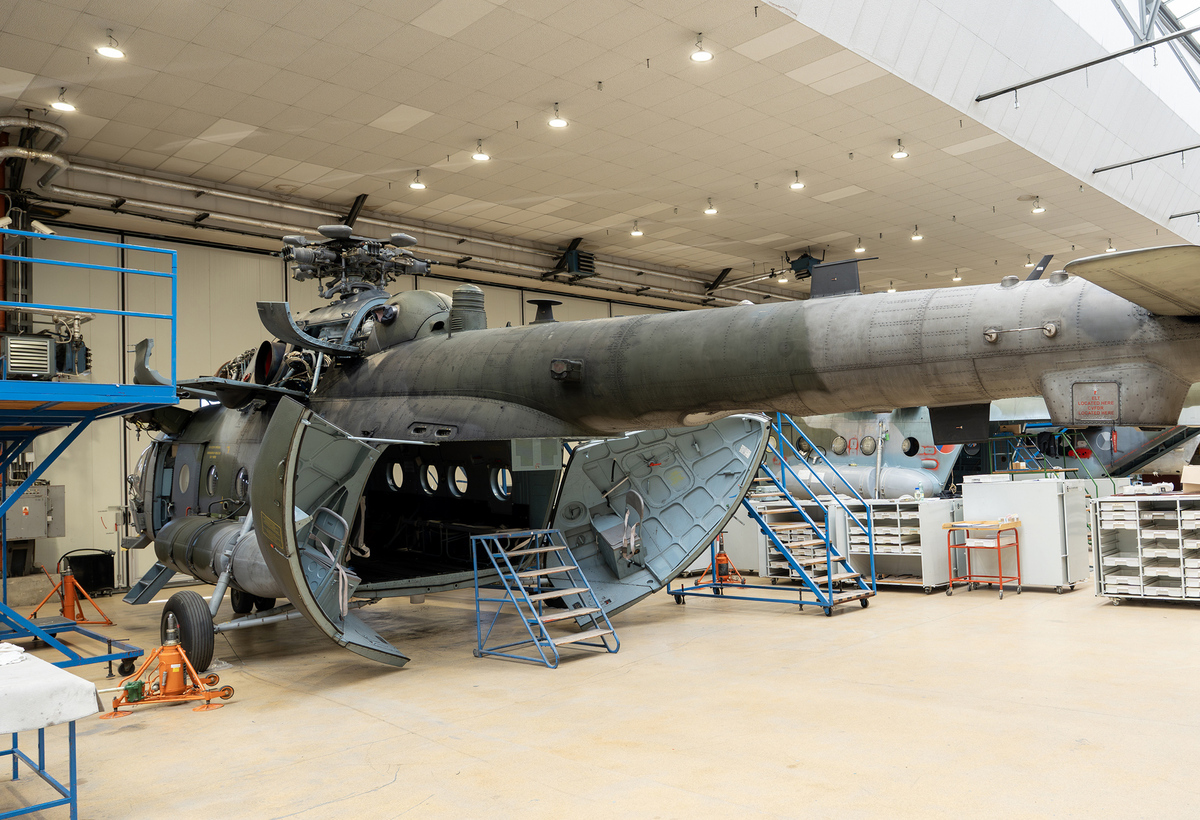
At the end of the interview, Protiva pointed out one more characteristic that he considers exceptional. LOM PRAHA still has the capability to service Eastern-made aircraft, while at the same time becoming increasingly involved in the maintenance of Western platforms. Added to this is its ability to modernize originally Soviet-made aircraft so that they can operate within NATO military environments.
“This state-owned enterprise is unique in that we are currently capable of repairing Eastern-origin aircraft. At the same time, we are becoming increasingly involved in the maintenance of Western-origin aircraft,” said Protiva. When you add training, airport operations, construction capabilities, and other newly developed competencies to the mix, he believes it creates a portfolio that is uncommon in the European context. “When you look at the range of capabilities that the state-owned enterprise is adding through these services, I think we’re truly unique in this regard. Our main role is to maintain and further develop all of these capabilities,” concluded Jiří Protiva, director of LOM PRAHA, in the next episode of the CZ DEFENCE podcast.