













The Rapid Deployment Force Support Battalion in Rakovník: The Invisible Pillar of Alliance Defense and the Logistical Backbone of the Czech Armed Forces
In modern high-intensity conflicts, one old rule applies more urgently than ever. Armies do not win solely because of infantry or tanks on the front lines, but primarily because of who can most effectively supply, move, and sustain their forces in combat. Logistics is a decisive factor in all conflicts, determining the outcome of operations under all circumstances. That is precisely why, in 2020, one of the newest yet strategically most important units of the Czech Army – the Deployable Forces Support Battalion – was established at the Milan Rastislav Štefánik Barracks in Rakovník.
The battalion is not a traditional combat unit equipped with heavy equipment for direct engagement with the enemy. Its role is primarily logistical. Without it, the deployment of any significant forces – whether Czech or allied – on our territory or moving through it would be extremely difficult and complicated. It is a specialized logistics unit directly subordinate to the Logistics Agency of the Ministry of Defense of the Czech Republic. This subordination is no coincidence, as the Logistics Agency is responsible for the entire system of supply, maintenance, transport, and host nation support within the framework of the Czech Republic’s commitments to the North Atlantic Alliance.
The battalion was officially established on January 1, 2020, and its roots date back to 2016, when an organizational unit originally intended for a mechanized battalion began to take shape in Rakovník. It was later transferred to the Logistics Agency in preparation for the creation of a specialized unit for host nation support and the process of receiving, assembling, and moving forces. This timing reflects NATO’s growing emphasis on force mobility following the annexation of Crimea and in the context of the increasing Russian threat. As a transit country on the Alliance’s eastern flank, the Czech Republic bears a specific responsibility in this regard. The battalion was created primarily to fulfill two key Alliance processes: Host Nation Support (HNS), i.e., comprehensive support for units by the host nation, and RSOM (Reception, Staging, Onward Movement), which includes the reception, staging, and subsequent movement of forces from ports, airports, or borders to the area of operations.

As a result, the Deployable Forces Support Battalion is the only unit of its kind in the entire Czech Army and fulfills a role that in many other NATO countries is carried out by larger logistics formations. Its activities are divided among individual companies, each with its own specific focus. The Command Company ensures the day-to-day needs of the headquarters, establishes the battalion command post in the field, and assigns personnel to its protection and defense. The 1st Support Company focuses primarily on logistical support within the host nation’s framework, including accommodation, catering, and other services. The Second Support Company operates convoy support points, where it enables passing NATO, EU, or UN units to refuel, park their equipment and ammunition, and obtain other necessary support both within the Czech Republic and, if necessary, abroad. The Third Support Company then operates assembly areas for units and materiel, which is key to the process of concentrating forces.
The battalion’s main tasks include establishing and operating mobile logistics bases to receive allied units, escorting and supporting convoys through the territory of the Czech Republic, ensuring the self-sufficiency of units outside permanent barracks, and coordinating the entire RSOM process in real time. This includes unloading equipment from trains, aircraft, or ships and subsequently moving it to the deployment area. In practice, the battalion’s soldiers are able to establish a logistics base with a capacity of hundreds to thousands of soldiers within a short period of time, which significantly enhances the Alliance’s operational readiness. The battalion is capable of performing third-level logistics support tasks independently or as part of multinational logistics operations and can also allocate forces to reinforce the command of NATO joint logistics groups.
Battalion Commander Lieutenant Colonel Václav Svoboda sums up this role very precisely. In his words, the battalion is capable of creating the necessary logistical infrastructure to receive allied units, ensuring their material support, and coordinating their movement to the deployment area. Host nation support and RSOM capabilities are now a key element of support not only for our own forces but also for our allies. The goal is for everything to function smoothly and reliably, which requires high flexibility and rapid response when coordinating the movement of large numbers of forces and assets.
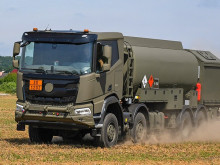
The battalion is equipped with modern, predominantly wheeled vehicles designed for rapid deployability and flexibility in the field. Key assets include Scania tractors with heavy Goldhofer semi-trailers, which are used to transport heavy combat equipment, including tanks and infantry fighting vehicles. This also includes Tatra 815-7 Multilift vehicles for handling various types of containers, accommodation and fuel containers, flatbed trailers, and Tatra Force 8x8 trucks. This equipment enables the rapid construction and dismantling of logistics bases, material handling, and operations outside permanent facilities, including mobile workshops, field kitchens, and supply systems. During a recent presidential visit, the equipment was demonstrated in action to show how the battalion can ensure the self-sufficiency of its units even outside of barracks and the high degree of flexibility required by its operations.

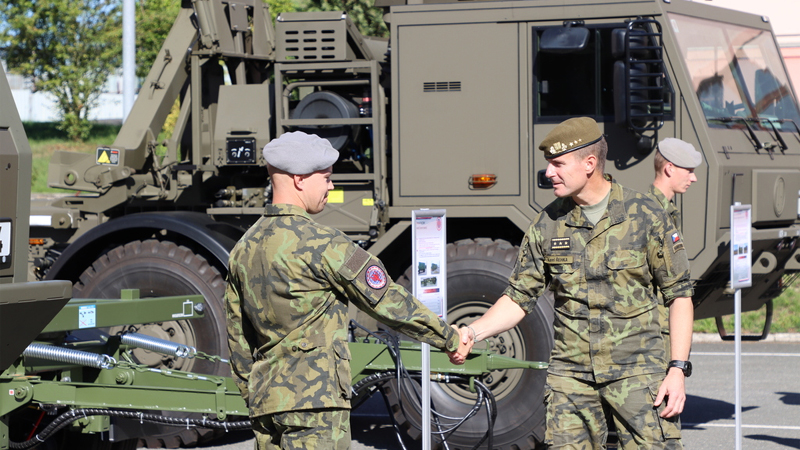
On March 19, 2026, the battalion was visited by Petr Pavel, President of the Republic and Commander-in-Chief of the Armed Forces. The President familiarized himself with the unit’s main tasks, its structure, equipment, and the practical aspects of its deployment. He inspected the equipment and inquired about the soldiers’ readiness, their training experiences, and cooperation with allies. The President praised the battalion’s work, stating that it is an indispensable part of the Czech Army’s capabilities today. He also expressed his appreciation for the readiness, expertise, and dedication with which the soldiers carry out their missions both at home and abroad.
Although the battalion is relatively young and developing dynamically, it faces the typical challenges of the Czech Army. These include a shortage of qualified personnel, particularly logistics specialists, heavy vehicle drivers, technicians, and medical personnel. NATO’s growing demands for speed and capacity in logistical support, in the context of Alliance exercises and potential crisis scenarios, require further modernization of the technical fleet and stable recruitment of new soldiers. As part of the planned reinforcement of the Territorial Forces, the battalion is to be transferred to the Territorial Forces Command, which will further strengthen its role in defending the territory of the Czech Republic in the event of a crisis.
Moreover, logistics in a hybrid environment requires not only traditional skills but also protection against cyber threats and integration with Alliance systems, such as German or American logistics elements. Regular training, joint exercises with partners in the Czech Republic and Germany, and planning activities contribute to strengthening interoperability and overall readiness. The battalion thus represents a textbook example of a balanced structure of a modern army, where combat units are supported by top-notch logistical support.
At a time when Russia is demonstrating in Ukraine just how critical the sustainability of battlefield supply is, the Rakovník battalion represents the Czech contribution to Alliance resilience and collective defense. Its work often remains in the background of media attention, but it is precisely thanks to this work that both Czech and allied units can carry out their missions effectively, safely, and with a high degree of self-sufficiency. As President Petr Pavel emphasized during his visit, this work is indispensable. In an era of a deteriorating security environment, further strengthening and modernizing the Deployable Forces Support Battalion should therefore be among the priorities of Czech defense policy. Only strong and flexible logistics will ensure that the Alliance is able to respond quickly and reliably to any threat.