













Colonel Milan Nykodym: Air superiority is crucial today
What does a modern air operation look like from a pilot’s perspective? In this interview, Colonel Milan Nykodym, the current acting commander of the 21st Tactical Air Base in Čáslav, discusses the reality of Alliance missions on NATO’s eastern flank, decision-making in the cockpit, and the growing pressure to respond quickly in an environment where drones and new technologies are playing an increasingly significant role. Drawing on specific experiences, he illustrates how training, deployment, and the very logic of air combat are changing.
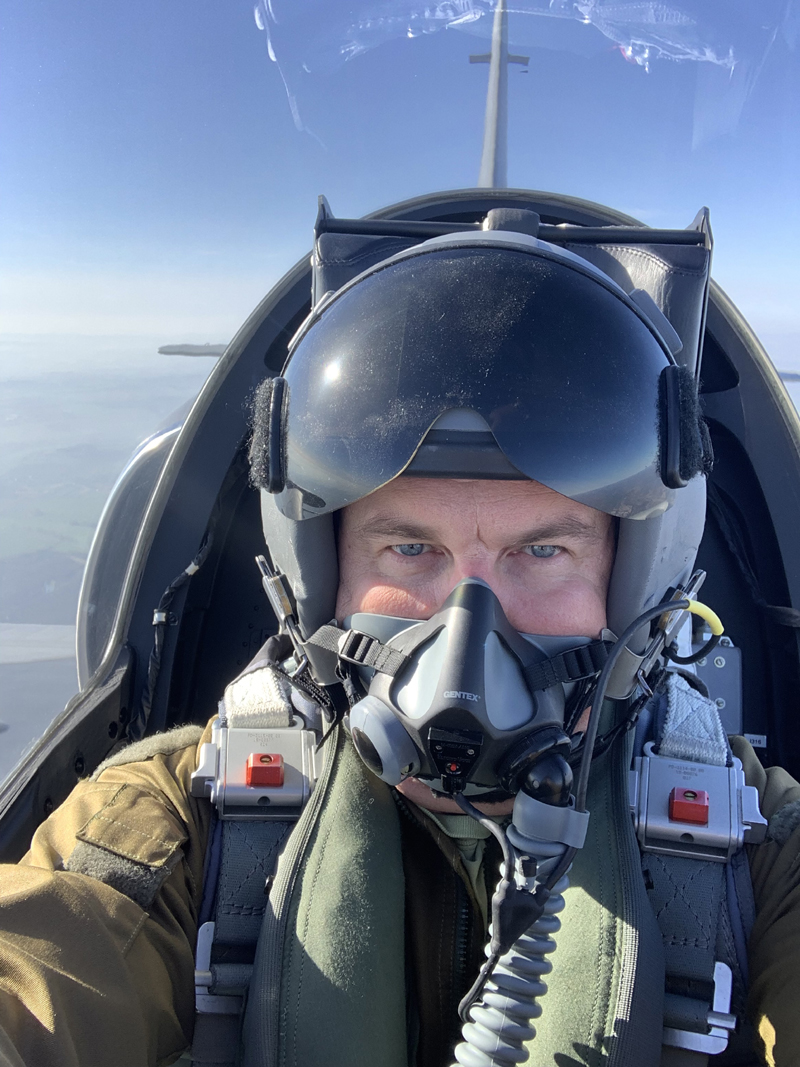
You have logged more than two thousand flight hours and have experience in NATO operations. From a pilot’s perspective, how has the environment in which you fly today changed?
Given the current events in Ukraine, our work, training, and military flying as such have taken on a much more realistic dimension than when I was an operational pilot on the Gripen. We are adapting our training to new trends that are emerging precisely in the aforementioned conflict in Ukraine. Live sorties to identify Russian Federation aircraft as part of our foreign operations in Lithuania and Estonia have taken on a completely different significance than during our debut in the Baltics in 2009.
When you compare your early days to today, what is the biggest change in how a pilot perceives threats and makes decisions?
To be honest, the perception of threats and the decision-making process remain essentially unchanged. Making quick decisions in critical situations is key to a pilot’s survival, regardless of the era or the type of aircraft. This could involve dealing with an aircraft malfunction, deteriorating weather conditions – perhaps combined with a fuel shortage – or handling situations during aerial combat. A pilot must be able to make quick decisions, often improvising, in order to survive. During my training, experienced instructors taught us that even a decision that later turns out to be wrong is better than no decision at all. And I believe that applies to all areas, not just aviation.
Your experience also translates into the specific operations currently underway on NATO’s eastern flank – that is, specific missions – and into the reality “in the air.” You served in the Baltic Air Policing missions. What does a real-world engagement with a non-communicating or Russian aircraft look like?
For a pilot, a real-world mission begins in the duty room, where they spend their 24-hour shift. As standard procedure, we maintain a 15-minute standby for takeoff, day or night. The wail of the siren thus triggers a relatively rapid sequence of well-rehearsed tasks, activities, and procedures. Putting on the flight suit, strapping into the seat, starting the engine and all aircraft systems, receiving basic information about the target, and many other tasks, followed by taxiing and takeoff, climbing to the target’s altitude, and maneuvering to take up a position in its rear hemisphere – all of this is already under the guidance of GCI (ground-controlled interception). From a certain distance from the target, the pilot begins using information from the onboard radar. Throughout the entire operation, he works in coordination with his wingman (a pilot under his command). The wingman maintains a precise position behind his leader, provides cover for the leader, monitors the situation behind him, and is prepared to take over all operations related to the engagement if necessary.

The moment visual contact is established, the intercepting pilot begins relaying all information about the target. This includes flight altitude, flight course, type and number of aircraft, visible armament or special equipment, aircraft markings, camouflage, and so on. Often, this procedure also includes a so-called cockpit check, during which the pilot attempts to gather available information about the crew’s condition. Whether they are communicating via visual signals, whether they are conscious, whether there are people other than pilots in the transport aircraft’s cockpit, etc.
Throughout such an operation, it is necessary to adhere to the established RoE (Rules of Engagement) for the given region or operation. It is important to keep in mind that despite the critical situation and the perception of Russia as such, we are participating in “peacekeeping” operations. Interventions against Russian Federation aircraft are more or less an “escort” during their flight over international waters in international airspace. We monitor their activities and make our presence and readiness known.
What happens in the cockpit during those first few minutes? What is the pilot actually dealing with, and how quickly does he have to make decisions?
The first few minutes are primarily about putting training into practice. The pilot performs standard procedures to reach the target area as quickly as possible. This is followed primarily by instructions from the GCI. The speed of decision-making is extremely important during any flight, including live operations.
These missions likely demonstrate just how significantly the intensity and nature of air operations on the eastern flank have changed. How different is the current environment – for example, in the Baltic states – from the situation ten years ago?
That’s more of a question for the pilots who are currently in the field; I’m more of a veteran now. However, as I mentioned, everything is becoming more tangible; you’re more aware of the real threat of armed conflict – it’s no longer just a matter of saying, “Hey, I’m here, so watch out.” Today’s operational pilots have to keep in mind that shooting will actually break out. The situation is simply more tense.
Are pilots in the air more often these days and closer to potential adversaries than before?
There has been a noticeable increase in the number of combat sorties in the Baltic region. As part of eAP (enhanced Air Policing), NATO is responding to the situation by having alliance aircraft spend more time in the air on patrols known as CAP (Combat Air Patrol), which significantly reduces response times because the aircraft are already in the air and near the potential area of engagement with enemy aircraft.
However, as the complexity of the operating environment increases, there is also a fundamental shift in the technologies pilots use. In fourth-generation aircraft, pilots process vast amounts of information on their own. What does this look like in practice?
As previously mentioned, during the initial phases of the flight, the pilot communicates intensively – first with air traffic control at the airport, where he receives a great deal of information regarding the departure clearance and builds a mental picture of the air situation and traffic around him, communicates with the pilot in command, and, of course, must constantly monitor the information provided by the aircraft, such as its position, speed, altitude, engine instruments, fuel level, and so on. During the flight to the target, the primary focus is on acquiring the target with the onboard radar based on information from GCI or, if applicable, the AWACS (Airborne Warning and Control System) crew. He also controls other sensors that enable target identification, such as the LDP (Laser Designator Pod), in our case the Litening 4i. He evaluates information from the data link (LINK 16) and, of course, processes visual information.
However, these technological changes certainly also influence how we respond to new types of threats. Drones are a major topic today. From a pilot’s perspective, how challenging is it to detect and intercept them?
By their very nature, drones are small and relatively slow targets. When moving at speeds of 600–800 km/h at low altitude (the operational altitude of these platforms), it is clear that this is a challenging task. Detecting these targets depends on the capabilities of the radar, which were not primarily developed for this purpose and, in the case of our aircraft, are limited by their age. It is even more challenging for a pilot to establish visual contact with a drone, and I dare say that under certain weather conditions, or at night, this can be practically impossible. The success of an engagement using onboard weapons directly depends on early detection and establishing visual contact. In our operational environment, visual contact is absolutely essential, as we must minimize the risk of such an engagement affecting the civilian population.
Note: Small unmanned aerial vehicles (weighing approximately 22 kg) are classified as drones; larger ones are referred to as UAS (Unmanned Aircraft Systems) or UAVs (Unmanned Aerial Vehicles). Due to their size, these are comparable to aircraft, and therefore measures are taken against them in the same manner.
To what extent are these threats forcing you to change your training methods, perhaps even in unconventional ways?
The need to adapt training is absolutely crucial if we want to keep pace with the changing trends on the modern battlefield. Simulators are of great assistance to us, as they allow us to configure target parameters such as dimensions, altitude, speed, maneuverability, thermal signature, and so on. Pilots are working to develop tactics and use weapons based on information from Ukraine and our allies. They are trying to utilize drones in the Czech Armed Forces’ arsenal, though these are primarily intended for other tasks. We are, so to speak, trying not to fall behind and to adapt, to make the most of what we have available, and to be prepared.
The Czech Army also responded to these new challenges with a very concrete deployment to Poland. The Czech helicopter unit was able to deploy to Poland within a matter of days. What did that mean from the perspective of the people and the organization?
That is, of course, a question for our colleagues at the 22nd Helicopter Air Base. However, the shorter the time required to go on standby, carry out a mission, or begin operations, the greater the demands on the organization and personnel. It is particularly difficult from a human perspective, because try telling your family at home that you’re flying to a conflict zone the day after tomorrow.
What does this deployment say about the Czech Armed Forces’ ability to operate within NATO?
Any deployment or cooperation within NATO demonstrates our reliability as an equal, dependable, and trustworthy partner.
However, these experiences also raise the question of how we are training the next generation of pilots. You yourself mentioned to me that in some countries, F-35 pilots are fully trained by around the age of 22. Is this a direction the Czech Republic should also take?
It’s a bit of a dilemma, and the solution lies in finding the right balance between young pilots and experienced ones who will be in charge of it all. The new aircraft brings not only a host of fantastic capabilities but also a shift in philosophy. Objectively speaking, it will be much easier for young pilots to embrace the new philosophy and everything that comes with it, to adapt to the AI, and to absorb the necessary information and knowledge. Older, experienced pilots will inevitably compare new things to what they’re used to doing. Adopting different tactics and the like – on the other hand, they’re the ones with experience and are naturally suited for command.
In any case, combatants – and not just pilots – aged 22 are certainly, in most cases, not preoccupied during deployment with thoughts of the wives and young children they had to leave at home to go off to fight.
What is the biggest obstacle to faster pilot training today: the system or the mindset?
Pilot training is a complex, long-term process. Teaching someone to take off and land isn’t all that difficult, but training a fully qualified pilot to whom you can entrust an expensive, high-performance aircraft is not something that can be accomplished in a matter of weeks. Today, we view a fighter jet as a single component of an entire system, and we must view the pilot in the same light – their knowledge must extend beyond simply operating the aircraft and its weapons. A shift in mindset will be necessary not only for pilots but for the entire military, and the system must be accepted as it is designed to operate such a sophisticated weapon as the F-35.
However, in addition to technology and training, the human factor remains crucial. How does a pilot cope with the pressure in a real-life situation, when it is no longer a drill but an actual mission?
Coping with the pressure and accepting the fact that this isn’t training but real combat is a personal matter. However, these principles have remained constant throughout the history of warfare, and the experiences of partners in real combat are the most valuable source for adapting training. And precisely in the spirit of the saying “train hard, fight easy” – or perhaps the sexier “train as you fight, fight as you train” – the ability to handle real-world situations is built on high-quality, meaningful training.
To what extent does experience from overseas missions play a role in handling these situations?
Any deployment in a foreign operation or participation in major international exercises helps pilots better handle real-world missions. A trained pilot who gets absorbed in the action and switches to peak performance mode essentially loses track of the line between reality and what he has drilled to perfection. And this stems from his rigorous training and the experience he gains throughout his career as an operational pilot.
This also raises the broader question of how society perceives this reality. Do you feel that Czech society understands the security environment we find ourselves in today?
I’m sorry, but based on certain personal experiences, I don’t feel qualified to judge Czech society, nor is it my place to do so.
To conclude, let me ask you a crucial personal question. From the perspective of a pilot and commander, what do you think is the single most important factor in defending our airspace today?
The most important thing is the ability to detect threats in time, make quick and correct decisions, and respond before the enemy strikes our territory. This is crucial for defending our airspace, whether I’m sitting in the cockpit of an aircraft or issuing orders as a commander. All of this is possible only if the system includes people who are convinced they are doing the right thing, are properly motivated, and are highly trained. They take pride in being part of an organization, a system that, when necessary, will help protect our country and the people living in it.