















Czech Roads and Railways: A Key Pillar of Allied Defense under Host Nation Support
The NATO summit in Ankara is slowly approaching, and with it, the topic of the Czech Republic’s commitments to the entire Alliance is once again coming to the fore. Currently, within the framework of NATO’s strategic planning, the Czech Republic represents a key transit hub through which allied forces would flow to the Alliance’s eastern flank in the event of a conflict or other risks. The Czech Republic’s national security is no longer defined solely by its ability to defend its own territory or participate in military missions far abroad; a fundamental element is ensuring the safe, smooth, and logistically well-organized movement of allied forces. The ability to rapidly and effectively move military forces from point A to point B appears to be an absolutely essential element of both deterrence and the conduct of war itself, comparable to the accumulation of firepower. In this regard, the Czech Republic plays the role of Host Nation Support.

Host Nation Support (HNS) represents a clear commitment for the Czech Republic. According to the definition in NATO standard AJP 4.3, it involves the provision of civilian and military assistance during times of war, crisis, and even peace. This part of the definition makes it clear that in the event of a crisis or war, the Czech Republic’s civilian infrastructure – such as highways, rail corridors, and other logistically important elements – will become part of the overall NATO operation. If allied forces were to become stranded in the Czech Republic due to insufficient bridge load-bearing capacity and other infrastructure obstacles, this failure would have a direct strategic impact on the course of a potential conflict, but above all on the reputation of the entire Czech Republic, which would in turn affect NATO’s overall deterrence capability.

It is clear that the Czech Republic must make significant preparations for such large-scale troop movements. Ensuring the safe transit of allied troops naturally depends on the physical condition of the Czech transportation infrastructure. However, modern military equipment is considerably heavier than was typical in the past, particularly in the Eastern Bloc during the Cold War. To provide a quick comparison, the new Leopard 2A8 tanks weigh approximately 68 metric tons, while the Eastern Bloc tanks used by the Czech Armed Forces weighed about 43 metric tons (T-72 M1) and 48 metric tons (T-72M4 CZ), respectively. Western military equipment follows the trend toward maximum crew protection, resulting in increased weight to accommodate thicker armor and other protective features throughout the vehicle. However, this trend places significant demands on road and rail infrastructure, which was not designed to handle such heavy loads in the past.
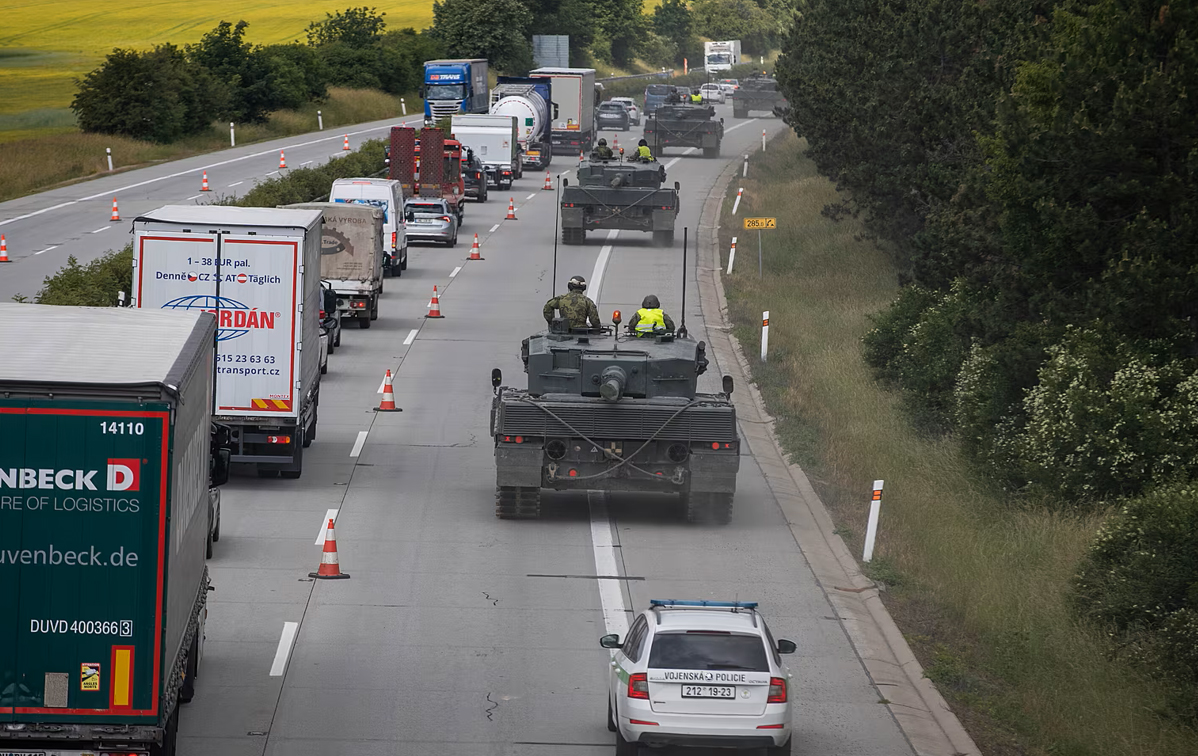
In times of crisis and war, roads and highways become the lifelines for the entire movement of forces. Extensive convoys of military equipment, ammunition resupply, and the provision of medical support cannot function without a high-quality transportation backbone that spans the entire country. This idea is not new to our country; for example, Jan Antonín Baťa had the same goal of creating a long-distance highway connecting the west and the east as early as the 1930s. Of course, when planning the movement of military equipment via road, it is not only distance and the smooth flow of normal traffic that matter. Other important factors include, for example, the width of the road and the radius of curves. However, the most important factor is the road itself – whether it is capable of supporting the given equipment.
In light of all this, it is clear that it is necessary to build dual-use infrastructure. The EU is also committed to assisting countries such as the Czech Republic that must address such issues; it is currently providing support through the Connecting Europe Facility 2021–2027 (CEF2), one of whose objectives is to improve military mobility. An example of EU support in this regard is the funding secured for the Šmejkalka Bridge project, valued at 720 million CZK. It goes without saying that the Czech Republic intends to continue seeking EU support under the upcoming CEF3 program as well.
Rail transport appears to be more suitable for moving large volumes of heavy equipment than road transport. Currently, rail transport is used, for example, to supply fuel to air bases or to transport units to various training exercises. The importance of rail transport is fully evident in the context of today’s heavy equipment. It is precisely the weight and dimensions of the new equipment that make road transport less advantageous. It is also important to note that tracked vehicles are not even designed for travel on regular roads. Rail transport helps reduce the strain on road networks as well as wear and tear on the heavy equipment itself. From this perspective, the full importance of rail transport will only become fully apparent in crisis situations, when the Czech transportation network is strained to its maximum capacity. The use of rail transport by the Czech Armed Forces (AČR) is facilitated by the state-owned freight carrier ČD Cargo, which is currently assisting with the rotation of Czech troops and equipment in the Baltic states. The continued relevance of rail transport today is also highlighted, for example, by the fact that as many as dozens of trains travel to the Baltic states each year.
The importance of this and other infrastructure is also evident in the commitment to spend 5% of GDP on defense, which the Czech Republic has pledged to achieve by 2035. This 5% of GDP is divided into two parts. The first portion, 3.5% of GDP, will be covered primarily by the Ministry of Defense’s budget for the development of the Czech Armed Forces (AČR) as such. This portion essentially consists of direct defense expenditures amounting to 3.5% of GDP, compared to the previous commitment of 2% of GDP. The other portion, amounting to 1.5% of GDP, is, however, the component that is more interesting iin the context of Host Nation Support (HNS). This portion consists of defense-related expenditures, which include investments in infrastructure, enhancing resilience and civilian preparedness to manage crises, expanding the capabilities of the defense industry, supporting innovation, combating hybrid threats, protecting critical infrastructure, and building strategic reserves. This portion will not primarily be funded from the Ministry of Defense’s budget; however, if we look at the list above, it also includes investments in the Czech Armed Forces’ (AČR) rail and road infrastructure and other aspects related to HNS itself.
In addition to the actual logistical movement of Allied forces, this also entails further related requirements for the Czech Armed Forces. As noted above, facilitating and supporting the movement is a given. Furthermore, appropriate rest areas must be provided, as well as protection against enemy sabotage. However, this entails additional major responsibilities for the Czech Republic. For example, it can be said that protection against sabotage is no longer limited to the mere physical guarding of bridges and bases. In today’s era of hybrid warfare, it is also necessary, for instance, to ensure adequate cybersecurity – not only for resources directly associated with the military, but also, for example, for railway traffic control systems. An attack on the ČD Cargo control center or the paralysis of the road traffic control center by an adversary could have consequences comparable to the physical destruction of infrastructure. In this context, the Czech Armed Forces must ensure the closest possible cooperation and communication with all affected entities that could be targeted in the event of HNS deployment during a crisis or conflict.
Host Nation Support is one of the Czech Republic’s greatest commitments. Preparing the entire infrastructure – not only for the Czech Armed Forces but for the entire country – is a financially demanding and time-consuming undertaking that deserves close attention. Along with the establishment of a modern heavy brigade, this is one of the Czech Republic’s most important tasks. However, the challenge in preparing for HNS lies in the scope of the entire commitment. It does not concern the military alone, but rather involves comprehensive interagency cooperation that must extend into the private sector and the for-profit sector. From this perspective, effective planning down to the smallest details is essential to ensure not only the smoothest possible deployment of allied forces but also adequate infrastructure with sufficient supplies and resources for directly hosting Alliance troops. The Czech Republic’s budgetary planning for the coming years should be tailored to this very purpose.