







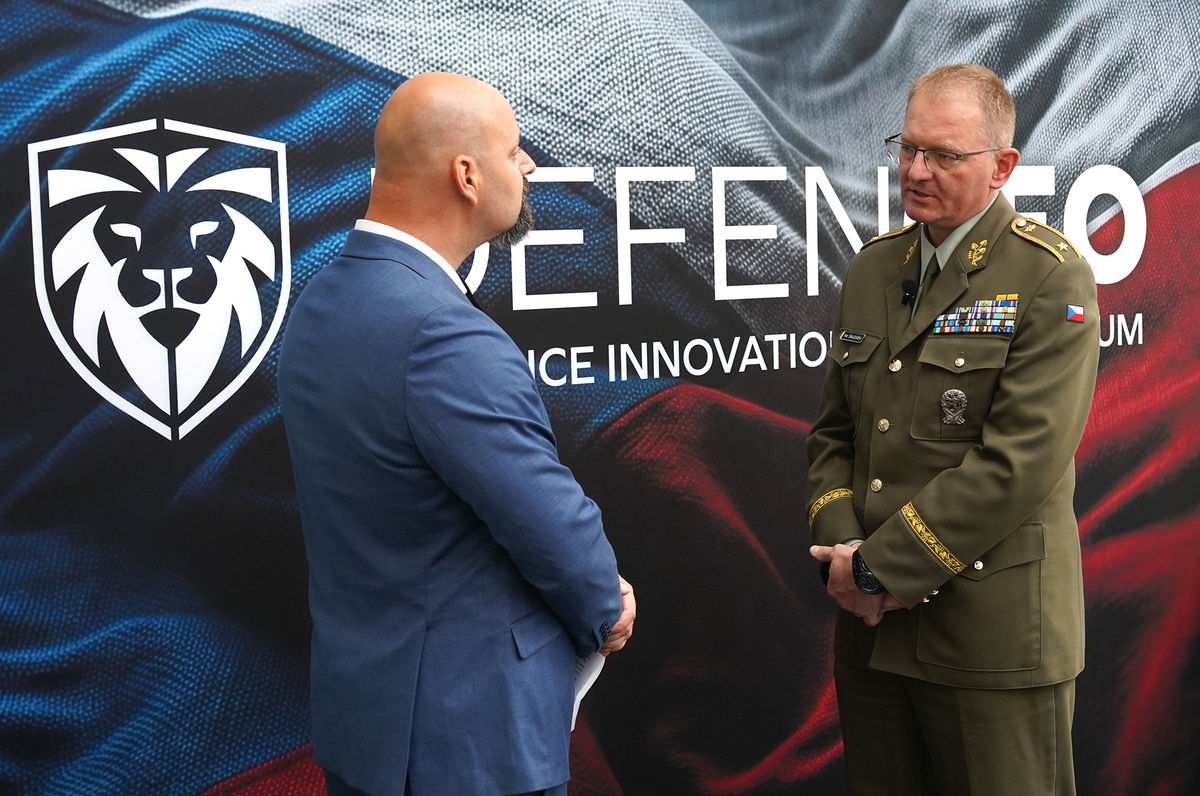
General Petr Šnajdárek: Bureaucracy Is the Biggest Obstacle to Adopting Modern Technologies
The importance of the national test range for autonomous and unmanned systems, cooperation between the Czech and foreign defense industries, and the need for fundamental changes in procurement processes were the main topics of an interview with Brigadier General Petr Šnajdárek, Director of the Communications and Information Systems Section at the Ministry of Defense, which he granted to the CZ DEFENCE editorial team during the DEFENCEO 2026 conference in Brno. The general emphasized, in particular, the need for faster implementation of modern technologies in the military, the removal of administrative barriers, and more intensive cooperation between the armed forces, government institutions, and industry.
Video: General Petr Šnajdárek: Bureaucracy is the biggest obstacle to the adoption of modern technologies / CZ DEFENCE
One of the main topics of the interview was the operation of the national testing range for command and control systems to date, the opening of which represented a significant step toward developing the capabilities of the Czech Army in the field of autonomous and unmanned systems. According to General Šnajdárek, the testing range’s primary benefit lies in its ability to comprehensively test various technologies and integrate them with one another. It is therefore not merely a matter of testing the mobility of individual platforms in challenging terrain, but also of integrating them into command and control systems.
The test range is set to undergo further development, including with regard to the use of 5G networks and the testing of additional technological add-ons. Its potential was also confirmed by the international Drone Shield 2026 exercise, during which foreign partners raised further requests to expand testing capabilities. In this context, the general mentioned, for example, the Israeli participants, who appreciated the opportunity to test autonomous systems in field conditions that they do not normally encounter in their own country. Plans for the future also include setting aside time slots for testing by foreign partners within the framework of NATO. The experience and know-how gained should subsequently contribute to the development of the Czech Army’s capabilities.
Another important topic was the issue of supporting the Czech defense industry and finding the optimal balance between domestic and foreign technologies. Šnajdárek emphasized that when selecting solutions, their actual functionality and ability to meet the military’s requirements must be the primary deciding factors. According to him, supporting domestic companies does not mean that the Czech Republic should rely exclusively on its own technological development at any cost.
As an example, he cited the possibility of combining high-quality Czech unmanned systems solutions with advanced components from foreign manufacturers, the independent development of which could take many years. Cooperation with NATO’s DIANA innovation accelerator also represents a significant opportunity in this regard. The general noted that approximately 70 companies participated in the Drone Shield 2026 exercise alone, which, in his view, confirms the industry’s considerable interest in cooperating with the military.
General Šnajdárek identified the insufficient speed of implementing new technologies into practice as one of the most serious problems with the current system. Although the military is gradually expanding its engagement with industry through testing, expert workshops, and joint exercises, a key challenge remains the alignment of these activities with the procurement processes themselves. According to the general, it is essential to change the current system, speed it up, and partially depoliticize it.
Particularly in the field of information and communication technologies, the procurement process – which can take many years – can pose a major problem. While the military is able to select and test suitable technological solutions relatively quickly, the actual procurement and implementation of those solutions can take considerably longer. In extreme cases, according to Šnajdárek, the time from the formulation of requirements to the implementation of the technology can approach ten years. Such a process, however, does not keep pace with technological development.
The general therefore also advocates a change in approach to defining military requirements. In his view, the military should not always specify the technical parameters of the required product in detail in advance, but rather formulate specific scenarios for its use and give industry more leeway to come up with innovative solutions. Broader interagency cooperation, the sharing of experiences, and the more effective use of dual-use technologies are also important.
According to Šnajdárek, this approach is particularly important in the field of communications and information systems. While the radio units themselves can remain in service for many years, their software and other related technologies undergo repeated changes during that time. A similar situation arises with battle management systems, which ensure communication and coordination among units on the battlefield. Without more flexible procurement procedures, there is a risk that the technologies being acquired will already be obsolete by the time they are deployed.
In the interview, General Šnajdárek also emphasized that the development of the Czech Republic’s defense capabilities cannot be viewed solely as the responsibility of the military and traditional defense contractors. Civilian industry and other state institutions must also play an irreplaceable role. According to him, their mutual cooperation is an essential prerequisite for building the country’s overall resilience. As the general noted, the defense of the Czech Republic is a shared responsibility of the armed forces, industry, and other partners across society.