















Col. Masopust: Hospital Must Remain Fully Operational Under Any Circumstances

The Central Military Hospital in Prague is facing extensive infrastructure modernization, the development of new medical specialties, and the strengthening of military healthcare at a time of growing security threats. In the next episode of our discussion program CZ DEFENCE, hospital director Col. Václav Masopust, MD, speaks openly about the reconstruction of the burned-out A5 wing, the shortage of medical staff, modern technologies in medicine, and why a military hospital cannot function without civilian patients. He also describes the hospital’s future direction, as it aims to be not only a top-tier medical facility but also a key center for the care of war veterans and military personnel.
Video: Plk. Masopust: Nemocnice musí být plně funkční a na ničem nezávislá / CZ DEFENCE
From a professional standpoint, the Central Military Hospital (ÚVN) is one of the most important healthcare facilities in the country; at the same time, however, it faces major infrastructure challenges. “From both an economic and personnel standpoint, the hospital is consistently stable. That hasn’t changed. The issue is more about the infrastructure itself,” says the director of the ÚVN. He notes that his predecessor, Professor Miroslav Zavoral, raised the hospital to a very high standard, opened a number of clinics, and significantly strengthened its scientific profile. “From a scientific standpoint, it is one of the best hospitals. The second issue is infrastructure,” adds Masopust. According to him, the key is to ensure that the hospital is fully functional and independent of external circumstances. “It’s a military hospital, so that means we have a huge number of tasks ahead of us. This concerns energy centers, water, and waste. We’re doing all of that now to make sure it really works perfectly. But it’s very costly.”
One of the most visible projects is the renovation of Pavilion A5, which was damaged by fire in the past. “When we took over the hospital, there was no plan yet for the fire-damaged Pavilion A5, so we got to work right away,” says Masopust. According to him, demolition work has now been completed, and the plan is being adjusted based on findings revealed after the structural elements were exposed. “A lot of issues have come to light that we now have to address. Construction hasn’t stopped; we’re making adjustments to certain structural elements. Ultimately, it turned out better than I feared, but even so, there are many things that can’t be determined until the structure is exposed,” he explains. According to him, the building was damaged not only by the fire itself but mainly by the water used to extinguish it. At the same time, the Central Military Hospital continues to develop as a leading clinical, scientific, and educational institution. “We are continuing what Professor Zavoral started. We’re striving to do a lot of work on the scientific and educational fronts,” says the hospital director. Recently, a neuropsychiatry and psychiatry clinic was opened in collaboration with the Second Faculty of Medicine at Charles University; a rehabilitation clinic is being prepared with the First Faculty of Medicine; and cooperation with the Czech Technical University is developing significantly. “I see a great future in this. Medicine will be influenced by artificial intelligence and other technologies, so we must also collaborate with technicians and biomedical engineers,” emphasizes Masopust.
As a military hospital, the Central Military Hospital must also respond to developments in current conflicts and the needs of the armed forces. Masopust notes that during overseas operations, military doctors used to gain valuable experience directly on the ground. “Now those opportunities are very limited, so we’re looking for other ways to gain that experience,” he says. One step was the launch of an emergency response service directly from the hospital, which the ÚVN is striving to staff with military doctors. “We want them to gain as much practical experience as possible,” he adds. The Combat Medicine Center, where realistic simulations take place, also plays a significant role. “The demand is enormous. When you can’t be on a real battlefield, you can simulate an almost real battlefield, including the stress for medical personnel.” The Central Military Hospital’s funding relies primarily on the public health insurance system, while activities performed for the military are covered by a contribution from the Ministry of Defense. “We are a subsidized organization. If we do something for the military, we receive a contribution from the Ministry of Defense; otherwise, our main income comes from health insurance companies,” explains Masopust. According to him, the hospital is in intensive negotiations with health insurance companies regarding an increase in reimbursements. “We’re succeeding. We’re in talks to increase the monthly flat rate with both the Military Health Insurance Company and the General Health Insurance Company. This is important so that we can reward healthcare professionals and maintain the current trend.”
As an organization under the Ministry of Defense, the Central Military Hospital is also subject to strict oversight mechanisms. “For a long time, we were subject to more scrutiny than anyone else. We are administered by the Ministry of Defense; we must undergo security clearances, and now all of the hospital’s statutory representatives will have to as well,” says Masopust. According to him, the audits highlighted procedural issues in particular, such as in the areas of pharmaceuticals and public procurement. “We have strengthened the selection process and completely overhauled the procurement guidelines. Today, their strictness even exceeds the parameters required by law,” he says. An electronic intake form has also been introduced to ensure an electronic trail is traceable at every step. Masopust rejects the notion that the events covered by the media indicate a systemic problem at the hospital. “Two cases appeared in the media, but they concerned individual doctors,” he says. In one case, he explains, it was a matter of resignations for health reasons, not the collapse of the department. “There has been no reduction in operations. It’s functioning, though partly with external contractors. I would be very happy to have a stable team there that is exclusively ours, and we’re working intensively on that,” he explains. According to him, professional interest in working at the Central Military Hospital is high. “As far as the medical staff is concerned, interest exceeds the capacity we have.” The hospital is closely linked to medical schools, which allows it to identify talented doctors even during their training. “We have clinics for the First, Second, and Third Medical Faculties, as well as for the Faculty of Military Health Sciences in Hradec Králové. Thanks to this, we can give priority to selecting the best candidates,” says Masopust. He believes that the training of registered nurses is equally important. “The biggest concern in society today is precisely the shortage of general nurses. They are the best nurses; they have greater competencies than practical nurses and are already performing procedures that were previously carried out by doctors,” notes Masopust, who considers the trend of expanding nurses’ competencies to be the right one.
Another key focus of the Central Military Hospital is conducting medical examinations for applicants seeking to serve in the military. According to Masopust, interest in joining the armed forces is growing significantly. “In 2024, we conducted 1,900 medical examinations, and last year nearly 5,000. The interest in the military is enormous,” he says. The system had to be reorganized so that applicants could complete most of the examinations in a single day. “They undergo about ten examinations during the day, and we try to wrap it up that same day if they have all the necessary documents,” he adds. Psychological examinations, which are a mandatory part of the assessment, take the most time. Masopust also acknowledges that the population’s health is changing. That is one reason he helped revise the regulation that defines medical fitness. “There are professions where people are in high demand, even if they won’t be directly in combat,” he explains. According to him, the military also needs specialists whose health may not meet the strictest requirements of combat units. “Let’s be honest, the population really isn’t as healthy as it used to be.”
The director of the ÚVN considers technological development to be one of the key areas for the future. According to him, the collaboration with CTU does not concern quantum computers, but a whole range of practical projects. “There are a lot of great programs there, whether it’s 3D printing, which the Center for Combat Medicine uses, or other technologies,” he says. According to him, 3D printing makes it possible to produce aids directly for training and practice. “You can print lungs, blood vessels, or other models that medical professionals use for training. It’s not quite perfect yet, but it’s very realistic,” he describes.
In the future, the Central Military Hospital plans to expand certain specialties, such as pulmonary medicine, plastic surgery, and oncology. The hospital has recently been approved to establish an oncology care center and has retained its status as a Level I trauma center. “Traumatology is the dominant field in military medicine,” says Masopust. Another major task is the modernization of the hospital’s information system, which he says is roughly twenty years old. “We want to put an integration platform out to tender so that we can connect all military hospitals and military medical facilities in the country, including garrison infirmaries. The goal is to have a complete overview of all soldiers,” he explains.
Care for veterans remains an important priority. The Central Military Hospital already operates a veterans’ home, which, according to Masopust, straddles the line between social and health care. “We would like to expand it. It’s a major investment and isn’t solely up to us, but we view it as a priority,” he says. The hospital is also working on a system for home care and telemedicine. “Last year, we ran a telemedicine project focused on cardiovascular issues and diabetes with great success. If we manage to implement the new information system, we would like to firmly integrate telemedicine into veteran care as well,” he adds.
Masopust rejects the idea of a purely military hospital intended solely for soldiers. “That’s not possible. You need doctors with experience, and soldiers are generally healthy. That’s precisely why we must also care for civilians,” he explains. According to him, daily contact with patients and a wide range of diagnoses is essential for maintaining expertise. “It’s not enough for a doctor to decide to perform lung surgery. You need diagnostics, surgery, follow-up oncological care, and a comprehensive approach. All of this enables doctors to be prepared even for severe injuries.”
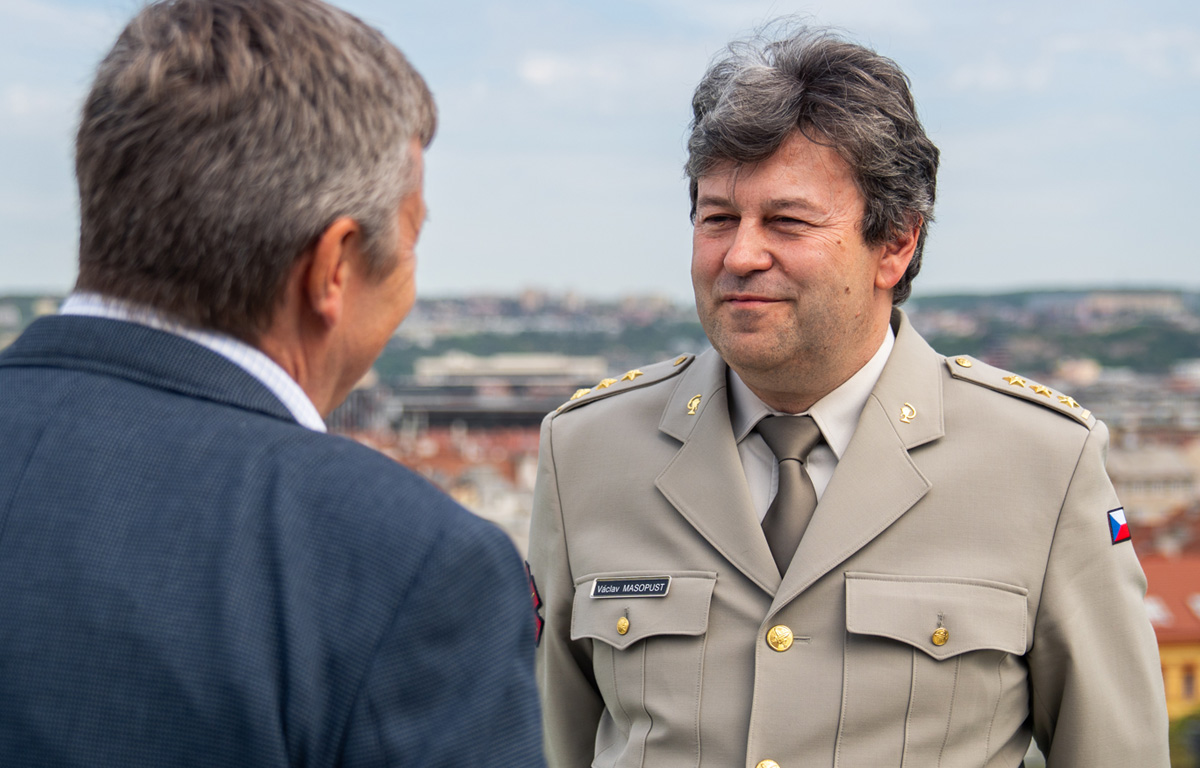
According to Masopust, in ten years the Military University Hospital should be more modern, better equipped in terms of space, and even stronger in terms of expertise. “We expect to open Pavilion A5 within twelve months. This will allow us to return departments to their original locations and free up space,” he says. He also plans to renovate the surgical pavilions and expand the medical specialties needed by the military. Although managing the hospital leaves him with minimal time for his own medical practice, he views his current role as a duty. “There are really a lot of tasks. Right now, I consider it my duty to focus on this. When the time comes, I’ll be very happy to return to what I’ve been missing,” concludes Colonel Václav Masopust, MD.
If you’d like to learn more, watch the full interview at the beginning of this article.