











Gen. Petr Bartovský: Against the backdrop of the war in Ukraine, China is gaining experience and technology
According to Lieutenant General Petr Bartovský, Director of Military Intelligence, the war in Ukraine has not fundamentally changed the direction of Czech military intelligence, but it has dramatically increased the volume of work, the speed of information exchange, and the pressure to analyze data. Russia, China, and North Korea pose current security threats. Military Intelligence cooperates with Ukraine and NATO allies, and also uses artificial intelligence and its own satellite, Saturnin 1. Learn more about all this in our interview.
Video: Interview with Director of Military Intelligence, Lt. Gen. Petr Bartovský / CZ DEFENCE
General, how has the war in Ukraine changed the tasks and priorities of Military Intelligence?
Military intelligence has been dealing with issues related to Russia and the Eurasian region continuously for several decades, so in principle there has been no particular change for us. What we had to do, and did, was essentially to increase our interest and, above all, the quantity of information. We were relatively well prepared in terms of both resources and analysis, so it was not an extraordinary challenge.
The situation in 2022 was extraordinary because, within a very short period of time, we were forced to deal with what could be called both positive and negative propaganda. It is wonderful to see that both the Russian Federation and Ukraine began to use propaganda and disinformation very heavily, and at least in the early days, it was very difficult to cope with such a huge amount of data and such a huge amount of information input. We succeeded in doing so thanks to artificial intelligence and other tools. But that was probably one of the main challenges that limited us at the time.
Did the Russian side have to change its monitoring in any way, given the hybrid threats, information warfare, and all those activities that suddenly became many times greater?
It was about strengthening the analytical part of the service, and the resources that had been devoted to this issue or territory in the past were given more specific and in-depth assignments. More effort was put into it, but nothing extremely significant. We were simply doing our job, but we had to intensify our attention and efforts in quantitative terms. It should be said that long before the attack on Crimea and the attack on Ukraine, we had informed the recipients that Russia was somehow demonstrating its superpower ambitions, its efforts to once again create a counterweight to the West. For some reason, this information was not listened to and was essentially not used as it could have been.
How can you tell that a particular threat or attack is coming from Russia? Can it be identified by type or signals?
At that time, it could be said that this was partly evident from technical disciplines. If you see that units are being moved somewhere or you register certain signal phenomena, you can assume that a unit that was somewhere in the past is suddenly somewhere else entirely, that traffic is intensifying. At the same time, sources can be used to communicate that something is happening, that something is moving somewhere. So it can be identified. However, I must say in all honesty that the intensity of the operation, especially before the invasion of Ukraine, and its scope surprised not only us, but in fact all the intelligence services of NATO and Western alliance countries.
How intensive is communication with the Ukrainian side between Military Intelligence and Ukrainian military intelligence?
Military intelligence has long had very intensive cooperation, especially with the Military Intelligence Service, i.e., the HUR. That's not to say that we don't also cooperate with the SBU and others, but given our competencies and scope of activity, we communicate very intensively with the HUR. Whether it's the exchange of information, the exchange of experiences, mutual training... In the first part of the war in Ukraine, military intelligence released funds from its own resources to support the combat units that the HUR and others need in order to be equipped with high-quality weapons and high-quality personal protective equipment. So I think the level of cooperation is above standard.
When we think about NATO member states, has the methodology or method of information exchange changed in any way?
The methodology has not changed, it is still the same, but the quantity and quality have changed. Basically, immediately after the occupation of Crimea and subsequently after the attack on Ukraine, communication has become much more intense, significant, and open. The information that each service obtains, whether through human resources or special technologies, is usually closely guarded and not readily disclosed or shared. In this case, however, essentially everything that could be provided was given to support Ukraine in its fight. In our case, this mainly involved satellite images, which we supplied to the Ukrainian fighting units in the first phase, plus technical assistance and training of specialists.
Now we are reaching a point where we are beginning to learn from the Ukrainians, because three years of intense fighting at the tactical-operational intelligence level have brought about enormous changes in the way intelligence is conducted. One of the areas where we are now cooperating is the acquisition of information, not only in the field of drones, but also in many other areas.
Is the war in Ukraine still the greatest security threat to Europe, or are there other threats as well?
Here, I would like to distinguish between short-term and long-term threats. At the moment, the war in Ukraine obviously poses a security threat and risk. We can return to this later. On the other hand, it is not just Ukraine. It is important to recognize that the Balkans are becoming increasingly unstable due to internal relations within Bosnia and Herzegovina and the Balkans in general. A very significant security aspect is also beginning to emerge in the South Pacific.
And I dare say that today, Russia is no longer the only threat that we all perceive and that is completely visible. In the long term, we should discuss whether China might not be an even greater threat. Against the backdrop of the war in Ukraine, China is gaining experience and technology and is gradually expanding its sphere of influence bit by bit. It is becoming a superpower and consolidating its position in the northern territories (Alaska and others), in Africa, and basically everywhere else, including the Balkans.
Isn't China also a security risk for Russia?
They clearly define themselves in relation to each other, but at the same time there is cooperation.
Let's imagine that the war in Ukraine ends one day. How will this change the security environment in Europe?
The war will end eventually. The question is how and when. Personally, I don't see either side being able to achieve its goals in the short term. Nor do I see Russia being able to occupy at least half of Ukraine, as it had planned. Unfortunately, at this point, it also seems unlikely that Ukraine will be able to push Russia out and liberate its entire territory in the short term.
So let's talk about some form of agreement, which will probably be mediated by some country, large or small, it doesn't really matter. The important thing will be how Ukraine can achieve economic stability. Furthermore, how motivated will the Ukrainians, many of whom are currently in Europe as emigrants or refugees from the war, be to return? If they are motivated and want to return, the risk associated with their stay on European soil will be slightly lower, but it will not disappear.
Take, for example, the return of Ukrainian fighters who have spent two or three years in the trenches in conditions that have certainly affected their mental health. We can assume excessive alcohol consumption, probably also drugs and other substances. These soldiers may be ill, many of them will be injured, and they will want to return to their families in Poland, to us, or anywhere else. This will place a burden on our social and health care systems, because we will want and be obliged to provide them with care. This will not only be medical care, but also psychological care.
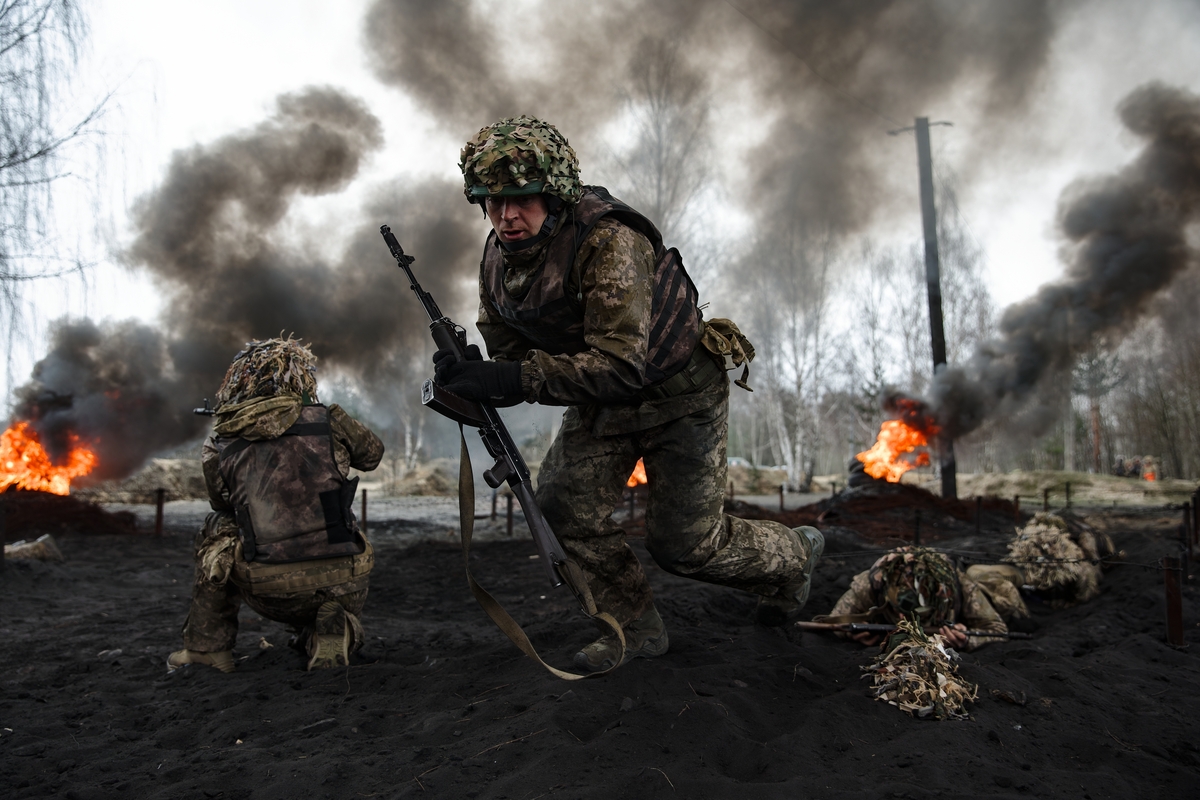
Post-traumatic stress disorder (PTSD) has been known since the Korean and Vietnam wars. These problems can also be expected among the people who will be coming here. We do not know how Ukraine will be able to employ and care for these people according to their expectations. The idea of "I fought for Europe, so take care of me" is understandable from the perspective of a Ukrainian soldier, but perhaps not so understandable to the national majority, which will not accept major exceptions in the long term.
We have seen how society reacted to non-payment of taxes, parking fees, health care, and social care. This may also affect the internal security of the state if their requirements and expectations are not properly set. It may happen that some of them will go down the "wrong path" and become involved in the criminal activities of Russian-speaking mafias, which we have here and have always had in relatively large numbers. That is another risk.
Last but not least, after the war in Ukraine, there will be a lot of weapons left behind. It is not a problem if one submachine gun and three pistols end up here. The problem would be if sophisticated weapon systems began to disappear from Ukraine in an organized manner, which could then turn up somewhere in Syria, Iran, or anywhere else, as we saw, for example, after the wars in Yugoslavia.
In one of our previous interviews, we talked about the fact that the need for Ukrainians to return to their country is somewhere around three million people. That is not a small number.
On the other hand, let's be honest: initially, there was a lot of discontent and criticism of social benefits for Ukrainian families who settled here. Yes, let's say so. But the vast majority of them are now employed, filling a gap in the labor market in jobs that the Czech population is not particularly interested in. Many wives, mothers, and daughters have started their own businesses, pay taxes, and contribute to the Czech economy. I believe that we should want some Ukrainians to stay here, even though Ukraine will naturally call them back home. The question is to what extent we will be able to influence this. We probably don't want any problems, but if there are people here who are educated, hard-working, have been here for three or four years, have established families, children who go to school, speak Czech, and are generally accepted, then I think it could bring us many benefits if some of the Ukrainians stayed here.
Almost every meeting of the Defense Committee included a closed session, where the current situation and other threats were discussed. What else does Military Intelligence monitor?
Essentially, we do not only monitor military threats, but all threats and risks related to national defense or state defense. It is not just about military intelligence services; we also deal with civilian ones if their activities enter the realm of national defense. In addition to immediate threats, this is standard espionage. Foreign intelligence services that act against the interests of the Czech Republic often do so with different goals and by different means, but they always act against the interests of the Czech Republic. Furthermore, there are activities in cyberspace that are partly conducted with the aim of obtaining espionage, industrial, or technical information, i.e., to acquire technology or know-how. This is, for example, the main part of North Korea's campaign against the Czech Republic. Military intelligence as such does not have direct jurisdiction over organized crime or activities directed against the democratic foundations, sovereignty, and territorial integrity of the state; this is primarily the domain of our colleagues from the BIS. However, based on a government decree, we, like our colleagues, are also responsible for activities of terrorists and extremists targeting not only the Ministry of Defense, but the Czech Republic in general. We work very closely together in this area. And then there is the area we call information protection within the Ministry of Defense or information issued or owned by the Ministry of Defense. Even if we pass on information to someone, we should check and monitor whether the recipient, for example another ministry, is handling it properly so that there is no leak. Then there is the area we call defense capability. This is basically any activity that could threaten the defense capability of the state. This ranges from the combat readiness of equipment, through the training of soldiers and the strength of units, to other factors that could ultimately lead to the army being unable to fulfill its tasks. We do not judge motives, we just gather information and report: something is not right somewhere, it is wrong and could ultimately threaten the defense of the Czech Republic.
That caught my attention. Where is the line or balance between the military being transparent and telling us how things are, and at the same time not risking exposing our weaknesses?
Since the beginning of my professional career, I have been a counterintelligence officer, so I view this from a very strict and specific perspective. I maintain that we should keep secret what we can keep secret, because that is how it should be. We should not talk publicly about weaknesses and draw attention to them. I fully understand and do not question the oversight, whether constitutional or otherwise, of the services. Nor do I question that the public and taxpayers have a right to be informed about how their money is being spent. On the other hand, I do not consider it fortunate to have large discussions in public forums and in the media about what works and what does not work, what we have and what we do not have. Okay, at the moment we are not the primary target of any adversary. But when we become such a target, it can complicate our situation greatly.
Is there another country besides Russia and China that is responsible for cyber attacks?
Yes, North Korea. It's very widespread there. Not only are a large number of people involved in it, but they also earn money from it. It's technical and industrial espionage, not just military espionage. Everything that can be obtained somewhere, how things are manufactured, what is manufactured, what is not manufactured, is organized by the state in order to help themselves economically and raise their status. There is one more thing about North Korea that worries us: there have been many reports, true or false, about how Korea is participating in the war in Ukraine on Russia's side. And we have long been asking ourselves what it gets in return. Clearly, it is gaining knowledge about modern warfare. Korea last fought in the Korean War in the 1950s, so since then it has not had any serious conflict in which it could test how it works. We are also concerned about the proliferation or leakage of special technologies. We are concerned that one of the "payments" for helping Russia could be the release of specific military or technical technologies and knowledge, for example in relation to the nuclear program or other programs.
Let's move on to artificial intelligence, which is a hot topic these days. Military intelligence works with artificial intelligence. Can you reveal to what extent or in what areas of your work?
I will try to explain in general terms what we use it for. I won't go into all the details, but basically it is a huge help in the field of big data. There is an enormous amount of information out there, and it is no longer possible to sift through it, sort it, organize it, and analyze it using human resources alone. Just take open sources, for example. There are thousands and thousands of pages and pieces of information in the media. You can find a huge amount of information on just one specific topic. If analysts had to read it all, they wouldn't finish by the next day, and by the next day it would already be out of date. This is where artificial intelligence helps us a lot. I recently visited a workplace that uses it, and when you see it live, it's really impressive. Another area, as is well known, is our satellite center, where we are the national authority for image reporting. There, too, the analysis and evaluation of images, their pre-selection and comparison can be automated by artificial intelligence. But in the end, there is always a person with a brain and cognitive abilities who checks to see if the AI has made a mistake.
You mentioned the BIS. Another agency that seems very similar to Military Intelligence is NÚKIB. Are there any areas where you overlap or even cooperate?
Although I am not a technical expert, I am convinced that cooperation between VZ and NÚKIB is very close and frequent. Our competences differ. NÚKIB is responsible for coordinating and setting security levels for state and non-state actors, i.e., private companies and state institutions, and for monitoring security standards in the field of cybersecurity. We do not have such a role. We understand our so-called cyber defense to mean that we are here to identify threats or attackers, analyze them, and then, if it is in fact permitted by law, take active measures, i.e., "eliminate" the threat with cyber countermeasures. Our colleagues from NÚKIB and our specialists meet very often, basically on a weekly basis. If a security incident occurs, NÚKIB usually calls not only us, but also special police units or BIS. We are heavily involved in analysis, forensic investigation, and the formulation of proposed measures. It is mutually beneficial. We learn from each other, and everyone has their own "testing ground" where they try out new things. In general, Czech security forces cooperate very intensively in the field of cybersecurity.
When I ask you about cooperation between Military Intelligence and the Czech Army, is it comprehensive, or are there certain areas that you focus on more?
I would say that there are not many branches of the military that do not cooperate with us, or we with them. The basis is that the military as such receives information support from Military Intelligence. At the moment, we give them about three to four briefings or presentations a week. As soon as they request an analysis or specific information, a system of requests and responses comes into play – and this runs in a standard manner. Defense attachés, who are part of Military Intelligence, work significantly to the benefit of the army. Military Intelligence is responsible for the so-called intelligence protection of the army, both in peacetime on the territory of the Czech Republic and during foreign operations or in times of war. Of course, this is not always met with a positive response, because when something happens, Military Intelligence is "to blame."
In this sense, caring for the army begins with the initial selection process. When a candidate goes to Vyškov for basic training, they undergo screening beforehand to identify individuals with serious problems – drugs, criminal activity, and the like. We only make recommendations; we do not make decisions. Military Intelligence no longer has the stamp of "security objection"; we simply inform the relevant authorities of our findings, and the decision is up to them.
In foreign operations, members of Military Intelligence are part of both counterintelligence and other units and support them. Our teams in Afghanistan received very positive feedback, where they were able to identify booby traps in real time, and I believe they saved the lives of several of our soldiers.
We also make sure that our soldiers are not the target of espionage or other activities. And today, in connection with Ukraine, we are obtaining training materials, instructional materials, technical documents, military regulations, military equipment, downed drones for research, and more for the army. This is also part of the work of Military Intelligence. We support the army with satellite images, and I believe that today there is no branch of the army that is not in contact with us in some way.
How important is the first military satellite, Saturnin 1, for Military Intelligence?
Saturnin is tiny, as you have probably seen. It measures approximately 30 × 25 × 25 centimeters, and when its solar panels are extended, it has a wingspan of 90 centimeters. However, its enormous contribution is not that it provides high-end quality images; such a "box" cannot replace large satellites. The key thing is that we managed to go through the entire process. From the conception and technical implementation of the satellite, through passing all the very demanding tests for operation in space, to its launch and commissioning. And it works: it responds and sends images. Although it is tiny, it is a huge experience and success for us. It is the first step, but definitely not the last.
Will there be more satellites?
This will not be the last step. We have learned from something small and will want to continue with projects that will significantly expand our capacities.
Do you have ambitions to develop this new system within NATO as well?
I must say that I am very proud of my colleagues, because only a few very rich and large countries have this capability. We are gradually joining them and are highly respected in the community, not because of one small "box," but thanks to something that has been built up over a very long time and is our family silver: analysts. Learning to recognize changes in the terrain from a picture taken from several hundred or thousand kilometers away, finding something that might mean something. It's not just about seeing a tank track. It's about noticing a strange dune that doesn't follow the wind, something that wasn't there a month ago, a strange shadow... They are perfect at this. The entire alliance recognizes them for this.
How long does it take to train such an employee?
We train the best ones we have for five to eight years. It's not just training here, but also courses abroad. And then there's something I call the "Czech factor," which we often present as our advantage, although sometimes I think it's the result of imperfect planning. They don't follow the manual. They don't have a manual that says, "When you see this spot, it means this." They look, try things out, communicate with each other, think about what's in the picture, what kind of space it is, how it was used, what was there, what the history of the place is. They look for connections. Incidentally, the results of their work can also be seen in our calendar from last year. Some of the images are less "sexy," while others are very impressive. Just identifying 60 to 80 Iranian launchers, finding out which ones are full and why, is a skill that Czechs have.
I must say that you are joining a group of guests who say that the ability to improvise is more of an advantage for Czech soldiers within the alliance forces than a violation of established procedures.
Sometimes, unfortunately, I wonder if it's because we're not very good at planning. If we planned ahead and knew we would need a certain number of components or spare parts where they were needed, we wouldn't have to "make them up as we go along." But the art of improvisation and a healthy dose of risk-taking are excellent things.
What missions is Military Intelligence involved in? Whether in the Balkans or on NATO's eastern flank. I assume you are very active there.
History has moved on, and today we are no longer in Afghanistan, where we were for many years, where we learned a lot and, unfortunately, suffered several losses. Subsequently, specific units were moved to Mauritania and Kenya, for example, but these are significantly smaller contingents than those that were once in Afghanistan, Kosovo, or Bosnia. We still have a police unit and several officers at headquarters in Kosovo, but it is no longer as significant a presence as it was during the time of the Czechoslovak mechanized battalion. The focus has shifted to NATO's eastern flank, where our presence is very significant given the size of the Czech Republic. The results of our teams are rated as very good here, and our alliance partners view them very positively.
We are talking about people—even in military intelligence, people are the foundation. If someone is interested in working for military intelligence, what do they have to do? Do they have to join the military?
Members of Military Intelligence are, by law, either professional soldiers or civilian employees. However, civilian employees can only perform certain specific tasks and are not allowed to perform others. If anyone is interested in becoming a member of Military Intelligence, the easiest way is to visit our website, where basic information is available. I recommend reading the law. It is written in legal language, but if you are intelligent enough (and that is what we are looking for), you will be able to deduce a lot from it. They can then contact us, and someone from the personnel department will get back to them shortly. They will explain the options, conditions of service, possible complications, what needs to be sacrificed or changed, and what career progression looks like. For me, if Military Intelligence had offered 24 years ago, when I joined, what it offers today, I would not have hesitated for a moment. We don't just offer a salary, which isn't always the main thing, but career growth, education, comfortable service, and prospects for service abroad, both in missions and in diplomacy or at foreign workplaces. I think that if someone is a patriot and is interested in joining those who protect and defend this country, they won't regret it.
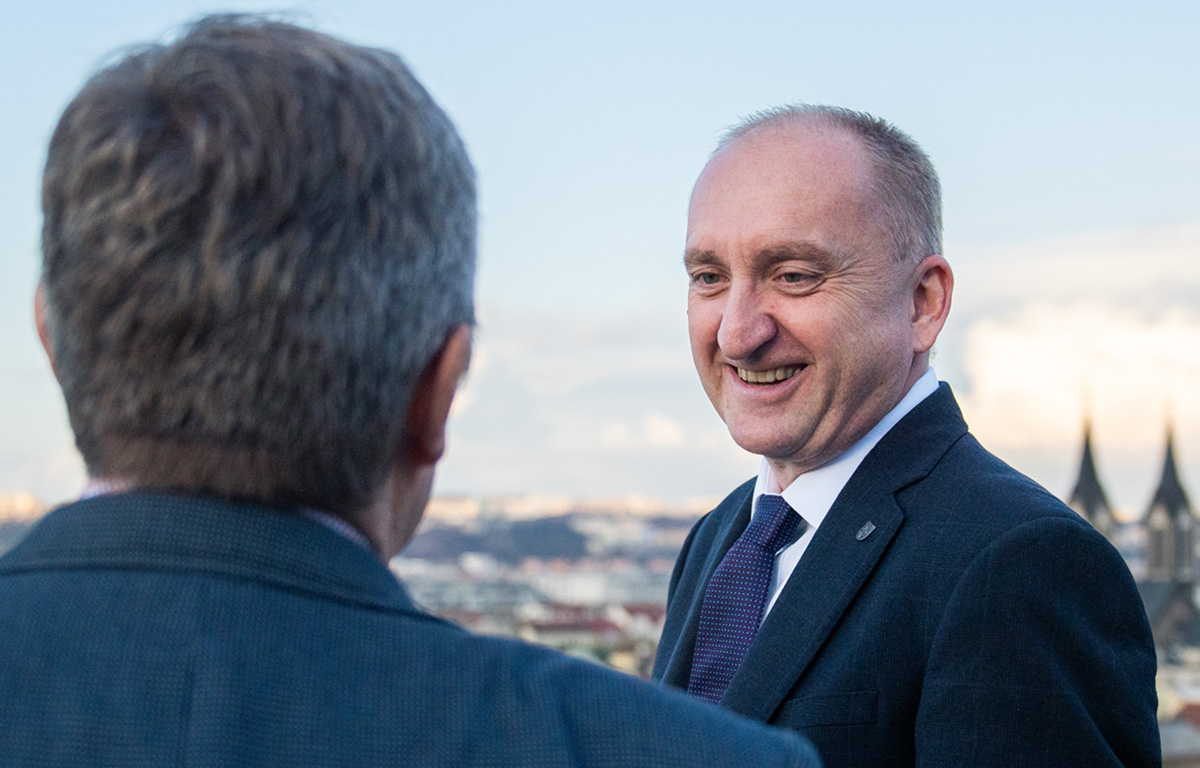
You mentioned your 24 years with Military Intelligence. You were recently awarded the rank of lieutenant general at Prague Castle. What did that mean to you?
I don't come from a military family, but I consider myself a soldier. I wanted to be one even in elementary school. In high school, I wanted to enroll in the Jan Žižka Military High School, but my father forbade me, and today I thank him for that. He said, "First, get your high school diploma like a decent person." It was 1990, and then he added, "And then do whatever you want." I graduated from a secondary industrial school specializing in chemistry and then enrolled in Vyškov. I completed my bachelor's degree, then I had to join the military, and only then did I complete my master's degree. I finished sometime in 1994 and joined units in Liberec, Mariánské Lázně, Olomouc, and elsewhere. In Olomouc in 2000, I received an offer to take the entrance exam for what was then Military Defense Intelligence, which I joined in 2001. I went through all the operational and management positions in counterintelligence. When I graduated from school as a second lieutenant, I said to myself, "If I were a captain one day, that would be awesome." When I was a captain, I said to myself, "Lieutenant colonel, that would be great." I couldn't even imagine being a colonel. Suddenly, it was May 8, 2022, and I was appointed to my first general rank and now to the highest possible rank in Military Intelligence. I would be lying if I said I wasn't proud of it. I am a soldier, and any soldier who says he doesn't want to be promoted is either lying or a bad soldier. On the other hand, it's about the humility that comes with the rank and especially with the position of director. It's a very complex job. I appreciate it very much, I accept it with humility, and I try to give something back—I've changed some things, and there are still some things I'd like to change. I hope my colleagues see this as positive rather than negative.
Related