
















Warrant Officer Kateřina Votrubová: Dental hygiene is a soldier's operational capability
Toothache can knock a soldier out of action just as reliably as an injured ankle. Warrant Officer Kateřina Votrubová, the only dental hygienist in the Czech Army, explains why oral care is an integral part of combat readiness, what silent threats lurk in the periodontium, and why systematic prevention saves not only the health of soldiers but also millions of crowns in public funds.
Video: Interview with Czech Army dental hygienist Warrant Officer Kateřina Votrubová / CZ DEFENCE
At first glance, dental hygiene may seem like a marginal part of healthcare. However, in the armed forces, it has a very specific impact on operational readiness. "Dental hygiene is an operational capability for soldiers because it directly prevents pain. And pain is what can affect them in the subsequent performance of their service or operational duties," says Warrant Officer Kateřina Votrubová. Sudden health problems caused by pain in the oral cavity are among the factors that can take a soldier out of action at the least opportune moment.

The oral cavity seems inconspicuous. "It may seem that it does not play such a big role, but as research, especially foreign research, shows, its importance is quite significant," Votrubová points out. The main problem is inflammatory diseases that remain hidden for a long time. In her experience, soldiers most often suffer from gum and periodontal inflammation. "It's not that soldiers underestimate this issue. These problems come on quietly and inconspicuously. That's why it's important to make room for visits to the dental hygienist and catch these findings in time," she explains.
Another common problem is tooth decay, especially under fillings. "Soldiers in the Czech Army regularly visit the dentist, but these problems are again inconspicuous and silent. They can then lead to dramatic situations," she adds. In an army environment, where performance is under pressure and stress, such a problem can manifest itself very quickly.
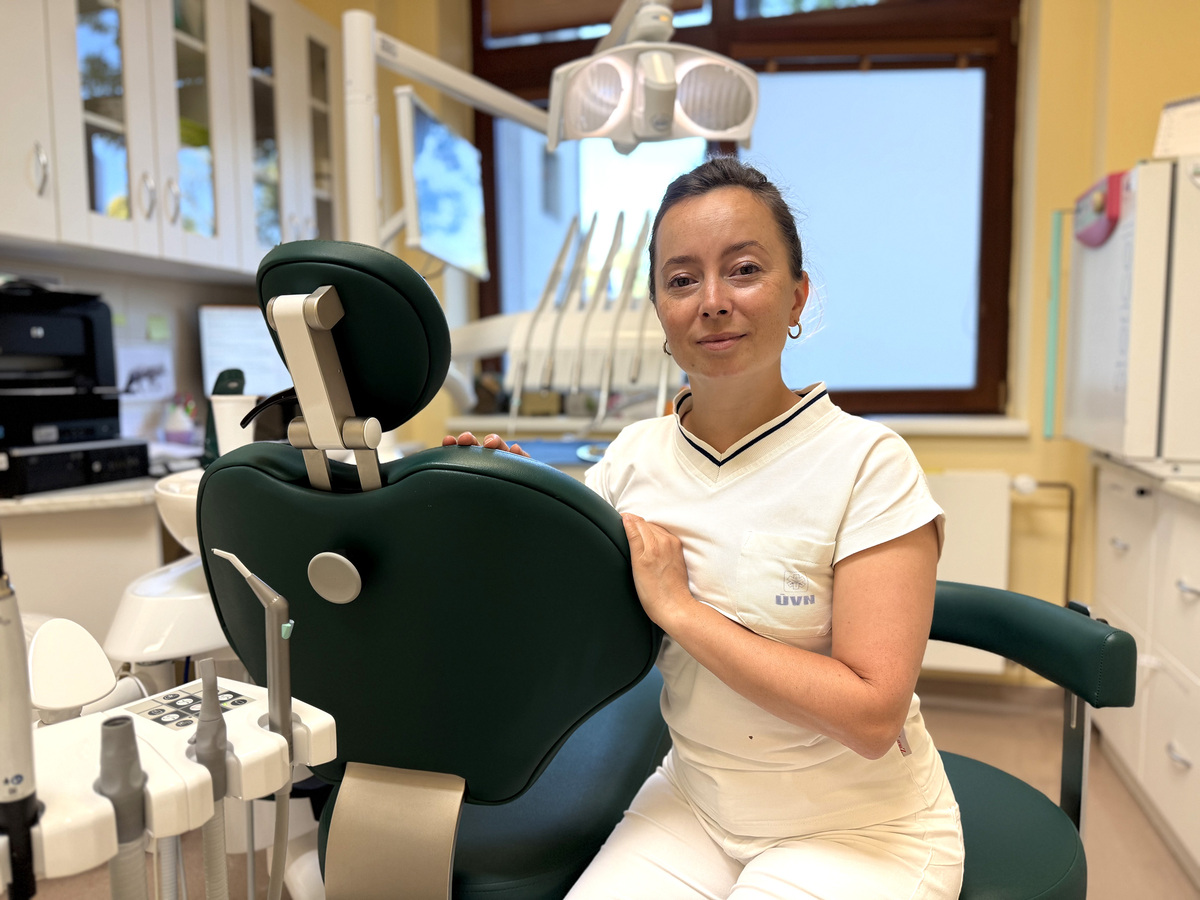
Ensign Votrubová is a certified dental hygiene specialist with many years of clinical experience in dentistry, dental surgery, and implantology. Since 2017, she has been working at the Central Military Hospital – Military University Hospital in Prague, where she focuses on soft tissue diseases of the oral cavity, periodontology, oncological diseases of the oral cavity, and temporomandibular joint problems. "I worked at the Central Military Hospital for a long time and then I got a rare opportunity to join my colleagues in active military service. I try to hold on to it and do my best," she describes her path to the uniform.
According to her, physical strength is important for a soldier, but it is not the only parameter. "In my experience, mental resilience is even more important. It often plays a greater role than physical strength itself," she states. Mental stress, stress, and long-term performance are among the triggers of inflammatory processes in the oral cavity.
Warrant Officer Votrubová sees a fundamental difference between the civilian and military spheres in their approach to prevention. "Professional soldiers tend to accelerate prevention as a whole. My goal is to make dental hygiene a systematic part of the preventive system," she says. In the civilian environment, dental hygiene is often perceived as a luxury. "That's one of the biggest myths. It's not a VIP service, but a professional tool that allows us to find sources of complications. These may not be life-threatening, but they can be a complication for combat and for the reliability of the unit," she emphasizes.
Dental hygiene is an integral part of the system at the Central Military Hospital. "I am fortunate to have great colleagues and a great team. We are able to provide comprehensive assistance to soldiers through multidisciplinary cooperation," he describes. Cooperation with dentists, general practitioners, ENT specialists, and other disciplines allows oral problems to be placed in a broader whole-body context. "It's not just about teeth. Inflammatory foci in the oral cavity can be related to cardiovascular disease, diabetes, or other systemic problems," she points out.
The importance of dental hygiene is also confirmed by experiences from abroad. "The armies of Great Britain, the United States, Israel, and Scandinavian countries have long-established dental hygiene in their systems," says Votrubová. In the United Kingdom, for example, regular dental hygiene is a mandatory part of soldier care, while in Israel, it begins with recruits in basic training. "It's not just about examinations, but also about teaching good habits," she adds.
According to her, the primary risk is not individual foods, but an imbalance of microflora in the oral cavity. "We need bacteria there, but there must be a balance. It's like in the army," she compares. Stress, physical exertion, and long-term performance are factors that can disrupt this balance. "Inflammatory lesions are silent and often painless. But then extreme stress comes along and the problem manifests itself fully," she describes from her own training experience.
Dental hygiene has its place even in field conditions. "There are recommendations and concepts such as Dental Fitness. Sometimes all you need is a toothbrush and a few minutes," she says. According to her, prevention in the field is simple but essential. "It may sound bizarre to talk about a toothbrush in combat, but the goal is to prevent complications that could take a soldier out of action," she adds. The warning signs are often subtle. Bleeding gums, bad breath, headaches, jaw or ear pain. "The symptoms come on very quietly. That's why I place such emphasis on prevention," she explains. Another widespread myth is the fear of fluoride. "Allergy to fluoride is extremely rare, yet its contribution to enamel protection is essential," she states. In the military environment, prevention also has a significant economic dimension. "Repatriating a soldier from a foreign operation costs millions of crowns. Regular dental hygiene costs a fraction of that amount," Votrubová points out. According to her, systematic prevention is therefore not only a health investment, but also a strategic one.

Since 2022, she has been the initiator of the "Dental Hygiene in the Czech Armed Forces" project and the founder of the "Mission and Oral Microbiology in Czech Armed Forces Soldiers" program, which focus on prevention and supporting the health of armed forces personnel. "It would be great if dental hygiene became an integral part of preventive programs. This is the way to help soldiers maintain their combat readiness," she says. In the future, she would like to see dental hygiene as a respected and firmly established part of the Czech Armed Forces' healthcare system. "I don't have the rank of general or a high position from which I could make systemic decisions. But if we manage to create a solid foundation to build on, it will be a huge step forward," concludes Warrant Officer Kateřina Votrubová.
If you want to learn more, listen to the entire interview at the beginning of this article.