














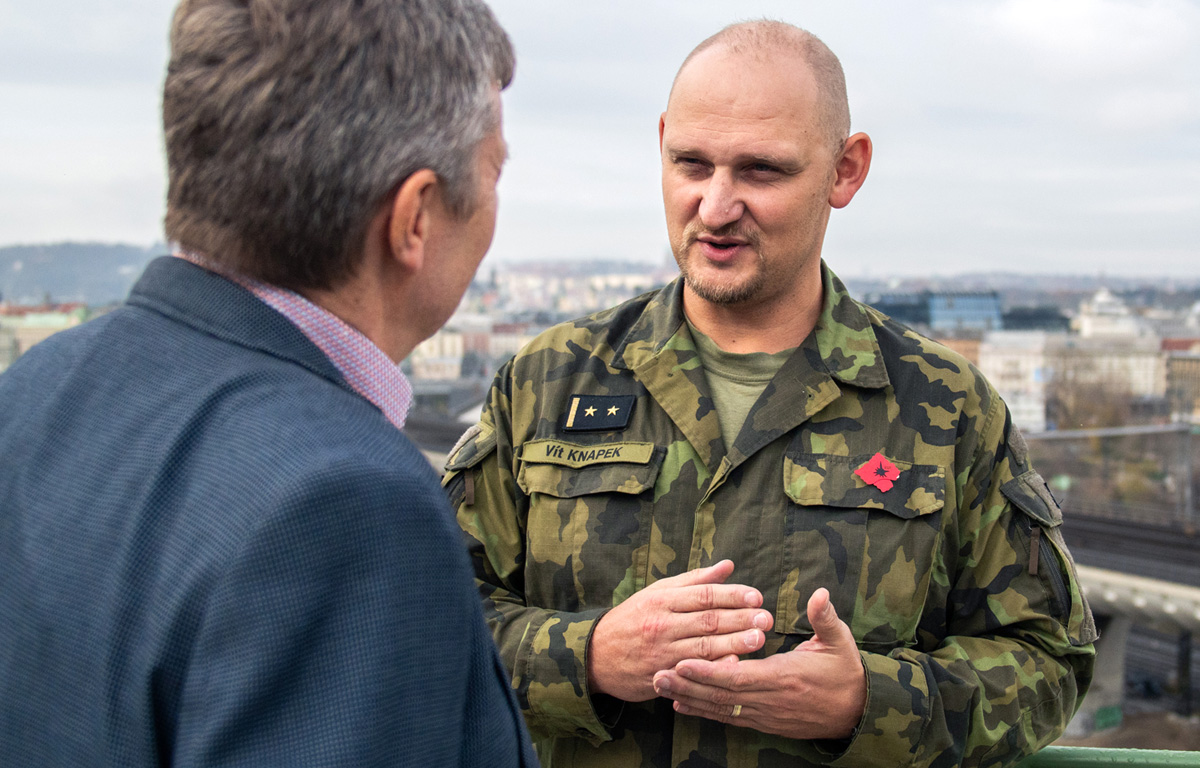
Lt. Col. Vít Knapek: I hope we will succeed in reincarnating field postal connections using drones
The Center for Deployable Systems and Command and Control Technology Development ensures that the Czech Army has reliable and secure communications from soldiers in the field to strategic headquarters. Today, the army is able to transmit robust data across various layers of communication, from tactical radio networks to satellites, while ensuring that new technologies fit into a unified architecture and are cyber secure. In the coming years, the army will face the task of "digitizing its thinking" and learning to make full use of robotic systems, 5G networks, and artificial intelligence. We discussed this and more with Lieutenant Colonel Vít Knapek, commander of the Deployable Systems Center.
Video: Interview with Lt. Col. Vít Knapek, Commander of the Deployable Systems Center / CZ DEFENCE
Lieutenant Colonel Knapek describes the task of his center as follows: "The center provides communication and information support for operational, tactical, and strategic command posts. It secures the transmission environment for various types of systems and different levels of command." As technical as this sentence may sound, it is in fact the essence of a modern army. Today, loss of communication does not just mean discomfort, but a collapse in the ability to coordinate units, share information, manage operations, and make decisions at the right time. Loss of communication means blindness, and in the age of the digital battlefield, this is doubly true.

In addition to operating existing capacities, the center is also responsible for their future. "We are also responsible for the development of command and control systems. This means that we not only maintain current capacities, but also monitor what is happening in the world and bring it to the army," says Knapek. This dual role—operational and developmental—is crucial. It is not just a matter of maintaining the functionality of current systems, but of actively preparing for what rapid technological development brings: from 5G and 6G networks, through robotic systems, to the advent of artificial intelligence and the threat of quantum cryptography. The modern battlefield relies primarily on the flow of information. Sensors without a connection provide no information, units without a connection do not know what is happening, and commanders without a connection cannot respond. "The backbone connection resources we have have transmission speeds of around 400 megabits per second, which is a robust connection for the level at which we operate," says Knapek. Transmission capacity is particularly necessary given the data demands of modern systems—video from drones, image data, telemetry transmission, sharing of maps and tactical overviews, and communication flows between vehicles and robotic assets. Different levels of the battlefield require different transmission speeds, and diversification of connections is key here.
But speed isn't everything. Above all, you can't rely on a single technology. "We use satellite connections, radio connections, various data lines. Each has its limitations. That's why I say that in a modern environment, communication cannot rely on a single type of connection. Technology needs to be layered," emphasizes the commander of the Deployable Systems Center, who believes that today's environment is so dynamic that no technology is 100% reliable, and robustness comes from combination. "Nowadays, it's complicated. You have to layer radio networks at different frequencies, radio relay links, 5G networks, military and commercial satellites. It's a set of connections that enables different types of data transmission. Sometimes larger, sometimes smaller," says Knapek.
Users often do not realize that modern transmission means are not isolated but form an ecosystem. As soon as one layer fails, another must take over its load. In times of electromagnetic warfare, this is an absolute necessity.
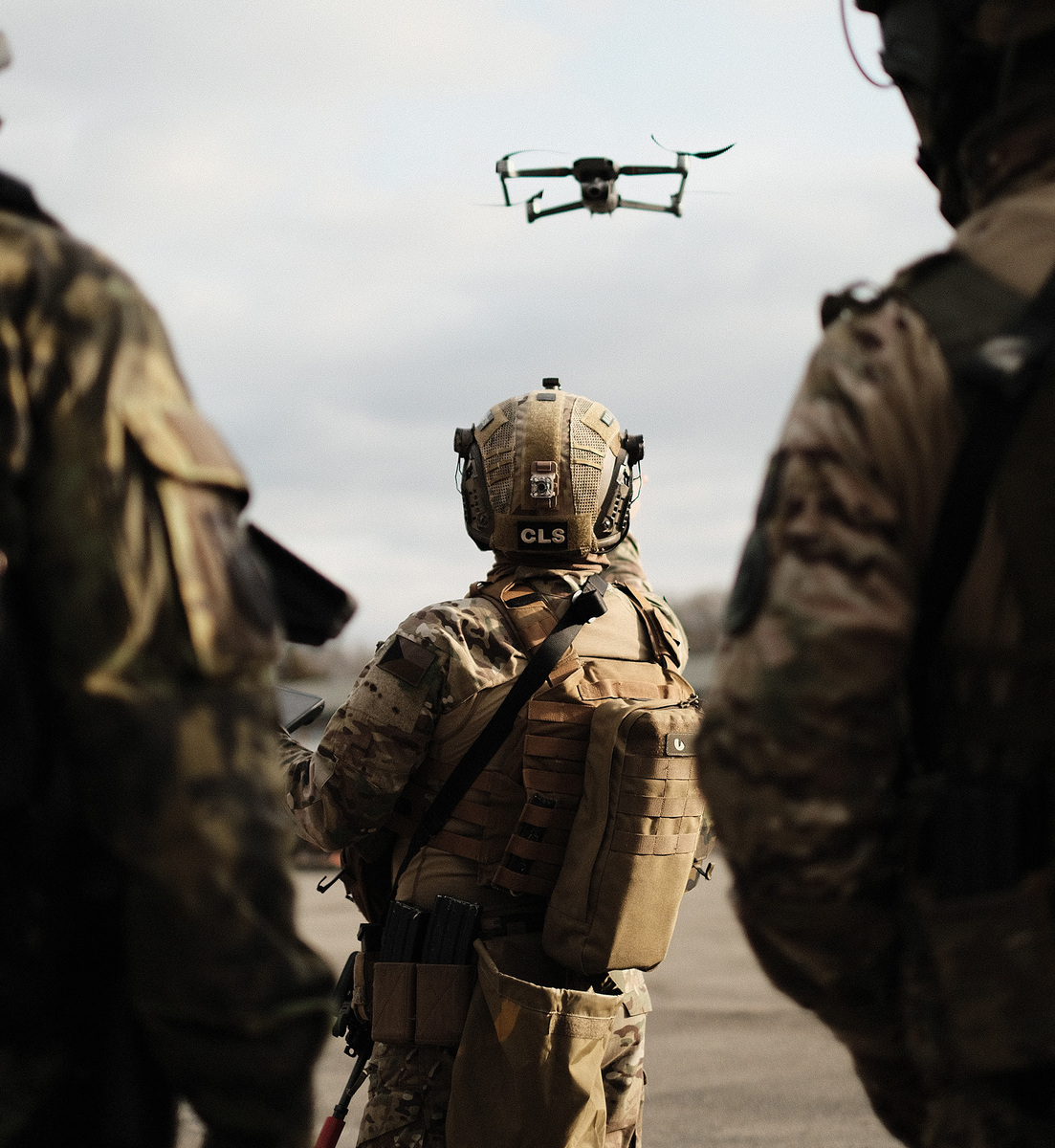
In the event of a failure, which Knapek says must be taken into account, there are still methods that older generations of military signalers remember. "When there is no data or lines, field postal connections come into play. We start the couriers," says Lieutenant Colonel Knapek with a smile. However, according to him, this "backup" method may take on a modern form in the future: "I hope we will be able to reincarnate field postal connections using drones. They could carry larger volumes of data from the battlefield. Once robotic systems are introduced, this will be necessary. No conventional lines will be able to carry such volumes of data." Among other things, the Deployable Systems Center continues to practice data transfer procedures using couriers. "We continue to use proven procedures, but we are modernizing them and bringing them closer to the digital age," says Knapek. This combination of old and new ensures that the army can function even in conditions where a purely digital army would fail.
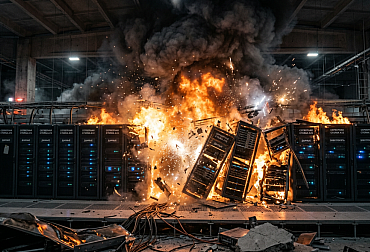
Cyber security is just as important today as physical security. "Nowadays, it's mainly about encrypting communications," emphasizes Lieutenant Colonel Knapek, adding that the advent of artificial intelligence and quantum computers will significantly complicate encryption security. Quantum ciphers will thus become increasingly demanding, and it will be very important to keep pace with this technology. It is already necessary to consider whether communications are secure not only against current adversaries, but also against future ones.
Regarding the frequency of cipher changes, which is a sensitive topic, Knapek comments in general terms as follows: "It depends on the level of security for which the system is designed. Where the possibility of a breach is expected, the change intervals are more frequent. Elsewhere, the mechanism is different." In the military environment, there are multiple levels of communication, each of which is protected in a different way and with different dynamics.
The center works closely with the Ministry of Defense's Communications and Information Systems Section and the Communications and Information Systems Agency (AKIS), which are responsible for the compatibility and interoperability of new technology purchases. "These are resources that will use C4ISTAR or C5ISTAR technology. And we act as an expert guarantor that these technologies comply with the concept of the tactical radio communication system and are in line with the strategy of defense development informatization and the concept of departmental informatization," says Lt. Col. Knapek, according to whom a unified architecture is not an abstract requirement but a necessary condition for survival on the modern battlefield. "We have precisely defined what L3 Harris equipment is used for, what MILSATCOM technology is used for, and what technological or sensory channels are used for. Our task is to ensure that there is a unified architecture that will be adhered to in all equipment. This will ensure that we are compatible and interoperable with our NATO allies on the battlefield."
Individual technologies are then evaluated not by brand, but by whether they actually work and what capabilities they bring to soldiers. "For example, if we have four different software programs from four different manufacturers, we assess whether they can be installed on our operating systems, what the level of security, administration, user interface, and many other parameters are that result from the established architecture. This is a completely independent assessment by a group of army specialists focused on the development of command and control system technologies," says Knapek.
In terms of information transfer, modern combat vehicles are mobile network nodes. "The vehicles consist of five basic components: an integration platform, a communication system, ICT resources, an intercom, and navigation. These are precisely defined components that must be adhered to in order for the vehicle to fit into the army's communication system," says the commander of the Deployable Systems Center. Without them, the vehicle would not be able to share battlefield images, report its status, provide information to the commander, or receive instructions.
One of the key areas currently being tested by the center is 5G networks. "We are just getting started, but General Šnajdárek has issued instructions to test aggressively. We have conducted two tests of 5G networks with O2 – not only for dismounted soldiers, but also for robotic systems," says Knapek, adding that this is a logical step towards a digitized battlefield: "5G and 6G will be the basis of the military Internet of Things. They will enable the robust deployment of technologies on the battlefield." Although this network will be purely military, in the event of a crisis it will enable support for, for example, the integrated rescue system. "We could also create mobile cells to provide connectivity to the civilian population in times of crisis," says Knapek.
However, the army faces one significant problem in relation to technological trends. "The army is undergoing massive digitization. In the next three to five years, there will be a significant change in thinking. However, we are encountering human capacity issues. There is a shortage of experts, and the commercial sector is able to pay them better," Knapek points out, but he believes that the army has something to offer these people: "It's a specific job, defined by the team and the purpose. You have to be a little crazy to do it, but then it makes a lot of sense."
Cooperation with the academic sphere also plays a key role at the center. "We work directly with the University of Defense, but also with the Technical University in Liberec and the Czech Technical University in Prague. This helps us especially in academic activities and in research into new technologies, quantum technologies, communications, robotics, and artificial intelligence," says Knapek.
The experience from Ukraine is also very important. "Ukraine has made tremendous progress, especially in robotics and unmanned systems. At the beginning of the war, we helped them, but today they are able to pass on their experience to us. We should draw as much information as possible from them, especially in the areas of unmanned systems and robotics," notes Lieutenant Colonel.
Robotics is an area that the commander of the Deployable Systems Center talks about with the greatest urgency. According to him, the army must proceed realistically, step by step. "It's very sexy to talk about robotic systems with machine guns. But the basis of the unit is still the human being. Soldiers must trust the technology," says Knapek. According to him, the first step must be taken in logistics, where robotics has proven itself in the civilian sector: "We will introduce systems for transporting ammunition, evacuating the wounded, or supporting units. People need to see that it helps them. Only then does it make sense to introduce more advanced systems."
Robotics will also be a necessity due to the fact that the army will never have as many people as it ideally needs. "The army will never have a growing number of soldiers. We will have to replace some capacities with robotic systems. One person can control, say, thirty robots," calculates Lt. Col. Knapek.
The advent of robotics and digitization will not be possible without fundamental advances in artificial intelligence (AI). "We use Microsoft's Copilot. It's a good start to learning how to work with AI in normal mode. Then we can talk about using AI in weapon systems," reveals Knapek, citing a practical example of the direct impact of AI on cooperation with allies: "When we fight alongside the Swedes or Finns, they will speak their own language on the radio. However, AI can translate the communication into Czech and send it back. The idea that everyone will speak perfect English is unrealistic."
However, technological transformation also affects the command system itself. "The command and control system is based on processes and roles. These will not change, but will be supplemented by additional processes and roles, or modified. We can only increase efficiency and effectiveness. But we must be careful. We should make changes based on analysis. What we have, what we don't have, what we need." According to Knapek, it is not possible to change the system without a deep understanding of what really works and what does not.
In order to implement new technologies as effectively as possible, two national polygons are currently being created. "We lacked a place where we could test the technology in real life. That is why we are building the National Test Range for Unmanned Ground Vehicles (NATEP UGV), where we will test various platforms on precisely defined obstacles, and the National Technology Test Range (NATEP AČR), where we will test the architectural elements of the tactical radio communication system," reveals Knapek. Thanks to these polygons, it will be possible to fine-tune new technologies before they reach the army's arsenal and prepare their integration into vehicles and systems.
Modern technological systems also need adequate support, which Knapek compares to a car: "You can leave it standing in the rain, and it will survive. But if you have a garage, it will last longer without repairs." The same principle applies to technological systems—the right support extends their service life.
We were interested in what specific systems the commander of the Deployable Systems Center would like to see introduced in the army as soon as possible: "Definitely robotic systems for logistics. The sooner we start introducing them, the sooner we will get people who want to work with them." According to Knapek, the second pillar is the modernization of command posts: "The command posts in the tents we use are clearly unsuitable, and the current situation in Ukraine only confirms this. Mobility, ballistic resistance, and energy independence are the future. I hope we will build the army on digital thinking and the digital world."
However, according to Lt. Col. Knapek, technology alone is not a panacea. It is only important if people know how to use it safely, if it is implemented correctly, and if it is embedded in a system that is capable of using it effectively. The Deployable Systems Center is therefore not just a technical unit, but one of the key elements of the army's transformation. In many ways, it is this center that translates the language of technological innovation into practice and ensures that the army keeps pace with current and future trends.
Related