














Recruitment Is Rising, but Departures Continue: Personnel Challenges Facing the Czech Armed Forces
When the Russian Federation annexed Crimea in 2014, the Czech professional army had a strength of just 21,000 soldiers. This was the result of a long era of budget cuts, but also of the political conviction prevalent in the 2000s that a major conventional conflict in Europe was highly unlikely. The annexation of Crimea led to a reassessment of this view and also to the recognition of the need to strengthen the armed forces in terms of both equipment and personnel. Currently, the goal is to increase the number of professional soldiers to 30,000 and active reserve personnel to 10,000 by 2030.
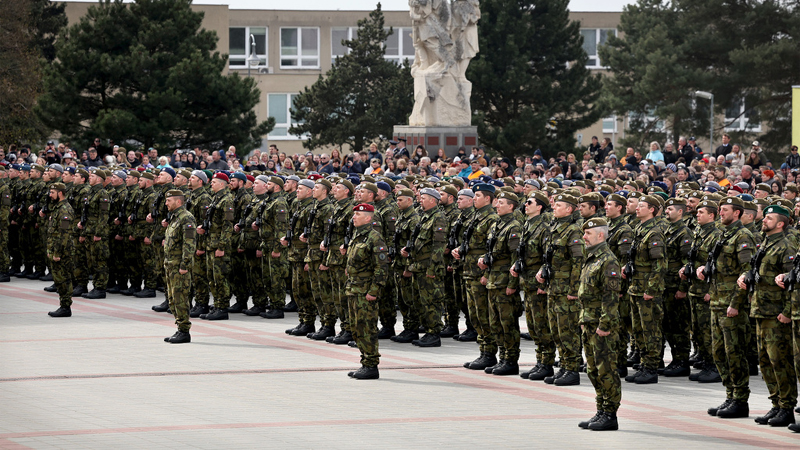
Based on data from this year and last year, it appears that meeting this goal will not be a problem for professional soldiers. At the start of 2025, the army had more than 28,000 soldiers and was looking at an exceptionally successful year, with 2,396 people joining the ranks. This exceeded the recruitment target of 2,100 and marked the highest number of new recruits since 2004, when mandatory military service was suspended. This year is expected to be even better – the quota of 2,250 new recruits per year is already 86 percent fulfilled. Defense Minister Jaromír Zůna announced that recruitment will continue even after the quota is met.
More money, fewer obstacles
This positive trend is primarily linked to improved financial conditions for soldiers. The lowest salary currently stands at 40,000 crowns net, and over the past two years, pay scales for soldiers ranging in rank from private to staff sergeant have increased by 15 percent. For new recruits in particular, a recruitment bonus of up to 450,000 crowns can be a motivating factor. Rising unemployment and layoffs in industry are also helping the military, which is perceived as a stable employer.

The Czech Armed Forces are also working to remove certain barriers that made recruitment a lengthy process and prevented the acceptance of some applicants. In addition to technical changes, such as an emphasis on digitizing the recruitment process, this also means lowering physical fitness and health requirements. These decisions are justified not only by the need to increase the number of professional soldiers but also by a general decline in the population’s physical condition, to which the army must respond. Furthermore, certain physical limitations do not pose an obstacle in many positions.
The military's growth is being hampered by departures
Despite the optimistic figures, it remains to be seen whether these results will be sufficient for the army. An important factor is not only how many soldiers join the army, but also the number of those who decide to leave. In recent years, departures have been just as record-breaking as recruitments; last year alone, 1,325 people left for civilian life. The net increase was thus 1,071 people; in 2024, it was only slightly more than 300.
According to Chief of the General Staff Karel Řehka, however, even more than a thousand new soldiers a year is not enough; he has set the number needed to meet the strategic goals of the North Atlantic Treaty Organization at 37,500 personnel. He would consider an increase of at least 1,200 soldiers per year to be optimal, a goal that was not achieved even last year. Furthermore, soldiers with lower officer ranks – who are crucial for maintaining unit functionality and passing on experience to newcomers – often leave. Despite improvements in pay and benefits, the army has so far been unable to significantly reduce departures, especially after soldiers become eligible for retirement benefits.
The situation with active reserves is also unsatisfactory; they are supposed to constitute an important component of the Czech Republic’s defense and join the professional army in the event of a threat. There are currently fewer than 5,000 active reservists, and their numbers are stagnating. This may be due to the difficulty of balancing military obligations (e.g., participation in military exercises) with employment, as well as a simple lack of public interest in a physically and time-demanding activity that offers no significant financial compensation.
Good recruitment results should therefore not be a reason for the military to rest on its laurels, but rather a springboard for further solutions to the long-term personnel crisis.