














Defense Minister Jaromír Zůna: A strong, modern army is a pillar of state sovereignty
At the recent security conference Our Security Cannot Be Taken for Granted, which regularly brings together representatives of the Czech political scene, the army, the security community, and experts, Defense Minister Jaromír Zůna was among those who spoke. In his speech, he emphasized the need for systematic strengthening of the Czech Republic's defense capabilities, modernization of the army, and broader political consensus on investments in security.
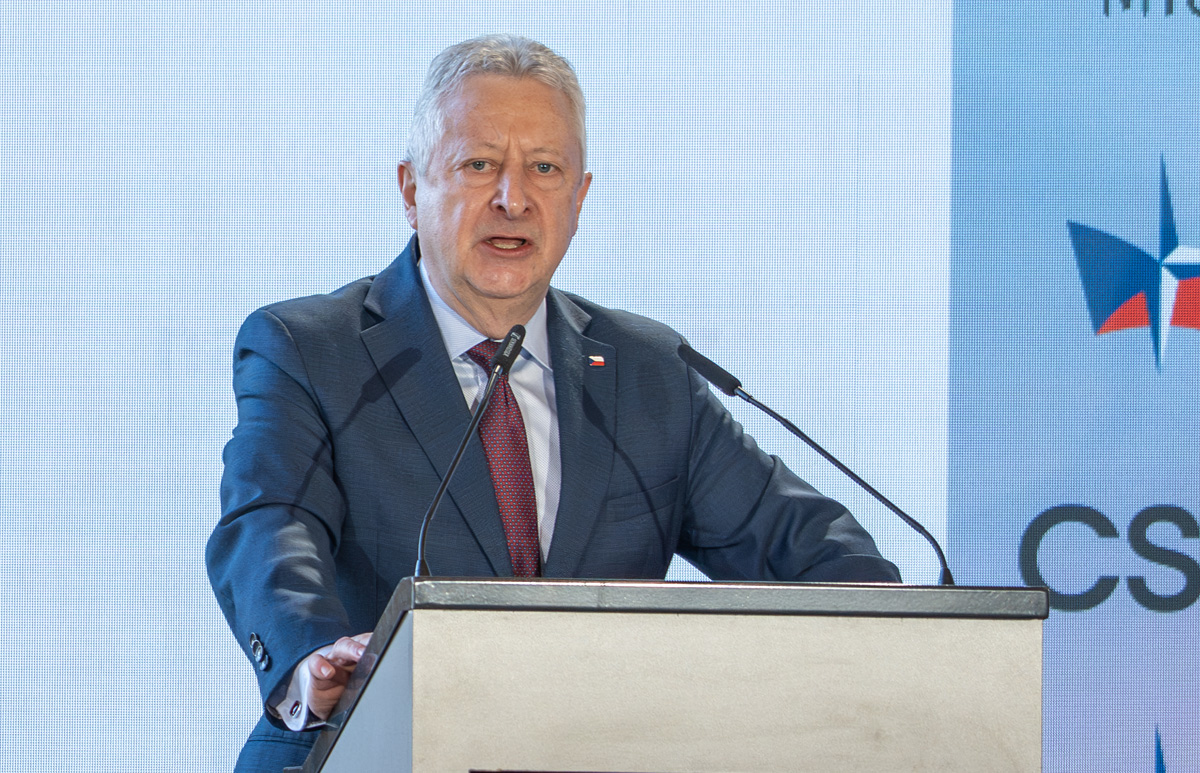
In his speech, Zůna pointed out that the security situation in Europe and around the world has long been deteriorating for a long time and that countries must respond to new types of threats. "We perceive a negative trend in the security environment and an ever-widening range of risks and threats to our country resulting from this development," he said. According to him, the government's goal is therefore "to ensure the security of the state, the stability of public finances, and a functioning state that can protect its citizens even in crisis situations." According to the minister, current conflicts also clearly show what capabilities are key to modern national defense. "The course of current conflicts and crises shows how essential, for example, high-quality air defense, strategic reserves—not only ammunition—and a functional public warning system are."
According to the minister, one of the projects the Ministry of Defense is focusing on is the development of modern air defense. "The planned concept of ground-based air defense focuses on protecting critical infrastructure and the population and envisages the construction of a multi-layered air defense system covering the entire territory of the state," said Zůna. At the same time, he pointed out that such a system would be very costly. "The costs will be very high. We must therefore reach a consensus so that we are willing and able to allocate these funds and invest them wisely."
In his speech, the minister also spoke about the transformation of the global security architecture. According to him, the world is currently heading towards greater rivalry between the superpowers. "We are witnessing an escalation of strategic rivalry on a global scale, with rivalry outweighing cooperation in the emerging multipolarity, and international norms and rules being challenged," he said. At the same time, he recalled the changes in the United States' approach. "In line with its strategy, the United States is taking steps to ensure that Europe assumes primary responsibility for its own security and that of its region," said Zůna. According to him, this means that both NATO and the European Union will have to adapt.
In his speech, the Minister of Defense also opened a debate on the effectiveness of defense spending in recent years. "If defense spending increased by 400 percent between 2014 and 2025, why did the combat value and level of readiness and modernization of the army not increase accordingly?" the minister asked. According to him, such debates must be based primarily on real data. "The answers to these questions exist, but not in the form of theories, but in the form of data and facts," said Zůna, emphasizing that modern and credible armed forces are a fundamental pillar of state sovereignty. "A strong, modern, and credible army is one of the fundamental pillars of state sovereignty, the security of the population, and the fulfillment of international obligations," he said.
According to him, the government's priority is therefore to build professional and technologically advanced armed forces. "The government's priority is to build professional, technologically advanced, and effectively managed armed forces that will be able to effectively defend the territory of the Czech Republic and its inhabitants, while contributing to the collective defense of its allies." In addition to modernizing technology, the minister also highlighted the importance of the human factor. "Without competent, motivated, and sufficiently numerous personnel, the Czech Republic will not be able to fulfill its political and military ambitions," said the minister.
According to him, the modernization of the army will continue in accordance with long-term plans and will include the introduction of new technologies. "The development of specific capabilities of the armed forces includes the introduction of modern air defense systems, unmanned aerial vehicles, the strengthening of ground forces, and the modernization of key infrastructure, including air bases."
At the end of his speech, the minister emphasized that the Czech Republic has good prospects for strengthening its defense capabilities. "Our army, economy, defense industry, the entire state security system, and our country as a whole have great potential, which will form the basis for our further progress in building the army and strengthening the country's defense capabilities," said the Minister of Defense.
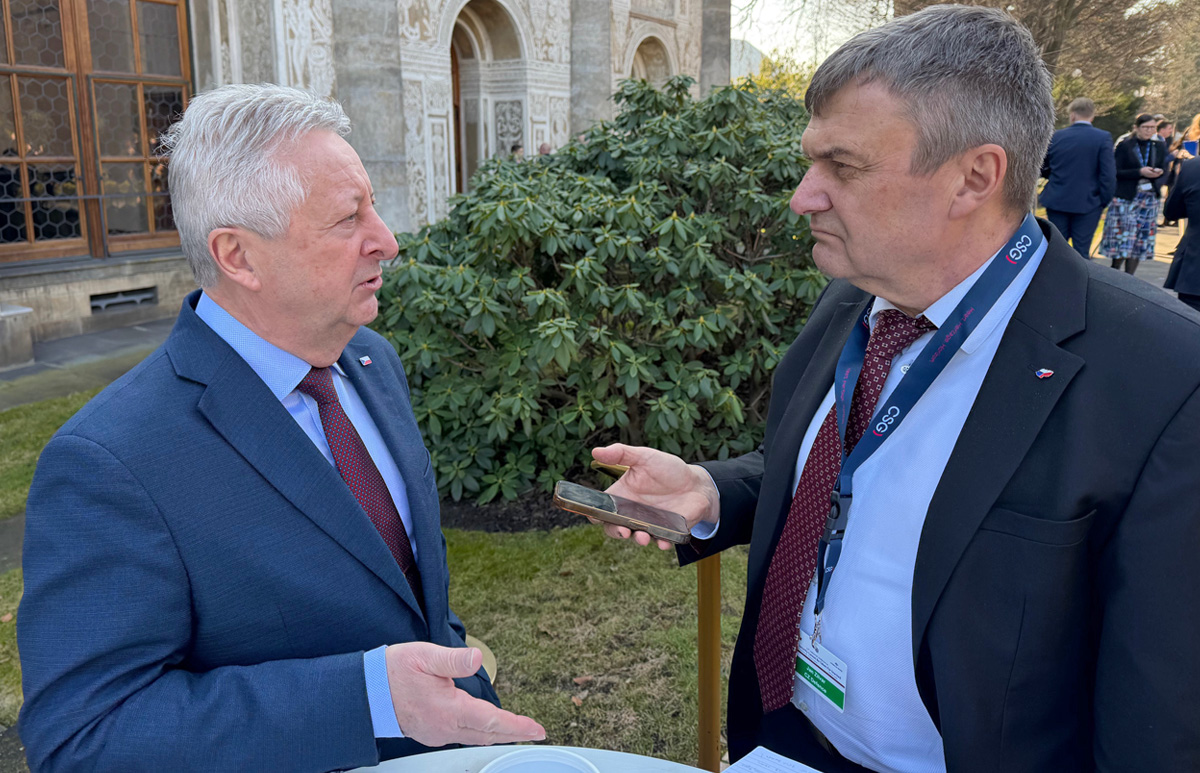
After his speech, we asked Minister Zůna the following questions primarily concerning air defense:
Minister, in your speech you mentioned, among other things, the need to build air defense, which is a long-term process. What do you think are the current tasks and priorities of our army in terms of air defense capabilities?
The first step is to complete the implementation of the SPYDER system. The first battery is currently being tested in the Czech Republic, and a total of four batteries should be delivered. Our task is to have them fully integrated into the air defense system by 2028. It is not just a matter of delivering the technology. We have to connect this system with radar equipment, command and control systems, and also with the Alliance's air and missile defense system. Implementation is therefore key. The next step is to gradually build a multi-layered air defense system. The first layer is the so-called alliance air defense. Today, we contribute to this with Gripen aircraft as part of the NATINAMDS system. This system is the basis of the entire defense, and in the future, the F-35 aircraft, which is already conceptually integrated into it, will also play an important role.
The second layer is the country's air defense. This includes SPYDER systems and other equipment that will need to be procured in the future. It also includes new radar systems, such as MADR radar, as well as passive radar technologies. The third layer is the air defense of the armed forces. Combat units must have their own short-range means, such as RBS-70 systems. And finally, there is the protection of individual weapon systems. Modern combat equipment must be resistant not only to enemy missiles and ammunition, but also to drones. This is where active protection systems (APS) come in. These will be fitted to the new CV90 infantry fighting vehicles and Leopard 2A8 tanks, for example. This entire multi-layered system must be built up gradually. It is extremely demanding, both financially and organizationally.
Exactly, it is a costly project, and the current security situation does not allow for sufficient time.
Yes, it is an extremely costly process, and at the same time, we have very limited time. In addition, there is another factor – production capacity. If someone orders a SPYDER system today, for example, the delivery time is four to six years, and implementation can take another four to six years. Now imagine that Romania, for example, has ordered a total of 24 batteries for these systems. That means years of work for the manufacturer. So if someone wants to purchase similar systems today, they either have to wait in a long queue or team up with someone who buys in large quantities so that they can conclude a supplementary contract and get access to production capacity sooner. There is often talk of the need to speed up processes "urgently." In reality, however, the problem lies elsewhere. There is a lot of non-public information that we cannot openly share, which sometimes gives the impression that things are not moving fast enough. In reality, however, urgency alone does not solve anything—the root of the problem lies elsewhere, for example in production capacity and the complexity of the entire process.
Is the SPYDER system sufficient to ensure adequate protection of Czech airspace?
The SPYDER system is a medium-range air defense system, although there are variants with longer ranges. In terms of capabilities, however, it still falls within the Medium Range category. When it comes to missile defense capabilities, i.e., Patriot-type systems, this is a specific category. In our case, cooperation within European and Alliance collective missile defense projects is a realistic solution in this regard.
This year marks the thirteenth annual security conference entitled Our Security Cannot Be Taken for Granted. Do you remember the first conference?
Yes, I remember it very well—I was even there in person. It was at a time when I was serving as logistics commander in Mladá Boleslav, and we were commemorating the fifteenth anniversary of the Czech Republic's accession to NATO. Since I was the only one of the people around who had been present at the signing of the Alliance accession agreement, I took it as a personal matter. I wondered where the fifteenth anniversary would be celebrated – and found out that it would not be celebrated anywhere. So I decided to organize a conference similar to today's at the castle at Brandýs nad Labem. At that time, the deputy mayor of Brandýs nad Labem was General Jiří Nekvasil, former Chief of the General Staff. When he took up the post of Chief of the General Staff, I was his first military assistant. That position was actually created at that time. I approached him with what I wanted to organize. He said to me, "I understand what you want to do. We'll do it. I'll give you the castle and we'll pay for everything." I invited guests from Brussels, political scientists—such as then-MP Ivan Gabal—as well as former Chiefs of the General Staff, generals, and unit commanders. The hall was full, just like today, and there were four main lectures. These were followed by a very open discussion. Even then – we are talking about March 2014 – there was a fairly clear assessment of where Russia was heading. A week later, MP Ivan Gabal submitted a parliamentary motion to increase defense spending. And that's when the whole process started again.