












The Czech Republic could acquire the ARV-3 Buffalo under the same terms as Germany—they are key to the heavy brigade’s combat readiness
The Ministry of Defense of the Czech Republic is reinforcing our sole heavy brigade of the Czech Army with 44 newly acquired Leopard 2A8 combat and command tanks, in addition to the Leopard 2A4 tanks already in service. These tanks cannot operate without support vehicles, such as the ARV-3 Buffalo armored recovery vehicles, also known as the Bergepanzer 3 Büffel. Two of these vehicles are already in service with the 7th Mechanized Brigade alongside the Leopard 2A4s; however, to ensure the full operational capability of our heavy brigade, the fleet must be expanded.
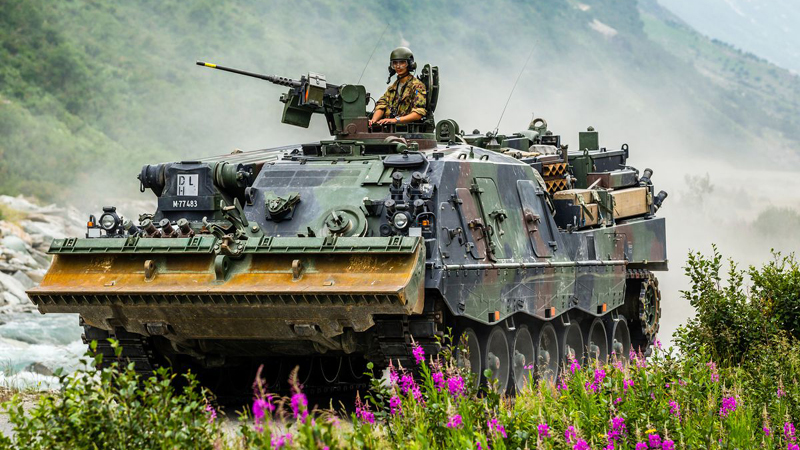
The German Bundestag recently approved an order for 23 new Büffel recovery tanks from Rheinmetall as a quick replacement for vehicles donated to Ukraine. The Czech Republic could acquire these vehicles through a joint purchase with the German Army, or negotiate the same terms, prices, and delivery dates with Rheinmetall as the Bundeswehr. This is a unique opportunity to quickly and cost-effectively supplement the Czech Leopard fleet with essential support equipment.
Why is a recovery tank so important? A modern tank brigade without specialized recovery vehicles is not deployable. The Leopard 2A4 (and in the future, the new 2A8) are the most powerful combat assets of the Czech Army’s Land Forces, but in any deployment, breakdowns and damage occur; tanks can get stuck in the terrain or lose mobility. Without a recovery vehicle capable of handling the weight of these MBTs, they would remain stuck in place and become easy targets on the battlefield; the entire brigade would lose its momentum. The ARV-3 Buffalo is essential for the effective deployability of both the tank battalion and the entire brigade. The vehicles also have indispensable civilian uses, for example in dealing with the aftermath of natural disasters such as floods.

Bergepanzer 3 Büffel – a recovery tank based on the proven Leopard 2 chassis
The ARV-3 Buffalo armored recovery vehicle is one of the most successful recovery systems of the past three decades. The first units were delivered by Krupp MaK—now part of Rheinmetall Landsysteme—to the German and Dutch armies as early as 1992. Since then, more than two hundred production vehicles have been in service in twelve countries around the world, from Germany to the Netherlands, Sweden, and Spain, all the way to Canada and Australia. It has demonstrated exceptional reliability in both military missions and natural disasters.
The Buffalo is based on the chassis of the Leopard 2 main battle tank. As a result, the Buffalo has the same mobility, armor, and reliability as the Leopards themselves. The crew consists of three men: a driver, a commander, and a mechanic-repairman. The engine is identical to that of the Leopard 2: a liquid-cooled, 12-cylinder, multi-fuel MTU MB 873 Ka 501 diesel engine with a displacement of 47.6 liters and an output of 1,100 kW at 2,600 rpm. This provides a maximum military load capacity (MLC) of 80 and allows the vehicle to recover and tow other vehicles in the same weight class.
Equipment and gear that saves lives and equipment
The Büffel’s primary capability is its comprehensive recovery system. The rotating crane on the right side of the hull has a lifting capacity of 30 to 32 tons, depending on the version, and a reach of up to 90 centimeters from the front edge of the blade. The crane can be operated from the cab or externally and is capable of lifting engines, turrets, and similar equipment. The main Rotzler Treibmatic TR 650/3 winch has a pulling force of 35 tons. In dual-reel mode, it can handle 70 tons, and in triple-reel mode up to 105 tons, which is sufficient to recover a stuck Leopard 2. The auxiliary winch is used for more precise maneuvers. The front support and clearing blade allows the vehicle to be supported while working with the crane, performing earthworks, creating ramps, or quickly extricating itself. The equipment also includes an electric welder and cutting equipment for field repairs directly on the battlefield, as well as a transport platform for carrying spare parts, engines, or entire turrets.
The armored hull is welded from sloped steel plates. A high level of ballistic protection comparable to that of an MBT and digital systems ensure that the Buffalo can operate under enemy fire on the same front line as tanks. A remotely controlled weapon station and smoke grenades provide effective self-defense.
Actual use in a heavy infantry unit of the Czech Armed Forces
In practice, the ARV-3 Buffalo fulfills three essential roles without which a tank brigade would lose its combat effectiveness. The first is the recovery and towing of damaged vehicles. A Leopard 2A4 or 2A8 may be hit, lose a track, or become stuck in the terrain. The Buffalo recovers it, tows it to a safe area, and enables rapid repairs. Without it, the tank would remain stranded and the crew would be at risk. The second role is supporting the repair of tanks and other heavy equipment in the field. The vehicle transports spare parts, engines, and tools. Mechanics can replace an engine or perform welding directly on site, which dramatically increases the availability of the entire fleet. The third role is logistics and overcoming obstacles. When crossing rivers, swamps, or constructing crossings, the plow and winch enable rapid maneuvering.
Experience not only from Ukraine shows that without recovery vehicles, tanks quickly lose their combat effectiveness. Germany is therefore immediately replacing the donated units, and the Czech Republic should not hesitate. Four Büffels represent a suitable number for a tank battalion—if the Czech Republic were to exercise the option for Leopard 2A8 tanks in the future and acquire more tanks to bring the total strength up to 77, it would need one or two additional recovery vehicles. As mentioned, two recovery tanks are part of Germany’s donation of Leopard 2A4 tanks, which totals 42.
It's not a luxury; it's a necessity
Every Leopard 2A8 lost due to the lack of recovery capabilities represents a real loss of hundreds of millions of crowns and puts soldiers’ lives at risk. The Büffel enhances the survivability of the entire brigade, shortens repair times, and ensures that tanks remain in combat for as long as possible. Just as with the German or Dutch Leopards, the ARV-3 Buffalo is a natural part of the system in the Czech Armed Forces, not a superfluous add-on. Rheinmetall offers the Czech Republic vehicles in the same configuration it supplies to the Bundeswehr—fully digitized, with the latest armor and electronics upgrades. Production and deliveries could take place practically in parallel with the German ones, which would significantly accelerate the integration into the heavy brigade’s arsenal.
The ARV-3 Buffalo is not an option; it is a necessity. Four, or ideally more, units under German terms represent an investment that will pay off in any realistic deployment scenario. The Czech Army’s heavy brigade deserves a complete and functional system, and the Büffel is an indispensable part of it.