














New Czech Armed Forces Chief Miroslav Hlaváč Presents Vision for a Next-Generation Military
The Chamber of Deputies’ Defense Committee discussed the government’s proposal to appoint Lieutenant General Miroslav Hlaváč as the new Chief of the General Staff of the Czech Armed Forces. The candidate presented his priorities to the deputies—ranging from the completion of the heavy brigade and the development of a multi-layered air defense system to the digitization of the armed forces and the reform of personnel policy. However, the debate quickly turned to the question of whether the state would find sufficient funds for its ambitious modernization plans.
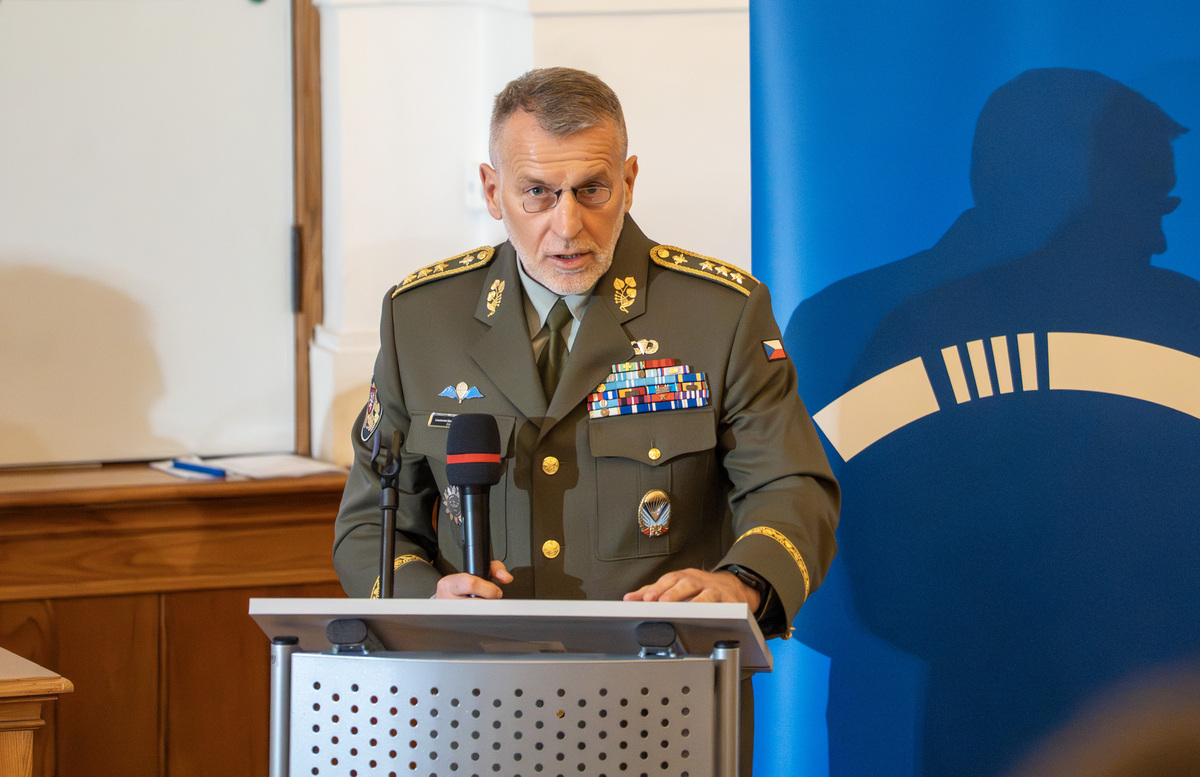
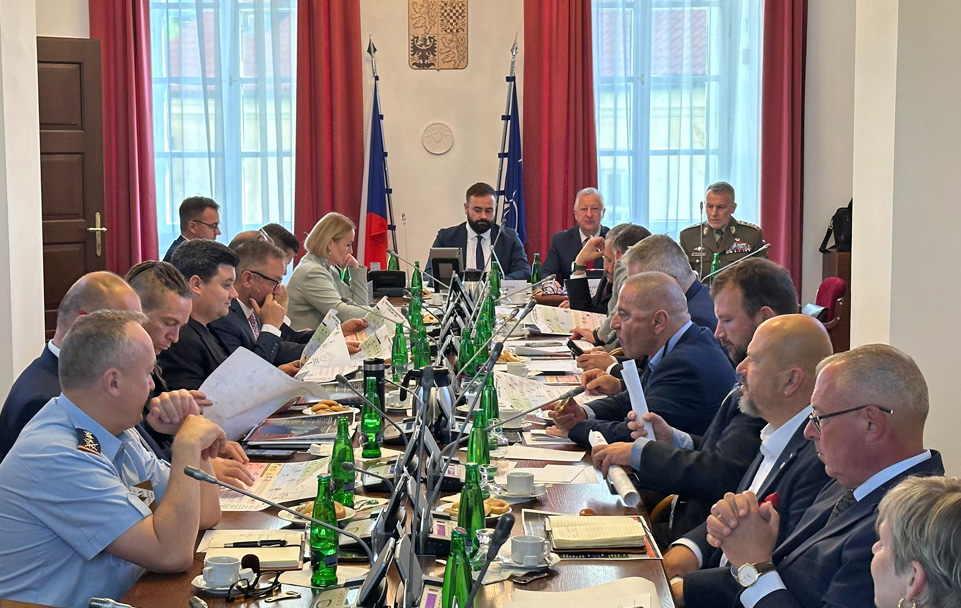
The 9th meeting of the Defense Committee was held on an extraordinary basis on May 27, and the main item on the agenda was a discussion of the government’s proposal to appoint a new Chief of the General Staff of the Czech Armed Forces. The term of the current Chief of the General Staff, Army General Karel Řehka, ends on August 31, 2026, and the government therefore proposed to the President of the Republic that Lieutenant General Miroslav Hlaváč be appointed effective July 1, to allow sufficient time for the handover of duties.
Defense Minister Jaromír Zůna, in introducing the candidate, highlighted his many years of experience in both command and strategic positions: “Lieutenant General Miroslav Hlaváč is one of the most experienced officers in the Czech Armed Forces. During his long career, he has held command, staff, and strategic positions and has gained extensive experience in the areas of troop command, operational management, and planning the development of the armed forces.”
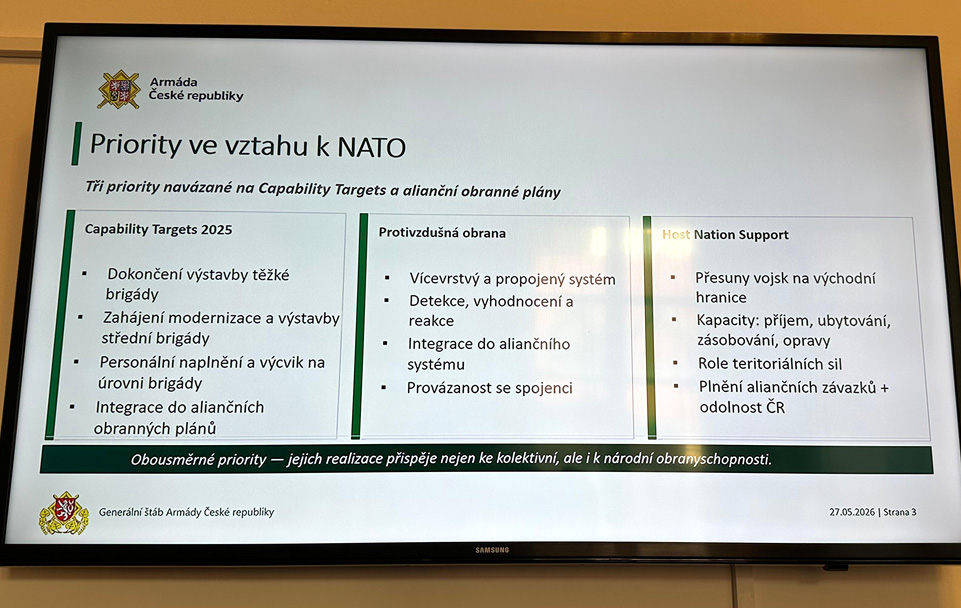
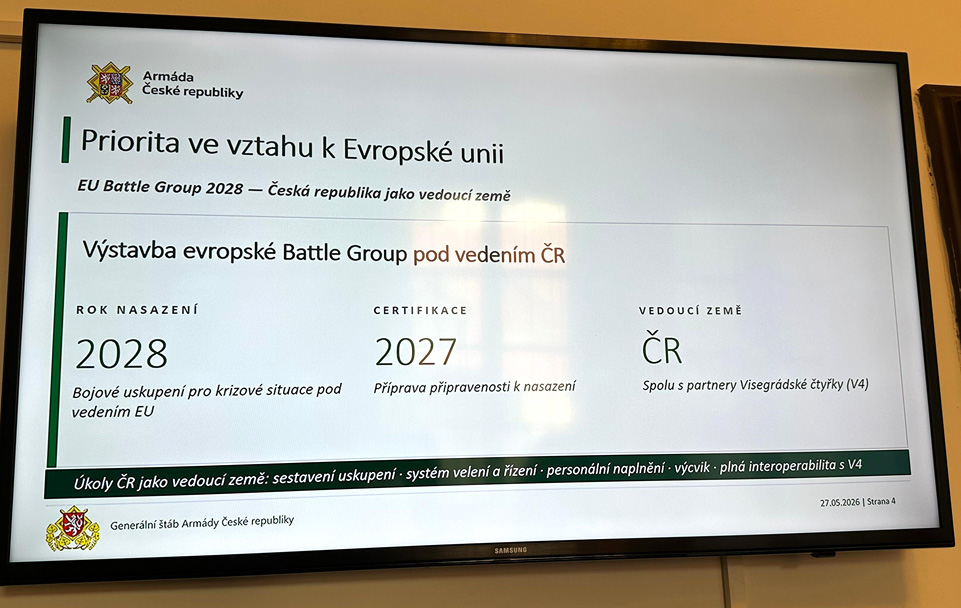
In his speech, Lieutenant General Hlaváč stated that he intends to maintain continuity in the development of the armed forces while accelerating their transformation. At the core of his strategy are four priorities: completing the establishment of a heavy brigade, strengthening air defense, developing the capacity to host allied forces, and preparing for a European battlegroup led by the Czech Republic in 2028. “My goal will be to begin building an effective, multi-layered, and interconnected system capable of detecting threats in a timely manner, assessing them, and responding quickly,” he said regarding air defense, which he identified as one of the most critical areas for future development.
The new candidate also intends to place great emphasis on unmanned systems, the digital transformation of the military, and cyber capabilities. “New technologies are fundamentally changing the way operations are conducted, and therefore my goal is to ensure that the military keeps pace with these developments and is able to quickly and effectively put new capabilities into practice,” the general said. His concept also includes the creation of a center for applied research in defense technologies, closer cooperation with universities and industry, and faster testing of innovations.
Hlaváč devoted a significant portion of his speech to personnel matters. He identified not only the recruitment of new soldiers but, above all, their retention as key priorities. “I consider personnel to be the greatest asset of the Czech Army, because it is the people who determine its true combat effectiveness,” he emphasized. He proposes continuing the digitization of recruitment, expanding scholarship programs, supporting service in the active reserve, and improving housing conditions for soldiers. He also spoke about greater support for families and a system to facilitate soldiers’ transition to civilian life.
MPs: The ambitions are right, but where will the money come from?
The MPs’ discussion quickly shifted from priorities to funding. Jana Černochová, chair of the Security Committee, supported the candidate but also raised the issue of long-term defense funding. “As far as those priorities are concerned, I don’t think there’s a single priority that General Hlaváč has that can be questioned. But of course, the question arises—where will we get the money for all of this?” said the MP. She was also concerned about the speed of decision-making processes in the military and the Ministry of Defense. “Some of those processes drag on terribly… we really don’t have that kind of time,” she said, referring to delays in certain legislative and policy changes. Similar questions were raised by other committee members, who highlighted the uncertainty of budget outlooks and the need for guaranteed funding for modernization projects.
Lieutenant General Hlaváč acknowledged that the military must speed up its processes. He sees the solution in digitization and adjustments to the organizational structure. “I want to eliminate unnecessary red tape. For me, this means simplifying and speeding up all these processes. It involves digitization as well as adjusting and simplifying the organizational structure.” He also noted that some projects—such as air defense systems—are already ready and are primarily awaiting funding.
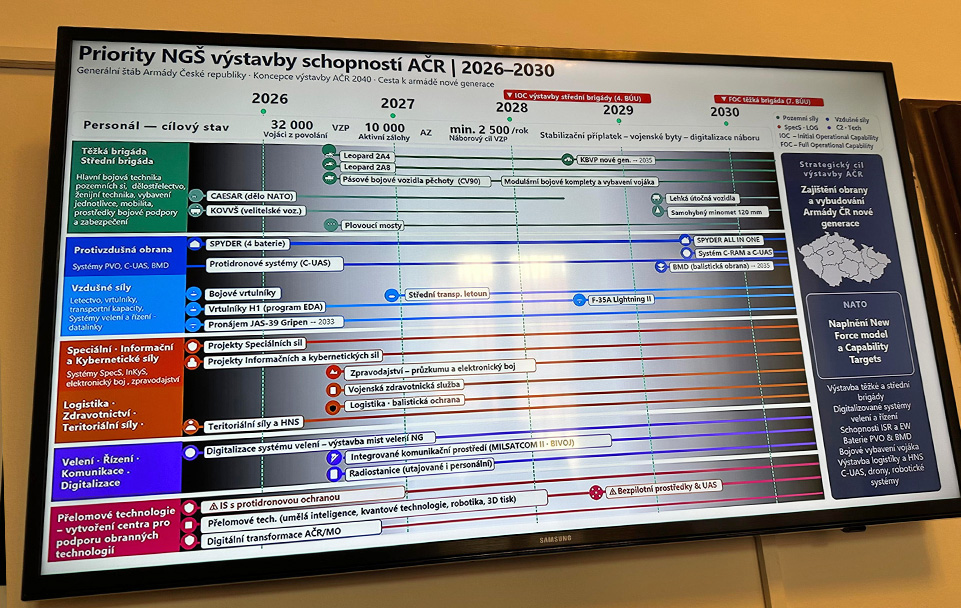
Regarding the development of territorial forces, he added that the territorial defense battalions currently being formed will consist mostly of active reservists. “Roughly 90 percent of these personnel will be drawn from the active reserve,” said General Hlaváč.
If the president approves the government’s proposal, Miroslav Hlaváč will take command of the army at a time when the Czech Republic is accelerating the modernization of its armed forces, expanding its NATO commitments, and preparing for higher defense spending in the long term.
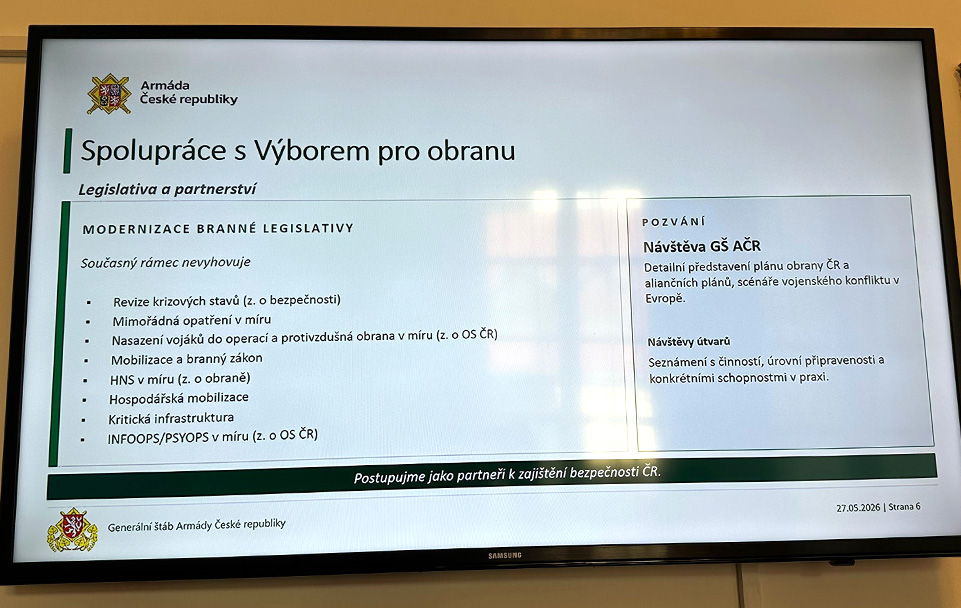
Speeding up decision-making and preparing the state for crises. What legislative changes would the defense leadership welcome?
Following the conclusion of the Defense Committee meeting, Defense Minister Jaromír Zůna and candidate for Chief of the General Staff of the Czech Armed Forces, Lt. Gen. Miroslav Hlaváč, also responded to a question from CZ DEFENCE regarding the legislative changes needed to accelerate the development of the military’s capabilities and enhance the state’s readiness. The discussion also touched on the development of garrison infrastructure and active reserves.
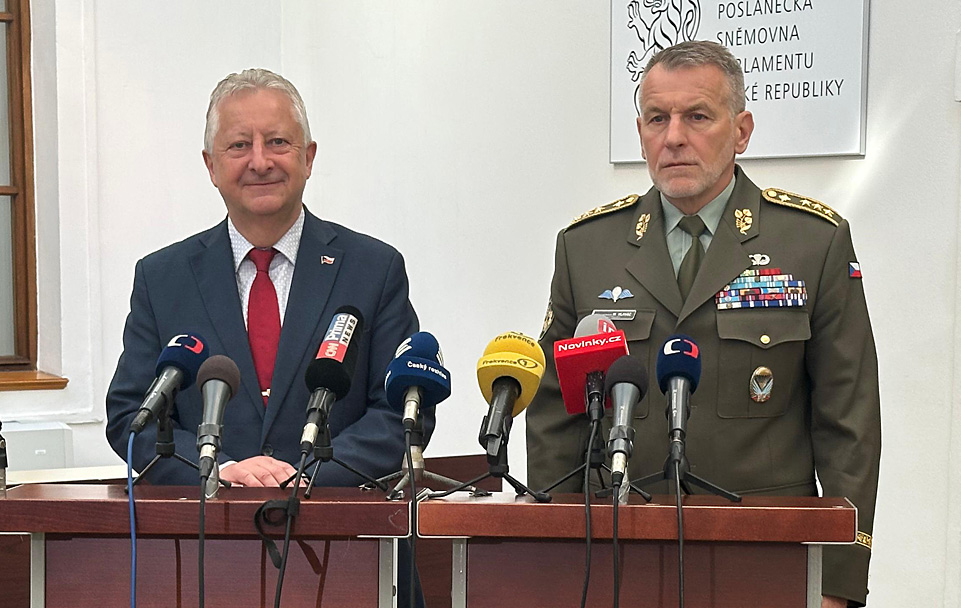
Defense Minister Jaromír Zůna: “As far as legislative changes are concerned, it really is a whole series of changes. It will be a process that we will be happy to initiate and launch. It’s a massive undertaking. Deputy Minister Vích has been tasked with this, and we are working intensively on it together with the Ministry of the Interior. We have a comprehensive plan, and we have also explained it to the Defense Committee.”
The minister also emphasized that the defense system cannot be viewed in isolation solely through the Czech Armed Forces, but as a whole that includes military education, military intelligence, the military police, and military healthcare.
Lieutenant General Miroslav Hlaváč: “For me, the two most important legislative changes are as follows. The first is that the state should be able to prepare during peacetime, even before a state of emergency is declared, and take the necessary measures and decisions. The second relates to the security situation—that the state’s air defense capabilities can respond even in peacetime and are not hampered by complex and cumbersome processes.” According to Hlaváč, the ability to respond quickly to emerging threats will be one of the determining factors in the Czech Republic’s future resilience. He argues that legislation designed for the crisis situations of past decades no longer corresponds to the current security environment.
This time, we focused our regular survey on representatives of the individual political parties, movements, and groups represented on the Defense Committee of the Chamber of Deputies of the Czech Republic: In your opinion, how great a challenge will it be for the new Chief of the General Staff of the Czech Armed Forces to advocate for the army’s needs in terms of ensuring the effective defense of the Czech Republic and fulfilling alliance requirements?
Jiří Horák (KDU-ČSL), Vice Chair of the Committee
Today, the future Chief of the General Staff of the Czech Armed Forces presented the Czech Army’s development plan for the coming years to the committee, focusing primarily on the establishment of a heavy brigade, the development of the Air Force, and air defense. The goal is not only to fulfill our commitments to NATO, but above all to strengthen the Czech Republic’s own defense capabilities and security.
It also became clear just how financially demanding this modernization will be. According to the plans presented, for next year alone, the Ministry of Defense’s budget would need to be increased from this year’s approximately 155 billion crowns to roughly 210 billion crowns—an additional 55 billion.
And that is precisely where I see the main challenge for the new Chief of the General Staff. The key factor will be whether the government provides the military with the resources needed for modernization and to achieve its stated goals. The new Chief of the General Staff’s main task will therefore be to convince the government and the Minister of Defense that increasing investment in defense is essential given the current security situation. That is why I consider it very important for the new Chief of the General Staff to have good, professional, and constructive relationships with both the Minister of Defense and the Prime Minister.
Ivan Bartoš (Pirates), committee member
This will be a huge challenge for the new Chief of the General Staff of the Czech Armed Forces, because it is nearly impossible to push through the army’s actual needs amid the current government chaos. I have serious concerns that the plans presented—particularly those looking ahead to 2027—will not be fulfilled. This government outlook, in fact, calls for defense spending amounting to 2.26% of GDP, which would mean roughly 60 billion crowns more than this year’s budget (which in reality amounts to only 1.75% of GDP).
While Defense Minister Zůna spoke confidently about this increase during the budget debate, Prime Minister Andrej Babiš immediately dismissed the idea entirely, stating that he had no idea what increase the minister was referring to. A number of key projects (such as the modernization of air defense) are thus nicely planned on paper, but their actual implementation depends practically only on the whims of Andrej Babiš. At the Defense Committee, we therefore received absolutely no guarantee that this money will actually be available and that the government will adhere to at least the legally mandated 2% of GDP for defense. Neither the Minister of Defense nor the Chief of the General Staff can logically guarantee this in the current situation.
From the Pirates’ perspective, it is absolutely clear where the funds needed to ensure our effective defense could come from. For example, they could come from the proceeds of frozen Russian assets on our territory, or by the state finally stopping the payment of billions in subsidies to oligarchs. Funds would also be available if the government did not take senseless populist measures, such as squandering 17 billion crowns on indiscriminate energy subsidies to large companies and households across the board.
These enormous sums are now sorely lacking not only for our security but also for measures that would genuinely and specifically help ordinary people. Unfortunately, the current government is stubbornly blocking these meaningful steps, as we can clearly see, for example, with our Pirate Party Family Package.
Jana Černochová (ODS), committee member
The selection of General Miroslav Hlaváč is a good and logical choice. As the first deputy to the Chief of the General Staff, General Karel Řehka, he has been involved in all key decisions, modernization projects, and complex debates in recent years. Together, for example, we pushed through the landmark Act No. 221 on Professional Soldiers last year, which brought an increase in pay scales and other allowances, a higher recruitment bonus for specialists, and, overall, easier entry into the army, the active reserve, or voluntary military training. General Hlaváč has also stood firmly behind support for Ukraine. He knows our army inside and out, understands its needs, and guarantees the natural continuity of the work we have begun.
I respect him as an exceptionally decent soldier, a hardworking man, and a professional who does not seek grand words but does honest work. That is precisely what is crucial in today’s security situation. Our army now needs stability, clear leadership, and an uncompromising commitment to modernization. General Hlaváč is a leader who can take full responsibility and who will undoubtedly rise to this challenge.
We will gradually add the responses from other representatives of ANO, STAN, the Pirates, and the SPD