















Troop mobility: The Achilles’ heel of European defense and a prerequisite for real deterrence
In non-military and lay circles, this topic is boring and uninteresting, but for combat operations and their sustainability at all three levels, this is a key issue, as Napoleon Bonaparte himself described. We are talking about the mobility and transport of troops and their subsequent supply, i.e., the ability to move forces from point A to point B and provide subsequent support so that they can carry out combat operations for a longer period of time. Unfortunately, this fundamental issue is one of the Achilles' heels of European defense capabilities. It is therefore not surprising that these disciplines have been receiving increased attention in recent years, both within NATO and the EU.
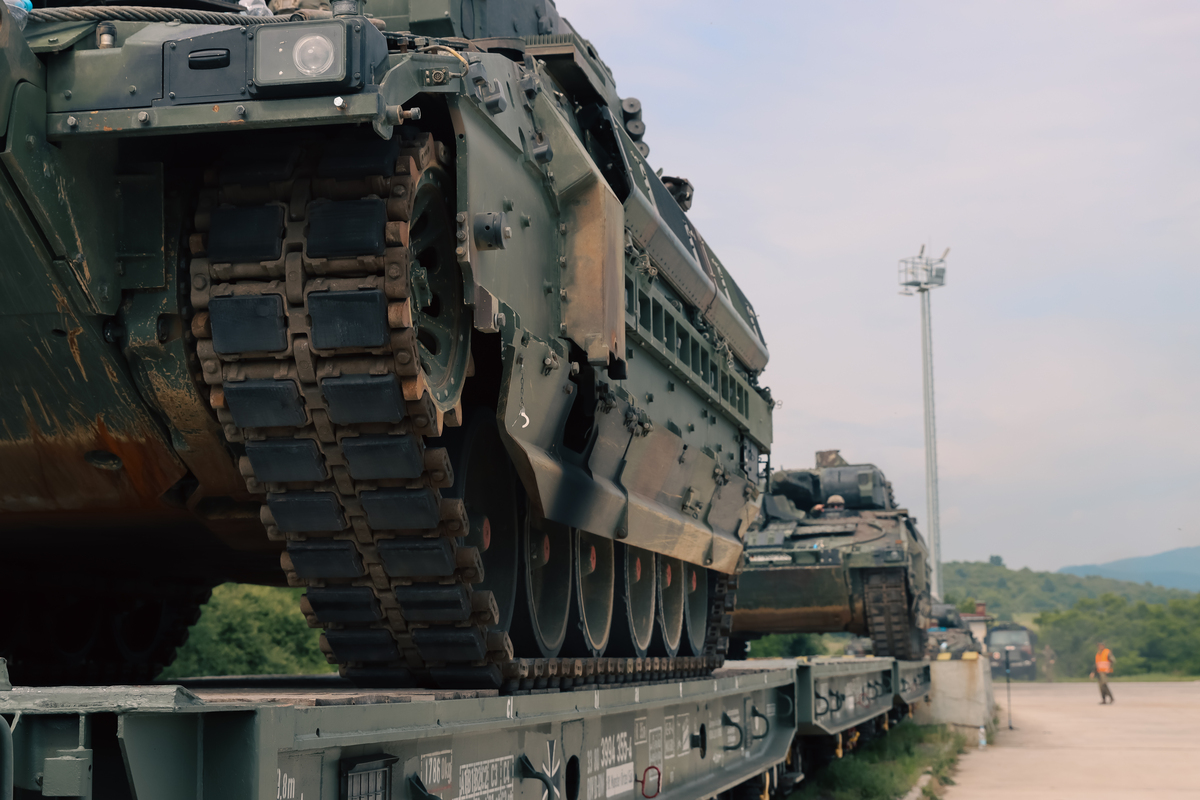
Long-distance troop mobility. When railways, ships, wings, and wheels must come into play
During the Cold War, a quantity of forces that is difficult to imagine today was concentrated in the vicinity of the Soviet satellite states. Not only brigades, but also divisions and corps were spread across what was then NATO's eastern flank. These were not only light units, but also heavier types of forces, including armored and mechanized units. For example, around 1980, the United Kingdom alone had a corps consisting of four armored divisions deployed in Germany. Yes, by today's European standards, this is a number and amount of equipment that is difficult to imagine. Nevertheless, at a time when efforts were being made to deter the Warsaw Pact, it was a necessary deterrent. Such a large number of forces naturally entails enormous demands in terms of security and support for these groups. It also requires the transport capacity needed to move these forces to the area of deployment. Given the complexity of transport and related processes, a certain practical approach began to be applied.
Forward presence with permanent equipment
The approach, which is still partially used by the United States and was partially applied, for example, in Afghanistan during the stabilization and reconstruction phase of the operation, is based on the principle that personnel rotate, but equipment and supplies remain. The application of this doctrine is based on building the infrastructure in or near the (potential) area of operations necessary for the independent operation of the equipment of the deployed units to the greatest extent possible, together with space for garaging, repairs, and personnel accommodation. Thus, during the Cold War, not only huge barracks were built in West Germany, but also garages, service areas, and warehouses with the materials needed for operational deployment. This practice arose out of necessity. Even for a military giant such as the United States, it would be too costly to constantly move hundreds or thousands of pieces of heavy equipment across the Atlantic.
At the same time, in the event of a Soviet attack, it would not be possible to deploy the necessary amount of equipment and materials quickly enough to the threatened parts of Europe and potential combat zones, which would also pose a threat of submarine attacks on transport routes and deep strikes on railway and road junctions, which would further complicate the deployment of forces in the initial phase of the war and cause unnecessary losses. Instead, in an emergency, personnel with the most essential equipment would be airlifted to Europe so that they would be ready to operate the ranks for the deployed equipment. The new "Cold War" between NATO countries and the Russian Federation seems to call for a return to these applications, reinforced by the fact and threat of significantly extended ranges of precision weapon systems. The first sign of this trend among European forces is Germany's initiative to establish its own permanent forward presence in Lithuania with deployed equipment and support infrastructure at the deployment site. Panzerbrigade 45, or the 45th Armored Brigade, is a new formation that will be put into service in the first half of 2025 in Vilnius. This heavy maneuver brigade, numbering around 5,000 men, is part of the Bundeswehr's 10th Armored Division. However, it is based in Lithuania.
Actions, not words
In addition to the practical aspects described above, this approach has another significant advantage. It sends a clear signal and is a realistic step toward deterring the enemy and strengthening trust among allies. Now, when planning potential offensive operations, an aggressor can no longer rely on the time needed to move such a unit and the political dimension of the situation. No, a unit such as Panzerbrigade 45 is a permanent part of a given state's defense and poses a problem for adversaries from the very first minute of a conflict. This was the case with Western units deployed in Germany during the Cold War. Germany's move is a clear signal and a real step toward securing the Alliance's eastern flank, and it can be expected that it will not be the last step if Europe wants to significantly increase its real deterrent potential in the Baltic republics or Poland.
In a theoretical scenario of Russian aggression, deploying forces to Lithuania from Spain, for example, would be a time-consuming and logistically demanding task, further complicated by Russian diversionary activities and deep strikes on transport infrastructure. Damaged railways, road junctions, and ports would pose significant problems for the mobility of heavier forces of higher units and would place increased demands on reinforced air defense, operational repair of transport infrastructure, and alternative transport options (such as moving equipment from rail cars to wheeled trailers). Similarly, without forward infrastructure and equipment, the supply, replenishment, and rotation of forces, as well as the maintenance and repair of equipment, will be a difficult task, especially for the more western Allied countries. Operations in such an environment will further increase the need for unification.
The capabilities of the Czech Armed Forces within realistic limits
The capabilities of the Czech Armed Forces are naturally limited due to their size and the ongoing inadequacy of the modernization process. The main focus of the Czech contribution to the Alliance's forward presence is on the Baltic republics (namely Lithuania and Latvia) and Slovakia. This involves the rotation of deployed task forces in their entirety. In other words, personnel, equipment, and material are sent out and returned. Considering permanent deployment is difficult to imagine in our current situation, given the overall size of the forces, their staffing levels, technical support, and the financial costs of building garrisons and infrastructure at the deployment site. However, there are steps we can take within our framework, given our geographical proximity to potential areas of operation.
This involves strengthening our own transport capacities, whether in terms of the acquisition of train sets and freight wagons (and the associated preparations by both the armed forces and state authorities for the need for operational repairs to the railway network), road transporters (we can mention the recent acquisitions of Scania tractors with modern Goldhofer semi-trailers), or air transport assets (e.g., C-390 transport aircraft). Further steps may include strengthening air and missile defense so that our territory becomes a safe haven and staging area for allied forces, building supporting infrastructure for the army (ammunition depots or repair and service infrastructure), ideally with multimodal capabilities near important transport hubs, and last but not least, strengthening the backbone road and motorway network, as well as strengthening and expanding the training of the military police, MOVCON (National Movement Coordination Center) under the military transport department, and other related units responsible for force mobility.
All these steps enable us, within our current capabilities, to strengthen the Alliance's overall deterrence potential and, in the event of a crisis, to reduce the time needed to deploy our own and allied forces and subsequently secure and support them in the field. Nevertheless, the fact remains that a permanent forward presence, with the deployment of equipment and the construction of infrastructure, is a powerful deterrent and provides the highest level of assurance to threatened Allied states. It can therefore be expected that the militarily stronger European states will seek to follow Germany's example of the 45th Armored Brigade, and that additional garrisons hosting allied equipment and personnel for longer than a few months will be established on the eastern flank. The Czech Republic can support these efforts within its capabilities.