












When Every Minute Counts: Scenarios for Conflict on NATO’s Eastern Flank and the Limits of European Readiness
A few days ago, GLOBSEC released a report titled "Annual Battle Readiness on the Eastern Flank 2026." This document is followed by an analysis of conflict scenarios on NATO’s eastern flank and an assessment of the limits of readiness for such conflicts.
From structural analysis to operational reality
An analysis of NATO’s eastern flank readiness shows that, since 2022, Europe has made significant progress in boosting military capabilities, investment, and the political attention devoted to defense. However, a key question remains unanswered: how would these capabilities fare in a real conflict, the dynamics of which are determined by speed, surprise, and simultaneous action across multiple domains?
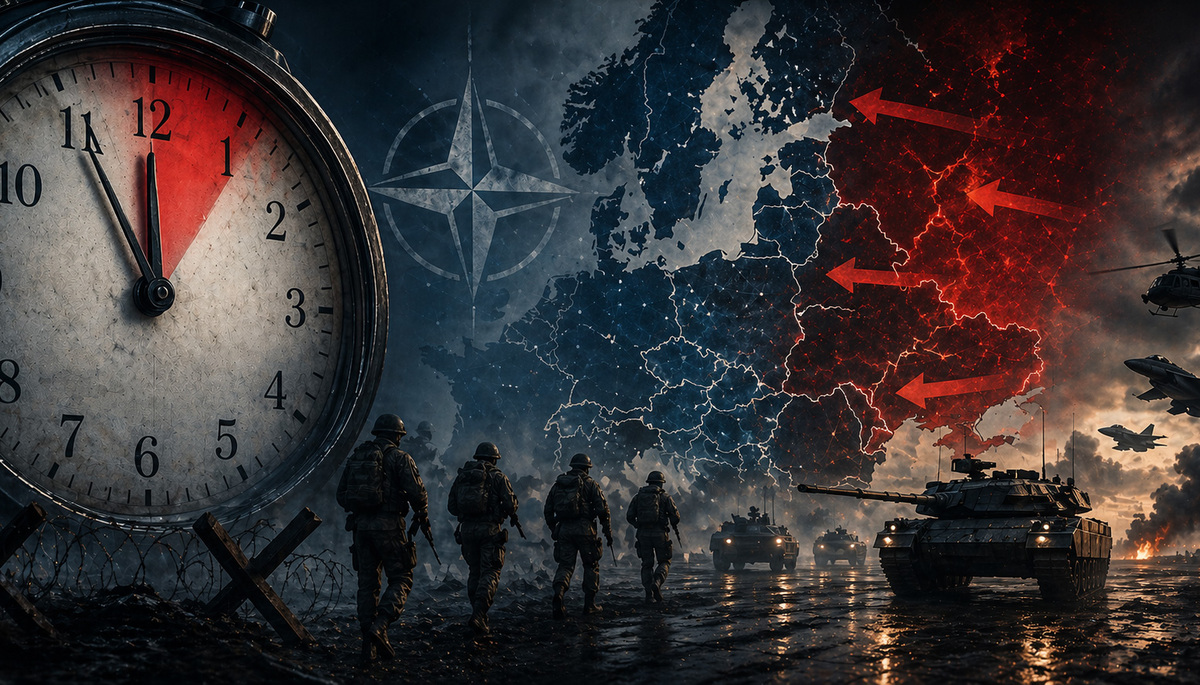
Modern conflict does not unfold in a linear fashion. It does not begin with a declaration of war, but with an escalation of hybrid activities that gradually disrupt decision-making processes, logistics, and social stability. In such an environment, preparedness is not reflected in spreadsheets, but in the first hours of a crisis.
Stages of the conflict: from hybrid pressure to open conflict
A potential conflict on the eastern flank can be understood as a process consisting of several successive phases. The first phase takes place below the threshold of open conflict and involves cyberattacks, disinformation campaigns, and economic pressure. The goal is not immediate destruction, but rather to disrupt the state’s ability to respond. At the same time, response mechanisms are tested, for example through border incidents or sabotage of critical infrastructure.
The second phase represents a sudden escalation, involving rapid kinetic strikes, often of limited scope but with high political impact. In this phase, it is crucial whether states are able to mobilize their forces within hours, facilitate the movement of allies, and ensure the protection of critical
systems.
The third phase transitions into open conflict, which may take the form of a high-intensity conventional clash. Here, the ability to sustain operations over time, replenish losses, and coordinate allied forces across the region is decisive.
The 72-Hour scenario: Testing decision-making systems
The first 72 hours represent a critical period in any conflict. This window of time reveals whether deterrence is effective or has failed. In the case of NATO’s eastern flank, this would involve a combination of cyberattacks on energy and transportation infrastructure, disruption of communication systems, and rapid military operations aimed at establishing a de facto situation on the ground.
The key factor would not be military strength itself, but the speed of political decision-making. Countries that can activate crisis mechanisms without lengthy procedures gain a crucial advantage. Conversely, a delay of even a few dozen hours can lead to a situation where the adversary achieves its objectives before the alliance can fully respond.
Military mobility also plays a crucial role. The ability to move troops from the heart of Europe to the eastern flank is limited not only by infrastructure but also by administrative processes. If these processes are not streamlined in advance, they become a critical weak point.
30-Day Challenge: The sustainability test
Once a conflict moves beyond its initial phase, it enters a period where sustainability becomes the decisive factor. After thirty days of combat operations, ammunition stocks are depleted, equipment wears out, and demands on logistics and medical support increase.
It is precisely here that the structural weaknesses of European defense become fully apparent. The defense industry is currently unable to rapidly scale up production to the necessary extent, and logistics systems are not designed for a long-term, high-intensity conflict. Countries that have invested in reserve systems and territorial defense have a significant advantage at this stage, as they possess a broader force base and greater resilience.
At the same time, the importance of societal resilience is growing. The ability to maintain public support, ensure the functioning of the economy, and resist disinformation campaigns is becoming just as important as military operations.
A protracted conflict: the return of industrial warfare
In the event of a protracted conflict, Europe finds itself in a situation reminiscent of the industrial wars of the 20th century, but with a modern technological dimension. The ability to manufacture, repair, and innovate in real time takes on a decisive role. The current situation shows that European countries are not fully prepared for this type of conflict. The fragmentation of the defense industry, labor shortages, and dependence on global supply chains represent major constraints. Without a coordinated approach at the EU and NATO levels, the ability to wage a long-term conflict risks being significantly limited.
Critical turning points in the conflict
The scenario analysis highlights several critical points at which the conflict could be decided. The first is the speed of decision-making in the initial phase, which determines whether an effective response will be mounted. The second is the ability to ensure military mobility and logistics, which influences the pace of operations. The third is industrial capacity, which determines the sustainability of the conflict.
These factors are interlinked, and a failure in one area can have a ripple effect. For example, slow decision-making can delay mobilization, which in turn strains logistics and increases pressure on industrial production.
Implications for the Czech Republic in the context of the scenarios
These scenarios have specific and practical implications for the Czech Republic. In the event of a conflict, the Czech Republic would serve as a key logistics hub for the movement of forces to the eastern flank. This means that its infrastructure, administrative processes, and coordination capabilities would come under immediate pressure.
In the first 72 hours, it would be crucial whether the Czech Republic is able to quickly facilitate the transit of allied forces while simultaneously protecting its own critical infrastructure from cyber and hybrid attacks.
Within 30 days, the focus would shift to the ability to maintain logistics flows, repair equipment, and ensure the functioning of the economy. In a long-term conflict, the ability to involve domestic industry in the defense effort would then play a key role.
These scenarios show that Czech security is not defined solely by the size of the military, but by the functionality of the entire system, which includes the government, industry, and society.
Conclusion: Readiness as the ability to act in a timely manner
Conflict scenarios on NATO’s eastern flank confirm that future wars will be decided within time frames that are significantly shorter than in the past. What matters will not only be the capabilities states possess, but how quickly and effectively they can deploy them.
Europe is in a transitional phase between the old security model and a new reality, where deterrence relies on the ability to respond immediately and sustain operations over the long term. This transition is not yet complete, and it is precisely in this space that the greatest risks arise.
For the Czech Republic and its allies, this leads to a clear conclusion: security cannot be understood as a static state, but as a dynamic ability to act under pressure. In an environment where every hour counts, readiness becomes not only a military category but a key element of national resilience and strategic credibility.