











The Belgian model: Voluntary military service as a response to the personnel crisis
Russia's invasion of Ukraine in 2022 marked, among other things, a shift in the thinking of Europeans, who, after the end of the Cold War, had learned to consider conventional military conflict a thing of the past. The hitherto underfunded area of defense, which had been on the margins of public and political interest, suddenly moved to the top of the agenda. However, efforts to rapidly improve the combat readiness of European armies face a number of obstacles. In addition to limited financial resources and insufficient capacity in the European arms industry, these include a shortage of personnel. Problems with recruiting new recruits are now affecting all European countries to varying degrees, and the results of recruitment campaigns remain ambiguous.
There are many reasons for this, and it is usually a combination of factors. These include an aging population, the poor physical condition of some of those interested who do not meet the conditions for joining the army, the low financial attractiveness of a military career, but also the simple lack of interest on the part of a large section of society in participating in the defense of the state. According to a 2024 Gallup International Association survey, European Union countries are particularly bad in this regard. Only 32% of respondents expressed a willingness to fight for their country, which is the lowest figure in a global comparison of individual regions.
Interest among young Belgians exceeds training capacity
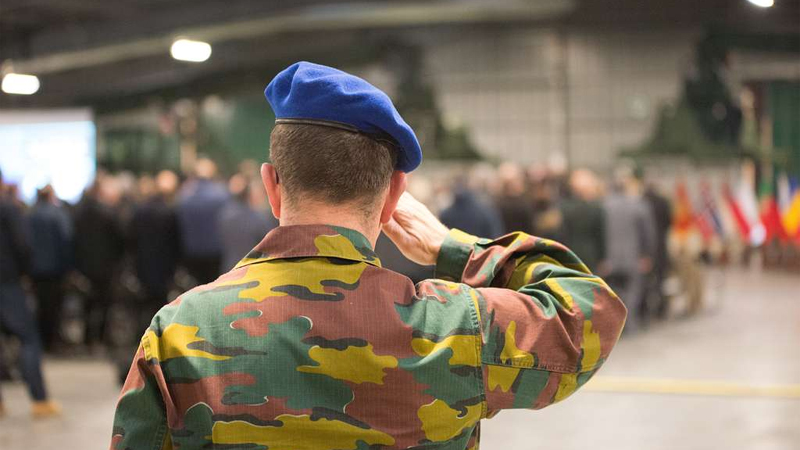
In this situation, every successful recruitment campaign in Europe is of legitimate interest. Belgium could be one such case. Its army has been struggling with a significant shortage of personnel for a long time, and Bart De Wever's center-right government has decided to address the situation by introducing voluntary military service, which has met with unexpected initial success.
The Ministry of Defense is sending a letter to young Belgians who will turn 18 next year, inviting them to serve in the Belgian army for one year. Those interested will undergo ten weeks of training, after which they will specialize according to the needs of the army and their own preferences. They will then be assigned to specific units with meals and accommodation provided. During their service, they will receive a salary of approximately CZK 50,000 per month. After completing their service, they can leave the army completely, remain in the reserves, or apply for a position as a professional soldier or civilian employee of the Ministry of Defense. Army experience should be a significant advantage.
The Belgian army aims to increase its training capacity so that it can train up to 7,000 people a year and gradually increase the number of reservists from 6,000 to 20,000. Next year, it will accept 500 applicants, but more than 3,000 young people have already expressed interest in serving. In a country where the willingness to defend one's homeland is among the lowest in the European Union (only 19% in the aforementioned survey in 2024), the successful start of the recruitment campaign is a positive surprise.
The question arises whether Belgian voluntary military service could also be a solution for Czechia, which is also looking for ways to increase the number of professional soldiers and reserves that can be used in the event of mobilization. The answer depends primarily on whether such an offer would be attractive enough for young people and whether this approach is effective for the army at all.
The real benefits of voluntary service for the military are uncertain
From a Czech perspective, a monthly salary of 50,000 may seem like a significant economic incentive. However, it is important to note that young people under the age of 25 in Belgium earn an average of approximately 63,000 CZK per month. In Czechia, it is approximately 43,000 CZK per month, and therefore, in order to create comparable financial conditions, it would be sufficient to offer participants a salary of around 34,000 CZK per month. However, it is not certain whether the same financial conditions would be sufficient in the Czech environment. In Belgium, youth unemployment reaches up to 18%, while in Czechia it is approximately 10%. This means that in Belgium there is a higher proportion of young people for whom the army's offer may become – in addition to unemployment – one of the few available options, thus increasing its attractiveness. In Czechia, where young people have a better chance of finding employment, the army would probably have to offer even more attractive conditions. And this brings us to the question of whether this method of recruitment is worthwhile at all.
Belgium's one-year voluntary military service does not impose any further requirements on its graduates. Whether they remain in the army or are at least listed as reservists is entirely up to them. This opportunity to try out the army without obligation increases the political acceptability and attractiveness of the offer, but on the other hand, there is a risk that graduates will soon reach the level of passive reserves, as we know it in Czechia. That is, people who last held a weapon many years ago, lack modern skills, and are not organizationally assigned anywhere, which would slow down mobilization in the event of war. In such a case, it would not be a real long-term benefit for the army, but rather a relatively costly social project for young people starting out in life.
The potential of the Belgian project to significantly alleviate the army's personnel problems is difficult to assess in its initial phase. However, it is off to a promising start and its further development certainly deserves attention. The key will be how successful it is in maintaining or even increasing the interest of young people and what percentage of graduates remain in contact with the army in some way. If the Belgian model succeeds in these two areas, it could provide an impetus for considering a similar form of military service in Czechia.